
Novenas
St George Novena — Full 9-Day Text and Prayers
The St George novena: the full nine-day text of the traditional novena to St George, martyr and soldier of Christ, with the daily prayer, the meditations, and the collect of the Roman Missal.
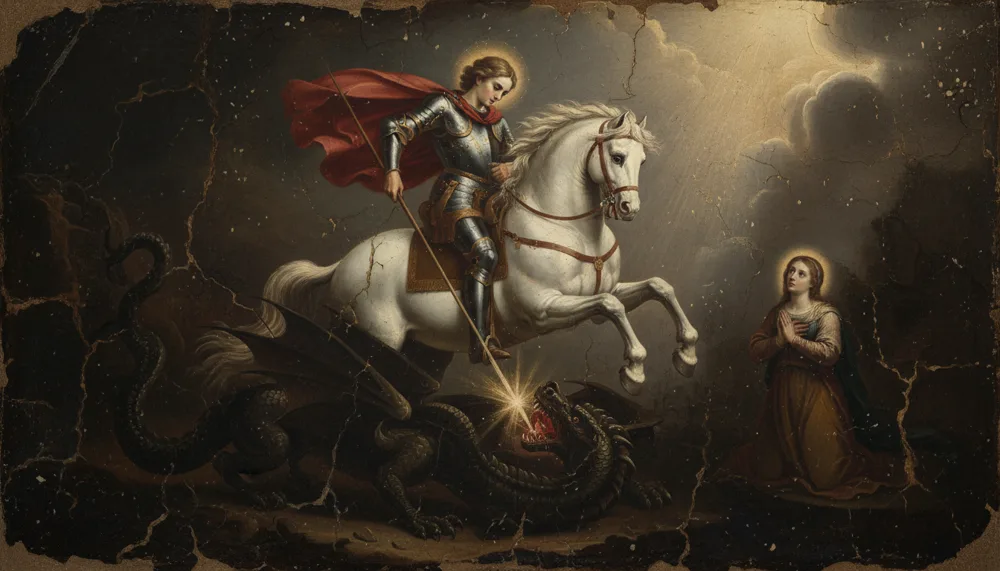
The novena to St George is nine consecutive days of prayer to the martyr who confessed Christ before the emperor and died for Him at Lydda, asking his intercession for courage, loyalty, and victory over the devil in the combat of the soul. He is the patron of soldiers and knights, of scouts, and of every Christian who must fight — which is every Christian. It is traditionally begun on 15 April and ended on 23 April, his feast; but it may be prayed at any time a trial calls for courage and protection.
The novena to St George
Recollect thyself a moment in silence, then say the daily invocation, which is recited on each of the nine days before the meditation proper to the day.
In the name of the Father,
and of the Son,
and of the Holy Ghost.
Amen.
Glorious St George, faithful soldier of Christ, thou who didst not fear to confess His Name before the mighty and didst give thy life in martyrdom, turn upon us thy gaze of kindness. Thou whom tradition depicts as conqueror of the dragon, obtain for us to vanquish sin and the snares of the enemy of souls; clothe us in the armour of faith, that we may fight the good fight and remain faithful to God in every trial. By the merits of Jesus Christ our Lord, obtain for us courage to serve the good, loyalty in our duties, and perseverance of soul unto the end.
Here name, simply and plainly, the intention thou entrustest to St George — the same throughout the nine days.
St George, martyr and soldier of Christ, pray for us. Amen.
Day 1 — The Christian childhood of St George
George was born toward the end of the third century, according to tradition in Cappadocia, of a Christian family, and grew up in the region of Palestine. His parents handed on to him with their blood the faith of the Church, and reared him in the fear of God and the love of Our Lord. From childhood he learned that the first victory is the one won over oneself, and he made ready, not yet knowing it, for the combat that would make him a martyr.
St George, formed from the cradle in the faith of thy fathers and nourished by the love of God, obtain for the children of our households to receive the Christian teaching with docility, and for us all to keep unbroken the faith of our baptism, that we may grow in strength and fidelity as thou didst grow.
Our Father, who art in heaven,
hallowed be Thy name.
Thy kingdom come.
Thy will be done
on earth as it is in heaven.
Give us this day
our daily bread.
And forgive us our trespasses,
as we forgive
those who trespass against us.
And lead us not into temptation,
but deliver us from evil.
Amen.
Three times:
Hail Mary, full of grace;
the Lord is with thee.
Blessed art thou amongst women,
and blessed is the fruit of thy womb, Jesus.
Holy Mary, Mother of God,
pray for us sinners,
now and at the hour of our death.
Amen.
Glory be to the Father, and to the Son,
and to the Holy Ghost.
As it was in the beginning,
is now, and ever shall be,
world without end.
Amen.
Day 2 — The soldier of the Empire
Grown to manhood, George entered the Roman army and distinguished himself by his valour, rising to high rank and the esteem of all. He bore arms with honour, joining to the bravery of the soldier the uprightness of the Christian: loyal to his commanders, just toward his comrades, he served without ever yielding aught of his conscience or his faith.
St George, brave and loyal soldier, who didst fulfil thy duties without ever betraying thy conscience, obtain for those who bear an office or a uniform uprightness and honour, and for us all to fulfil faithfully the duty of our state under the gaze of God.
Then the Our Father, three Hail Marys, and the Glory Be, as on the first day.
Day 3 — The confession of faith
When the emperor Diocletian let loose, about the year 303, the great persecution against the Christians, George did not conceal his faith. He distributed his goods to the poor and presented himself openly as a Christian before the court, proclaiming that the idols were nothing and that Christ was the only true God. In the fullness of his career, he chose to lose all rather than deny his Saviour.
St George, thou didst confess the Name of Christ before the mighty without trembling, preferring truth to thy career and thy life: obtain for us the courage to profess our faith in every place, without human respect, and to prefer God to all that the world can take from us or promise us.
Then the Our Father, three Hail Marys, and the Glory Be, as on the first day.
Day 4 — The soldier of Christ
George was a soldier twice over: in the ranks of the Empire, and yet more in the ranks of Christ. The Apostle exhorts us to fight the good fight of faith and to put on the armour of God: the shield of faith, the helmet of salvation, and the sword of the Spirit, which is the word of God. It is not against flesh and blood that we wrestle, but against the powers of darkness; and George shows us the true field of battle.
St George, valiant soldier of Christ, who didst put on the armour of God to fight not flesh and blood but the spirit of evil, obtain for us to take up the shield of faith and the sword of the word of God, that we may stand firm in the evil day and never desert the combat of our salvation.
Then the Our Father, three Hail Marys, and the Glory Be, as on the first day.
Day 5 — Constancy under torments
To force him to apostasy, the persecutors inflicted upon George cruel and prolonged torments; but in each of them he remained unshaken, confessing the Name of Christ. The grace of God sustained him so visibly that several witnesses of his suffering were converted, and tradition relates that the empress herself embraced the faith. His steadfastness preached louder than all his words.
St George, whom neither threats nor tortures could turn from thy God, obtain for us patience in suffering and constancy in trial, that, sustained by grace, we may never yield to pain or to fear, but stand firm in the faith unto the end.
Then the Our Father, three Hail Marys, and the Glory Be, as on the first day.
Day 6 — The martyrdom at Lydda
Unable to overcome him, his judges had him at last beheaded, about the year 303, at Lydda, the ancient Diospolis, in Palestine. George thus sealed with his blood the fidelity he had kept to the last, fulfilling the word of Scripture: "Be thou faithful unto death, and I will give thee the crown of life." Over his tomb a basilica soon arose, and the Church venerated him as one of the great martyrs.
St George, faithful unto death, who didst receive the crown of life promised to the martyrs, obtain for us to hold fast in the faith until our last breath, and to love Our Lord more than our own life, that we may merit to be crowned one day with thee in the glory of Heaven.
Then the Our Father, three Hail Marys, and the Glory Be, as on the first day.
Day 7 — The victory over the dragon
The famous image of St George slaying the dragon belongs not to the chronicle of his life, but to the tradition that sought to paint his holiness. The dragon is the ancient figure of the devil: Scripture names the enemy "the great dragon, that old serpent, who is called the devil and Satan". George piercing the monster is the Christian who, armed with faith and grace, overthrows sin and the prince of this world; and the maiden delivered is the soul, or the Church, snatched from the bondage of evil.
St George, whom Christian piety shows victorious over the dragon, image of the enemy vanquished by faith, obtain for us to overthrow within us sin and the wiles of the ancient serpent, and to deliver by prayer the souls held captive by evil, that the victory of Christ may shine forth in our lives.
Then the Our Father, three Hail Marys, and the Glory Be, as on the first day.
Day 8 — The spiritual combat against temptation
The true combat of St George was not that of iron, but that of faith confessed before the emperor. The real enemy of the Christian is never his neighbour — neither the man beside him, nor the rival, nor the one who has done him wrong — but the devil and sin. After the example of George, who conquered by forgiving his executioners as Christ did on the cross, we are called to overcome evil with good, and never to render evil for evil.
St George, invincible in the faith, who didst not fear the enemies of truth, obtain for us the strength to resist temptations and to overcome evil with good; that no malice may separate us from Christ, and that we may fight only the one true enemy, who is the devil, without ever hating any of our brethren.
Then the Our Father, three Hail Marys, and the Glory Be, as on the first day.
Day 9 — Patron of soldiers and knights
The cult of St George spread with prodigious swiftness in East and West, so that men called him the great Martyr. The Church gives him as patron of soldiers and knights, whose model he was in the Middle Ages, and of scouts, who find in him the virtues of service, loyalty, and courage in the service of good. To all who must fight, visibly or invisibly, he teaches that the true victory belongs to God.
St George, patron of soldiers, knights, and scouts, model of courage and loyalty, protect all who strive for the good, and present to God the supplication we have entrusted to thee; obtain for us to fight the good fight unto the end, and to receive, with thee, the crown of life.
Then the Our Father, three Hail Marys, and the Glory Be, as on the first day.
The closing prayers
Said at the end of each day.
V. Pray for us, O holy George.
R. That we may be made worthy of the promises of Christ.
Let us pray.
O God, who dost gladden us by the merits and intercession of blessed George, Thy Martyr: mercifully grant that we who ask Thy benefits through him may obtain them by the gift of Thy grace. Through our Lord Jesus Christ, Thy Son, who liveth and reigneth with Thee in the unity of the Holy Ghost, God, world without end.
Amen.
The Latin of the same oration, from the Mass of St George on 23 April:
Deus, qui nos beati Georgii Martyris tui meritis et intercessione laetificas: concede propitius; ut, qui tua per eum beneficia poscimus, dono tuae gratiae consequamur. Per Dominum nostrum Iesum Christum, Filium tuum, qui tecum vivit et regnat in unitate Spiritus Sancti Deus, per omnia saecula saeculorum.
Amen.
In the name of the Father,
and of the Son,
and of the Holy Ghost.
Amen.
Variants people look for
A PDF or a printed copy. There is no single official booklet of the St George novena: it is a traditional text, and the printed versions differ in wording from one prayer-book and one country to another. The full text in English is on this page and may be printed as it stands — that is the whole novena, nothing is held back — or prayed day by day in the app. Beware of downloads that promise "the" authentic version: what is authentic here is the collect, which comes from the Roman Missal and is given above word for word, and the shape of the nine days.
A novena for a particular intention. Name one intention and keep it in the same plain words all nine days, at the place marked after the daily invocation. St George's patronage suggests the petitions naturally brought to him: a son in the army or the police, a scout troop, a besetting temptation, a hostile workplace where the faith must be professed, a soul harassed by the devil. But any lawful intention may be entrusted to him. Hold Thy will be done underneath the asking: a novena is not a lever on God but an act of confidence, and He answers in His hour.
A short or "special" novena. Some ask for a shortened form — one prayer a day, no meditation. The novena above is already short: read the day's paragraph, say its petition, add the Our Father, three Hail Marys, and the Glory Be. That is five minutes. The word "special novena", widely used on devotional sites, names no distinct rite in the Church's tradition; there is no secret text, no guaranteed formula, and no promise attached to a number of repetitions. What the Church asks is the nine days kept.
Novenas in St George's churches, and for the dead. Many parishes dedicated to St George — in England, where he is Protector of the Kingdom, and across the world — keep a public novena before 23 April, and some, such as the Syro-Malabar church at Edappally in Kerala, hold weekly novena services whose times are published by the parish itself; for those, ask the parish, not a website.
Where the search is for a Mass or a novena offered for a deceased person in a St George's church, note the distinction: this novena asks St George's intercession for the living, whereas prayer for the departed has its own texts and its own logic of suffrage — see the novena for the dead. Nothing forbids praying this novena while also having Mass offered for a soul in purgatory; they are two different acts.
How to pray the nine days
Fix the start date first. To end on the feast, begin on 15 April and pray through to 23 April, the day the Church keeps St George. That is the traditional reckoning and the one the app follows. Outside that season, any nine consecutive days will serve: before a deployment, before an examination of conscience you have been putting off, before a decision that will cost you something to make honestly.
Pray at the same hour each day and with the same intention. Do not break the chain for want of feeling; dryness is not failure, and nine days finished in dryness are worth more than three abandoned in consolation. Why the Church counts nine, and what a novena is for, we set out in what is a novena — it is the pattern of Our Lady and the Apostles persevering with one mind in prayer from the Ascension to Pentecost.
Two things give this novena its teeth. First, confession within the nine days: St George is asked here for victory over sin, and it is idle to ask for the victory while refusing the sacrament that gives it — how to go to confession sets out the steps. Second, the fight itself. This is a novena for men and women at war with the devil and with themselves, and the asking is meant to be matched by the resisting; on what that combat actually looks like, see spiritual combat. Those who want a second patron for the same battle will find him in the novena to St Michael the Archangel, who fights the same dragon.
Who St George was
Very little about St George can be affirmed with confidence, and traditional does not mean credulous: it is better to say so plainly than to dress up guesswork. What is solid is this. He was a real martyr, put to death at Diospolis — Lydda, in Palestine — probably before the time of Constantine, and his tomb there was a place of pilgrimage from an early date. Pilgrims from the sixth to the eighth century, Theodosius among them, name Lydda as the seat of his cult and the resting place of his relics. His name is entered in the Hieronymian Martyrology and assigned to Diospolis. Beyond that, as Butler's says without softening it, there seems to be nothing which can be affirmed with any confidence.
The Acts of St George — the marvels the meditations touch on, the torments repeated and repeatedly undone, the wheels, the molten lead, the conversion of the persecutor's wife — exist in a great many recensions in Greek, Latin, Syriac, Coptic, Armenian, and Ethiopic, differing widely from one another. They are legendary. Even the Cappadocian birth, which the novena's first day repeats as tradition does, is set down by Butler's, quoting Fr Delehaye, to the responsibility of the compiler of the acta, who confused our martyr with the other George of Cappadocia, the Arian intruder into the see of Alexandria and enemy of St Athanasius. None of this touches the martyrdom itself, which the Church has never doubted.
The dragon is later still. It has no sure trace before the twelfth century, and reached the West chiefly through the Golden Legend of Bd James de Voragine, which Caxton translated and printed: the city of Sylene, the marsh, the king's daughter led out as a bride, the lance, the girdle, the fifteen thousand baptized. It is an allegory of the Christian conquering the devil, and the seventh day of the novena prays it as exactly that — not as a chronicle.
The patronage of England came late and by the crusades. William of Malmesbury reports St George and St Demetrius, the martyr knights, seen assisting the Franks at Antioch in 1098; Richard I's men came home with a high idea of his intercession. The synod of Oxford in 1222 put his day among the lesser holidays; Archbishop Chichele made it a chief feast in 1415; Edward III founded the Order of the Garter under his patronage, and Benedict XIV recognized him as Protector of the Kingdom. In the calendar of 1962 his feast is kept on 23 April, a commemoration in the universal Church and a proper feast where he is patron. For a fuller life, see Saint George.
Frequently Asked Questions
What is the St George novena?
It is nine consecutive days of prayer asking the intercession of St George, martyr. Each day has a meditation on a trait of his life or martyrdom, a petition proper to that day, then the Our Father, three Hail Marys, and the Glory Be, closed by the versicle and the collect of the Roman Missal for 23 April.
When should I start the novena to St George?
Traditionally on 15 April, so that the ninth day falls on 23 April, his feast. It may be begun on any other day: nine consecutive days is the only requirement, and a trial calling for courage is reason enough.
What is the St George novena prayer?
The daily invocation — "Glorious St George, faithful soldier of Christ…" — said on each of the nine days before the meditation, followed by the day's own petition. It is given in full at the head of the novena above.
Is there a St George novena PDF?
There is no official booklet, and printed versions vary in wording. The complete English text is on this page and may be printed from it directly, or prayed day by day with reminders in the app.
What is St George the patron saint of?
Soldiers and knights, scouts, and courage in the spiritual combat against temptation and the devil. He is also Protector of the Kingdom of England, a patronage that dates from the crusades and was recognized by Benedict XIV.
Did St George really kill a dragon?
No. The dragon story has no trace before the twelfth century and spread through the Golden Legend; it is an allegory, not history. The dragon is the devil, "that old serpent", and George piercing it is the Christian overcoming sin by faith. What is historical is his martyrdom at Lydda.
Can I pray the novena to St George for someone else?
Yes. Name the person and the intention after the daily invocation, in the same words all nine days. Soldiers, police, scouts, and those under heavy temptation are the intentions most naturally brought to him, but any lawful petition may be entrusted to his prayers.
Is St George still on the traditional calendar?
Yes. The 1962 Missal keeps him on 23 April, with the collect Deus, qui nos beati Georgii Martyris — a commemoration in the universal Church, and a feast of higher rank where he is patron, as in England.
Pray the novena to St George day by day, with reminders and audio, in the Iter Fidei app. Download it here.
Sources. Holy Scripture (Douay-Rheims: Apocalypse 12:9; Apocalypse 2:10; Ephesians 6:11-17); Roman Missal of 1962, Mass of St George, Martyr, 23 April (collect Deus, qui nos beati Georgii Martyris); Roman Martyrology, 23 April; Hieronymian Martyrology; Butler's Lives of the Saints (St George, Martyr, and Fr Delehaye as quoted there); Bd James de Voragine, Golden Legend.