
Prayer
Prayer to St Joseph, Protector and Patron of a Happy Death
The prayers to St Joseph — the Memorare to St Joseph, 'O St Joseph whose protection' (the so-called 1700-year-old prayer), Leo XIII's prayer and the Litany — for protection, the family, and a happy death.
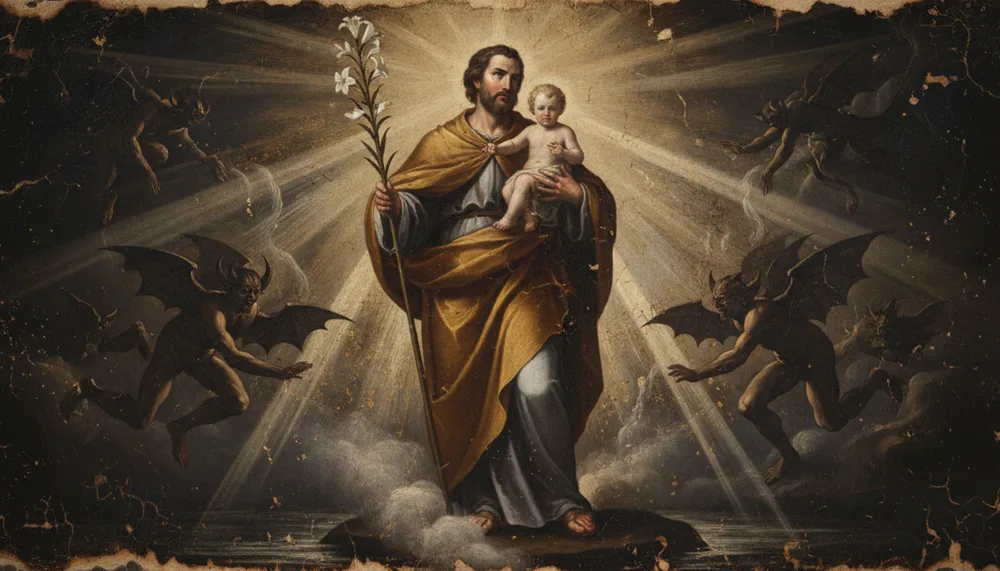
A prayer to St Joseph is the Christian's recourse to the foster-father of Our Lord — the spouse of the Blessed Virgin, patron of the universal Church, of workers, of the family, and, above all, of a happy death. The oldest of these prayers asks plainly for what he is fittest to give: that he who guarded the Child Jesus would guard us, and that he who died in the arms of Jesus and Mary would obtain for us the like death. Below we give the traditional texts — the Memorare to St Joseph, the prayer beginning "O St Joseph, whose protection" with an honest word on the legend attached to it, the prayer of Leo XIII, the Litany, and the prayer for workers — with the reason these prayers are heard.
Why we pray to St Joseph
We pray to St Joseph for the same reason we honour any saint: not to add a god, but to ask a friend of God to pray with us and for us. The Catechism of St Pius X teaches that "it is very useful to pray to the Saints, and every Christian ought to do so," and it names, after the Angels, "Saint Joseph, Patron of the Church." Of all the saints few have such a claim on the ear of Jesus, for Joseph is the man Our Lord obeyed for thirty years (Luke ii, 51).
The Gospel sums up his whole sanctity in one word — he was "a just man" (Matthew i, 19) — and to him alone the angel of God gave the charge of the Child and His Mother (Matthew ii, 13). If the very ground of asking the saints to pray for us is in question, we have set it out in why do Catholics pray to saints; for the whole life and titles of this saint, see St Joseph.
A prayer to a saint is never magic, and the distinction is not a nicety. The Catechism of St Pius X defines superstition as "every devotion contrary to the doctrine and usage of the Church, as also the attributing to any action or thing whatsoever a supernatural virtue which it does not possess." A prayer, a medal, or a novena works through the Church's prayer and the petitioner's faith, never as a charm that binds God or compels an answer.
To say a St Joseph prayer rightly is to ask, in submission — Thy will be done — trusting that the foster-father of the Word made flesh will obtain either the favour we name or the better thing God chooses to send. This is the same sober rule that governs every Catholic prayer and every sacramental, as we explain in holy water and the sacramentals.
The Memorare to St Joseph
The Memorare is best known as a prayer to Our Lady, but prayer-books also give the same form addressed to her spouse, a devotional adaptation with no liturgical text. The Memorare to St Joseph carries the identical confidence — that no one who fled to his protection was left unaided — and turns it toward the guardian of the Holy Family:
Remember, O most chaste spouse of the Virgin Mary, that never was it known that anyone who implored thy help and sought thy intercession was left unassisted. Full of confidence in thy power, I fly unto thee and beg thy protection. Despise not, O Guardian of the Redeemer, my humble supplication, but in thy bounty hear and answer me. Amen.
This is the prayer to reach for in sudden trouble, when there is time for one petition only. It is the same instinct that sends the faithful to the Memorare of his spouse, and to other sure intercessors in distress — to St Jude in desperate causes, and to St Anthony of Padua for what is lost.
"O St Joseph, whose protection" — the so-called ancient prayer
This is the prayer most people mean when they ask for a St Joseph prayer for protection. It is a sound and tender prayer, and its last lines ask for the one thing Joseph is fittest to give: the presence of Jesus at our dying breath.
O St Joseph, whose protection is so great, so strong, so prompt before the throne of God, I place in thee all my interests and desires. O St Joseph, do assist me by thy powerful intercession, and obtain for me from thy divine Son all spiritual blessings, through Jesus Christ, Our Lord; so that, having engaged here below thy heavenly power, I may offer my thanksgiving and homage to the most loving of Fathers.
O St Joseph, I never weary contemplating thee, and Jesus asleep in thy arms; I dare not approach while He reposes near thy heart. Press Him in my name and kiss His fine head for me, and ask Him to return the kiss when I draw my dying breath. St Joseph, Patron of departing souls, pray for me. Amen.
It asks exactly what Joseph is fittest to grant. Tradition holds that he died at Nazareth in the arms of Jesus and Mary — the two whom every soul most longs to have near at its last hour — and so the dying have for centuries placed themselves under his patronage. A St Joseph prayer for protection is, at bottom, a prayer about death: not a charm against accident, but a plea that the hour on which eternity turns be a holy one. For what that hour holds, see the four last things and what happens after death; for the Church's care of the dying, anointing of the sick and the prayers for the dying said at the bedside.
The so-called 1700-year-old prayer to St Joseph
The prayer just given is the one that circulates on cards and leaflets as a prayer "over seventeen hundred" (or "nineteen hundred") years old. The note printed with it says that it was found in the fiftieth year of Our Lord, that in 1505 a Pope sent it to the Emperor Charles as he went into battle, and that whoever reads it, hears it or carries it will not die a sudden death, be drowned or poisoned, or fall into the hands of the enemy. None of this has any historical foundation: a prayer to St Joseph in the year 50 would be older than most of the New Testament, and no such papal letter is known. Nor has the Church ever made those promises her own.
We give the prayer for its words, which are sound, and not for the legend. Prayed with faith, as a plea for a holy life and a holy death, it is a good prayer; read as a guarantee against accident, it would become the very superstition defined above. The same discretion governs every devotion, whether the St Benedict medal or the miraculous medal.
The prayer to St Joseph for the Church
When the prayer is for the whole household of God rather than for one soul, the faithful turn to the great supplication Leo XIII ordered said after the Rosary in October:
To thee, O blessed Joseph, do we have recourse in our tribulation, and having implored the help of thy most holy Spouse, we confidently invoke thy patronage also. By that charity wherewith thou wast united to the Immaculate Virgin Mother of God, and by the paternal love wherewith thou didst embrace the Child Jesus, we beseech thee and we humbly pray that thou wouldst look graciously upon the inheritance which Jesus Christ purchased by His Blood, and assist us in our needs by thy power and strength.
O most watchful Guardian of the Holy Family, defend the chosen offspring of Jesus Christ; keep far from us, most loving Father, all blight of error and corruption; mercifully assist us from heaven, most mighty defender, in this our conflict with the powers of darkness; and, as once thou didst rescue the Child Jesus from deadly peril, so now defend God's holy Church from the snares of the enemy and from all adversity; shield, too, each one of us by thy constant protection, so that, supported by thy example and thy aid, we may be able to live piously, to die holily, and to obtain eternal happiness in heaven. Amen.
This is the prayer for the family writ large — the same guardianship that sheltered the Head of the Church in the manger and in the flight into Egypt, begged now for His members.
The St Joseph novena
To pray any of the above for nine days running is to make a St Joseph novena — the most common form being the great supplication of Leo XIII or the prayer "O St Joseph, whose protection," repeated daily for nine days with a named intention. The number nine recalls the nine days the Apostles and Our Lady spent in prayer between the Ascension and Pentecost (Acts i, 14). A novena is not a count that compels heaven but a discipline of perseverance, the prayer Our Lord praised in the importunate friend (Luke xi, 8).
The full nine-day form, with the daily prayer and the Litany, we set out in the novena to St Joseph — the surest of the saints' devotions for a happy death, for daily provision, and for causes the world has given up as impossible. For two needs most often brought to him there are nine-day forms of their own, the St Joseph novena to sell a house and the novena to St Joseph for a job. A simple daily prayer of the prayer-books (a devotional composition) to open each of the nine days:
O glorious St Joseph, faithful follower of Jesus Christ, to thee do we raise our hearts and hands to implore thy powerful intercession in obtaining from the benign Heart of Jesus all the helps and graces necessary for our spiritual and temporal welfare, particularly the grace of a happy death and the special favour we now implore. O Guardian of the Word Incarnate, we feel animated with confidence that thy prayers in our behalf will be graciously heard before the throne of God. Amen.
The Litany of St Joseph
The Litany of St Joseph is the Church's own roll-call of his titles, approved for public use by Pope St Pius X in 1909. It is prayed like the Litany of the Saints and the Litany of Loreto: the cantor names the title, and all answer pray for us. It gathers in one prayer everything the faithful ask of him — his place in the Holy Family, his virtues, and his patronage of the dying. Here it is in full:
Lord, have mercy on us.
Christ, have mercy on us.
Lord, have mercy on us.
Christ, hear us.
Christ, graciously hear us.
God the Father of heaven, have mercy on us.
God the Son, Redeemer of the world, have mercy on us.
God the Holy Ghost, have mercy on us.
Holy Trinity, one God, have mercy on us.
Holy Mary, pray for us.
St Joseph, pray for us.
Renowned offspring of David, pray for us.
Light of Patriarchs, pray for us.
Spouse of the Mother of God, pray for us.
Chaste guardian of the Virgin, pray for us.
Foster father of the Son of God, pray for us.
Diligent protector of Christ, pray for us.
Head of the Holy Family, pray for us.
Joseph most just, pray for us.
Joseph most chaste, pray for us.
Joseph most prudent, pray for us.
Joseph most strong, pray for us.
Joseph most obedient, pray for us.
Joseph most faithful, pray for us.
Mirror of patience, pray for us.
Lover of poverty, pray for us.
Model of artisans, pray for us.
Glory of home life, pray for us.
Guardian of virgins, pray for us.
Pillar of families, pray for us.
Solace of the wretched, pray for us.
Hope of the sick, pray for us.
Patron of the dying, pray for us.
Terror of the demons, pray for us.
Protector of Holy Church, pray for us.
Lamb of God, who takes away the sins of the world, spare us, O Lord.
Lamb of God, who takes away the sins of the world, graciously hear us, O Lord.
Lamb of God, who takes away the sins of the world, have mercy on us.V. He made him the lord of his household.
R. And prince over all his possessions.Let us pray. O God, in Thy ineffable providence Thou wert pleased to choose Blessed Joseph to be the spouse of Thy most holy Mother; grant, we beg Thee, that we may be worthy to have him for our intercessor in heaven whom on earth we venerate as our Protector: Thou who livest and reignest forever and ever. Amen.
The Litany is fittingly joined to the Rosary or said on the nineteenth of the month in his honour.
Prayer to St Joseph the Worker
St Joseph the Worker is the carpenter of Nazareth honoured under the title of his trade — the man who fed the Holy Family by the labour of his hands and taught that craft to the Son of God (Mark vi, 3). He is the patron of workmen and the model of those who sanctify their daily toil. The prayer composed by Pope St Pius X offers the day's work to God through him:
Glorious St Joseph, model of all who are devoted to labor, obtain for me the grace to work in the spirit of penance in expiation of my many sins; to work conscientiously by placing love of duty above my inclinations; to gratefully and joyously deem it an honor to employ and to develop by labor the gifts I have received from God; to work methodically, peacefully, and in moderation and patience, without ever shrinking from it through weariness or difficulty; to work above all with purity of intention and unselfishness, having unceasingly before my eyes death and the account I have to render of time lost, talents unused, good not done, and vain complacency in success, so baneful to the work of God. All for Jesus, all for Mary, all to imitate thee, O patriarch St Joseph! This shall be my motto for life and eternity.
This is the prayer to begin the working day, asking that ordinary labour be turned into a means of grace, as St Joseph's own hidden years in the workshop were.
How to use these prayers
Say them at a fixed hour, name your intention plainly, and join them where you can to a Mass, a Communion, or a decade of the Rosary. Add the Thy will be done without which no petition is rightly made. A St Joseph prayer is not measured by its words but by the soul that says them — content to receive the favour it named or the better thing God sends in its place.
Frequently Asked Questions
Who is St Joseph?
St Joseph is the foster-father of Our Lord Jesus Christ and the spouse of the Blessed Virgin Mary. The Gospel sums up his whole sanctity in one word — he was "a just man" (Matthew i, 19) — and to him alone the angel of God gave the charge of the Child and His Mother. He is honoured as patron of the universal Church, of workers, of the family, and above all of a happy death.
What is St Joseph the patron saint of?
St Joseph is patron of the universal Church, declared so by Pope Pius IX in 1870 (decree Quemadmodum Deus); patron of workers and of fathers of families, for he provided for the Holy Family by the labour of his hands; and, most beloved of all, patron of a happy death, since tradition holds he died at Nazareth in the arms of Jesus and Mary. The dying have for centuries placed themselves under his protection.
How did St Joseph die?
Scripture does not record his death, but the constant tradition of the Church holds that St Joseph died at Nazareth before the public ministry of Our Lord, in the arms of Jesus and Mary — the two whom every soul most longs to have near at its last hour. It is from this that he is honoured as patron of a happy and peaceful death.
When is St Joseph's day?
St Joseph's day is 19 March, his principal feast, a feast of the first class in the 1962 calendar and a day to pray his Litany. A second feast of the first class, St Joseph the Worker, is kept on 1 May: Pius XII instituted it in 1955, and it replaced the older Solemnity (Patronage) of St Joseph, formerly kept in Eastertide. A novena for 19 March begins on 10 March. The 19 March feast is the oldest and the chief.
What is the Litany of St Joseph?
The Litany of St Joseph is the only litany of the saint approved for public use, given by Pope St Pius X in 1909. It calls upon him under his titles — Spouse of the Mother of God, Head of the Holy Family, Patron of the dying, Protector of Holy Church — each answered with pray for us, and closes with a collect. It is prayed like the Litany of the Saints, often joined to the Rosary or said on the nineteenth of the month.
What is the most powerful prayer to St Joseph?
No prayer is "most powerful" in itself. The faithful love "O St Joseph, whose protection is so great, so strong, so prompt before the throne of God" for its tenderness, but the legend of its age and its printed promises have no foundation. For the whole Church, the great supplication of Leo XIII, "To thee, O blessed Joseph," is the surest, especially prayed for nine days as the novena to St Joseph.
The Iter Fidei app carries the Douay-Rheims Bible, the catechism, and the traditional prayers and devotions — including the prayers to St Joseph and his Litany, in Latin and your own language, with audio. Join early access here.
Sources. The Holy Bible, Douay-Rheims (Matthew i, 19; ii, 13; Mark vi, 3; Luke ii, 51; xi, 8; Acts i, 14). Catechism of St Pius X, Part II, ch. 4, The Invocation of the Saints; Part III, ch. 2 (superstition). Pope Pius IX, decree Quemadmodum Deus (1870). Pope Leo XIII, encyclical Quamquam pluries (1889). The Litany of St Joseph (approved by Pope St Pius X, 1909; Rituale Romanum). Prayer to St Joseph for workers (Pope St Pius X). The Memorare to St Joseph, O St Joseph, whose protection is so great and the novena prayer O glorious St Joseph, faithful follower of Jesus Christ, as carried in Catholic prayer-books (devotional compositions).