
The Saints
St Vincent de Paul: Life, Feast Day and Prayer
St Vincent de Paul (1581-1660), the priest of the poor: who he was, the Congregation of the Mission and the Daughters of Charity, what he is patron saint of, his feast on 19 July in the 1962 calendar and the collect of his Mass in Latin and English.
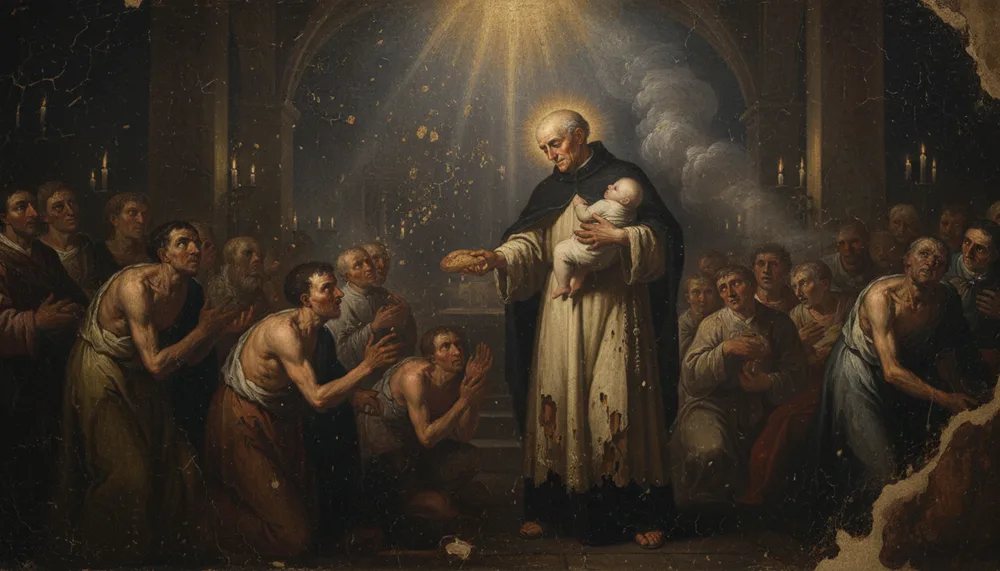
St Vincent de Paul (1581-1660) was a French priest who gave his whole life to the poor and to the reform of the clergy: he founded the Congregation of the Mission, the priests known as Lazarists or Vincentians, and, with St Louise de Marillac, the Daughters of Charity. In the Roman calendar of 1962 his feast is kept on 19 July, as a feast of the third class in white vestments. Below are his life, what he is patron saint of, the collect of his Mass in Latin and English, and the difference between the saint and the charity that bears his name.
Who was St Vincent de Paul?
Vincent de Paul was born at Pouy, a village of the Landes in Gascony, near Dax, the son of a family of small farmers; the village has since taken his name. The year usually given is 1581; some older lives say 1576. As a boy he kept his father's animals. His quick mind led his family to send him to school at Dax and then to study theology at Toulouse, and he was ordained priest in 1600, very young, as was then still possible.
The young priest was, by his own later admission, more concerned at first with a comfortable benefice than with the poor. In letters written in 1607 to a benefactor at Dax, he related that, travelling by sea in 1605, he had been seized by Barbary pirates and sold as a slave at Tunis, where he served several masters until he escaped in 1607 with the last of them, a renegade from Nice whom he brought back to the Church. Historians have debated the details of the story; the letters remain the only source.
In Paris he placed himself under the direction of Pierre de Bérulle, became parish priest of Clichy, near Paris, in 1612, and entered the household of the Gondi family, the generals of the royal galleys, as tutor to the children. Two experiences of the year 1617 decided the rest of his life. On the Gondi estates near Folleville, in January 1617, he heard the general confession of a dying peasant at Gannes and saw that the country people were perishing for want of instruction and of the sacraments. Later that year, as parish priest of Châtillon-les-Dombes, he was told of a whole family lying sick and without help, and he organised the women of the parish to care for them in turns: this was the first Confraternity of Charity, the seed of all his later works.
What is St Vincent de Paul known for?
He is known above all as the apostle of charity, but his works fall into three great families, and all three still exist.
The Congregation of the Mission (1625). With the support of the Gondi, Vincent gathered priests who would preach missions to the poor of the countryside, going from village to village, catechising and hearing confessions, without taking any fee. The congregation later received the old priory of Saint-Lazare in Paris, which is why its members are called Lazarists in France; in English-speaking countries they are better known as Vincentians.
The reform of the clergy. Vincent saw that missions were of little use if the parishes were left to ignorant priests. He organised retreats for those about to be ordained, the weekly "Tuesday Conferences" for the priests of Paris, and seminaries. This is what the collect of his feast means when it says that God strengthened him "for the dignity of the ecclesiastical order".
The works of charity. From the confraternities came the Ladies of Charity, the great ladies of Paris whom he enlisted to visit the sick of the Hôtel-Dieu and to support his works. Since such ladies could not themselves do all the humble work required, he and St Louise de Marillac formed in 1633 the Daughters of Charity: country girls and women who, without enclosure, served the poor in their homes, the sick in hospitals, the abandoned children of Paris and later the wounded of the wars. Unlike the nuns of their time they were not cloistered: they lived among those they served.
He was also named royal chaplain of the galleys and worked to relieve the convicts chained to the oars; he sent relief into the provinces ruined by the wars, ransomed Christian captives in North Africa, and gathered in the foundlings of Paris. Under the regency of Anne of Austria he sat on the Council of Conscience, which advised on the appointment of bishops, and he used his place there to keep unworthy men out of the episcopate. For many years he directed the Visitation nuns of Paris, the order founded by St Francis de Sales; you can read the life of their founder in our page on St Francis de Sales, Bishop of Geneva.
What held all this together was not a programme but a way of seeing: in the poor man Vincent saw Christ, and served him as he would have served his Master. The whole Christian tradition of the corporal and spiritual works of mercy is summed up in his life.
How did St Vincent de Paul die?
Vincent died at Saint-Lazare in Paris on 27 September 1660, aged seventy-nine, worn out by age and long infirmities. He was beatified by Pope Benedict XIII on 13 August 1729 and canonized by Pope Clement XII on 16 June 1737. In 1885 Pope Leo XIII declared him the patron of all the charitable associations of the Church.
His bones, enclosed in a wax figure, rest in a silver reliquary in the chapel of the Lazarists, 95 rue de Sèvres, in Paris, where pilgrims still come to pray; his heart is kept apart, in the chapel of the motherhouse of the Daughters of Charity.
The collect of St Vincent de Paul (Missal of 1962)
The prayer that the Church herself addresses to God on his feast is the surest "prayer to St Vincent de Paul". It asks for two things: that we may honour his merits, and that we may learn from his example.
Collect, 19 July
Deus, qui, ad evangelizándum paupéribus et ecclesiástici órdinis decórem promovéndum, beátum Vincéntium apostólica virtúte roborásti: præsta, quǽsumus; ut, cujus pia mérita venerámur, virtútum quoque instruámur exémplis. Per Dóminum nostrum Jesum Christum, Fílium tuum: qui tecum vivit et regnat in unitáte Spíritus Sancti Deus, per ómnia sǽcula sæculórum. Amen.
O God, who, for the preaching of the Gospel to the poor and the advancement of the dignity of the ecclesiastical order, didst strengthen blessed Vincent with apostolic power: grant, we beseech Thee, that we who venerate his holy merits may also be instructed by the example of his virtues. Through our Lord Jesus Christ, Thy Son, who liveth and reigneth with Thee in the unity of the Holy Ghost, God, world without end. Amen.
Postcommunion
Quǽsumus, omnípotens Deus: ut, qui cœléstia aliménta percépimus, intercedénte beáto Vincéntio Confessóre tuo, per hæc contra ómnia advérsa muniámur. Per Dóminum nostrum.
We beseech Thee, almighty God, that we who have received the food of heaven may, by the intercession of blessed Vincent, Thy Confessor, be thereby defended against all adversities. Through our Lord.
For a nine-day prayer before his feast, with a daily prayer of intercession for the poor, see our novena to St Vincent de Paul.
When is the feast day of St Vincent de Paul?
In the traditional calendar the feast of St Vincent de Paul is 19 July, a feast of the third class, with white vestments; you will find it in its place in our traditional Catholic calendar of 1962. The day of his death, 27 September, is in that calendar the feast of Saints Cosmas and Damian, and so his feast was set on another day when it entered the universal calendar after his canonization.
The reform of the calendar promulgated in 1969 moved his memorial to 27 September, the day of his death, and that is the date found in the newer books and kept by most of the parishes and conferences that bear his name. Those who follow the 1962 Missal and Breviary keep 19 July.
What is St Vincent de Paul the patron saint of?
St Vincent de Paul is the patron of all the charitable associations of the Church, a title given him by Pope Leo XIII. He is accordingly the patron of works of charity and of those who serve in them, and the founder and father of the Congregation of the Mission and of the Daughters of Charity.
It is natural to ask his prayers for the poor, the sick, prisoners and abandoned children, whom he served all his life, and for priests, whose formation was his other great work. To pray to him is to ask for a heart like his, and to remember, with Our Lord, that what we do to the least of His brethren we do to Him. His near contemporary St Camillus de Lellis, patron of the sick, served the same Christ in the same poor.
Is the Society of St Vincent de Paul Catholic?
Yes. The Society of St Vincent de Paul is a Catholic lay association, founded in Paris in 1833 by Frédéric Ozanam, a young student, and a few companions, who placed their work for the poor under the patronage of St Vincent. It is organised in "conferences", usually attached to a parish, whose members visit the poor in their homes. In the United States and elsewhere, the society runs food pantries, help with rent and utilities, thrift stores and other services; most of the many "St Vincent de Paul" searches for local help, donations, opening hours and pick-ups concern its local conferences and stores, and the right place to ask is the parish or the local council of the society.
It is distinct from the Congregation of the Mission and from the Daughters of Charity, which were founded by St Vincent himself; the society took his name two centuries later. The many parishes called St Vincent de Paul Catholic Church, in their turn, are simply churches dedicated to him, as so many churches are dedicated to the Catholic saints whose memory they keep.
Frequently Asked Questions
Who is St Vincent de Paul?
He is a French priest of the seventeenth century, born in Gascony in 1581 and died in Paris in 1660, who founded the Congregation of the Mission (the Vincentians or Lazarists) and, with St Louise de Marillac, the Daughters of Charity. The Church honours him as the model of Christian charity and as patron of all charitable works.
When was St Vincent de Paul born?
The date commonly accepted is 1581, at Pouy, near Dax, in the south-west of France; the village is now called Saint-Vincent-de-Paul. Some older biographies give 1576.
When did St Vincent de Paul die?
He died on 27 September 1660, at the house of Saint-Lazare in Paris, aged seventy-nine.
When was St Vincent de Paul canonized?
He was canonized by Pope Clement XII on 16 June 1737, eight years after his beatification by Benedict XIII in 1729.
Is St Vincent de Paul in the 1962 calendar?
Yes. He has a feast of the third class on 19 July, with his own collect in the Missal. The 1969 calendar moved him to 27 September.
What does the Society of St Vincent de Paul do?
Its members, organised in parish conferences, visit the poor in their homes and give practical help: food, assistance with rent and bills, clothing and furniture, often through thrift stores. It was founded in 1833 and takes St Vincent as its patron, but was not founded by him.
The Iter Fidei app carries the calendar of 1962 with every feast, the Roman Missal with the proper prayers of each day and the Breviary, in Latin and English. Join early access here.
Sources. Roman Missal (1962), Proper of Saints, 19 July (St Vincent de Paul, Confessor). Roman Calendar of 1962, 19 July and 27 September. The Catholic Encyclopedia (1912), article "St. Vincent de Paul".