
Novenas
Novena to St Martin Of Tours
The traditional St Martin of Tours novena — the full nine-day prayer to the soldier-saint who shared his cloak with Christ — prayed for charity, for work and provision, and for those in need, before his feast on 11 November.
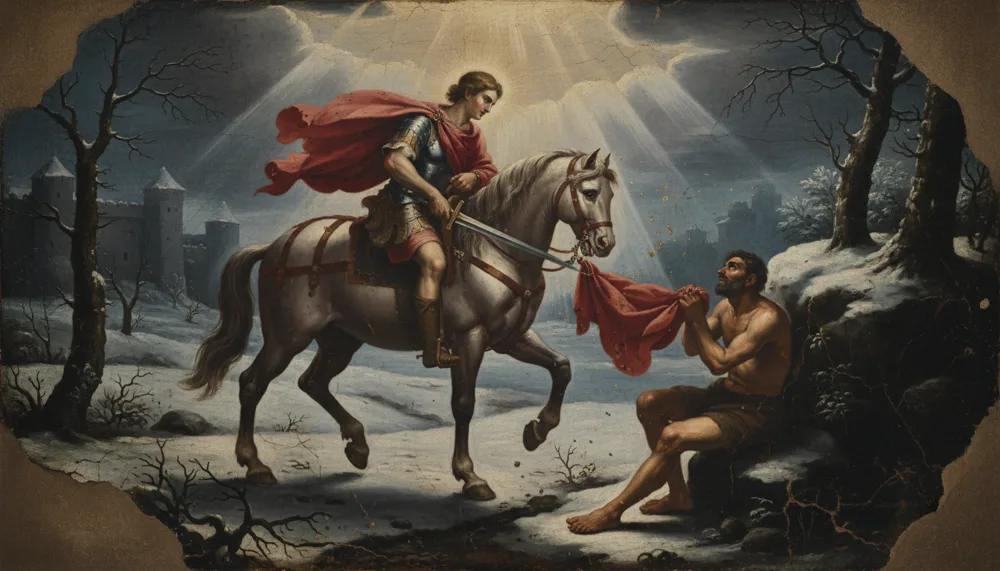
The novena to St Martin of Tours is the nine-day prayer to the great soldier-bishop of Gaul — the man who cut his military cloak in two to clothe a freezing beggar and then saw Christ wearing the half he had given away. It is most often prayed for the grace of charity toward the poor, for honest work and provision, and for deliverance from hardship, and it is kept in the nine days leading to his feast on 11 November, traditionally begun on 2 November. Below we give the full prayers, the way to pray it, and the life of the saint himself, drawn from the old accounts.
Who St Martin is, and why we ask his help
St Martin (316–397) was a Roman soldier before he was a bishop, and he remains one of the best-loved saints of the West — "the glory of Gaul and a light to the Western church," as Butler's Lives of the Saints has it.
He is the patron of soldiers, of beggars and the poor, of the cavalry, and of those who must provide by the work of their hands; and because his one famous act of charity was answered by a vision of Our Lord, he is invoked above all for the grace of open-handed love and for relief in want. A novena to him leans on that history: he is the saint who gave what little he had and found Christ in the beggar. If you are new to this form of prayer, see our short guide to what is a novena.
The full novena to St Martin of Tours
There are two traditional forms in wide use. The first is the popular petition-novena, prayed by working people and the poor for relief and provision; the second is the shorter liturgical form built around the Church's own collect for his feast. Both are given here in full. Pray one prayer, or both, once a day for nine consecutive days, naming your intention.
The daily prayer
Say this once on each of the nine days:
Blessed Saint Martin of Tours, full of the Spirit of the Lord, always having inexhaustible charity for the needy: you who, full of love and generosity, when you saw the beggar freezing with cold — without knowing that in truth he was Christ — did not hesitate to give him half of your cape, and did not give it wholly to him only because the other half belonged to the Roman army; you who did not seek recognition but only to help your neighbour, found glory before the Lord.
And when the Saviour appeared to you clothed with that half-cape, to show His gratitude for your gesture, and said to you, "Today you have covered me with your mantle," you resolved to serve the army no longer, and to dedicate your life to God and to the salvation of souls, being from that day a propagator of the faith and a holy man wholly given to whoever was in need.
Glorious Saint Martin, you who worked miracles and wonders, who with joy, kindness and the most exquisite goodness won the hearts of all and never ceased to work for their good: give me your hand and help me to come out of all the want and scarcity that today afflicts and weighs me down.
Glorious Saint Martin, my blessed patron, I humbly ask you with great faith to obtain from God, the fount of all mercies, that my ways on this earth, my work and my toil, may be cleansed and opened with clarity. In the name of Almighty God, Saint Martin of Tours, remove all that harms me, and give me work and provision. O blessed help, give me your holy protection; assist me, I beg you, in these difficult times.
(Here name your request.)
The concluding prayer
You, noble Saint Martin, who have miraculous power, take my supplications in haste to Heaven; ask for my home all that is good; may sorrows, ruin and misery depart, and may the Lord grant that I merit a blessed fortune in my work, and with it abundance and provision, so that I may give freely to all in need.
Saint Martin, blessed Bishop of Tours, may your virtues and charity be always with me. I will not cease to pray to you and to thank Almighty God for all the favours granted; and I promise to be charitable and giving toward all my brothers and sisters in need. Saint Martin, intercede for me; free and protect all my loved ones and myself from all that is evil. Amen.
Saint Martin of Tours, pray for us.
The short novena from the Church's collect
Those who prefer a briefer, more liturgical form may pray the following, which is drawn from the Church's own prayers for his feast. It is well suited to those attached to the 1962 books, and can be said in a minute a day for the nine days:
O God, who seest that we are not able to subsist by reason of our own weakness, mercifully grant that, by the intercession of blessed Martin, Thy Confessor and Bishop, we may be defended against all adversities. Through our Lord Jesus Christ, Thy Son, who liveth and reigneth with Thee in the unity of the Holy Ghost, God, world without end. Amen.
Blessed Saint Martin, born under pagan ways yet chosen from childhood to be a prince of the Church: as Bishop of Tours many souls were redeemed and set free through your prayers, austerities and blessings. We humbly ask your intercession before Our Lord Jesus Christ, that we may be worthy of the grace and mercy of the Holy Spirit, who leads us from darkness to light into the eternal kingdom, for ever and ever. Amen.
Blessed Saint Martin of Tours, obtain for us not only forgiveness, but also a spirit of love toward our neighbour, that we may be compassionate. Obtain for us the grace to love all people as brothers and sisters, with a pure and selfless heart, that we may one day enjoy with you the blessed vision of God for ever. Amen.
Saint Martin of Tours, pray for us.
The novena for work and provision
Of all the requests brought to St Martin, the plea for work and provision is the most common, and the most fitting: he was a soldier who lived by his wage, and later a bishop who fed the poor from what he had. The daily prayer above carries this intention directly — it asks that "my work and my toil be cleansed and opened," and that the saint "give me work and provision."
Name the work you seek plainly, and ask first for the grace to labour honestly and to be generous with what you are given. St Martin's whole life teaches that provision is given not to be hoarded but to be shared; a novena to him is well prayed by the unemployed and the hard-pressed, in the same spirit as the novena to St Joseph, the carpenter who provided for the Holy Family.
A novena for charity and for the poor
St Martin is, before all else, the saint of charity to the poor. If your intention is not a need of your own but the grace to love and to give — to see Christ in the beggar, as Martin did at the gate of Amiens — the same nine days serve. Pray for a heart opened to those in want, for the courage to give when giving costs, and for your own works of mercy to be blessed. This is the intention the Church herself sets before us on his feast, and it is the surest way to pray his novena, since it asks for the very virtue that made him a saint.
How to pray this novena
A novena is simply nine days of steady, trusting prayer. To pray St Martin's well:
- Start nine days before the feast. His feast is 11 November; the novena is traditionally begun on 2 November and finishes on the vigil, so that the ninth day falls the evening before the feast. But it may be begun on any day of the year for a pressing need.
- Pray once a day, at a fixed hour. Say the daily prayer (and, if you wish, the concluding prayer or the short liturgical form), naming your one intention throughout the nine days.
- Join it to the Mass or the Rosary where you can; a novena gains much when united to Our Lord's own sacrifice. For the method, see how to pray the Rosary.
- Ask in submission. Name your request plainly, then add Thy will be done. A novena does not compel God; it commends a need to a friend of His and waits in trust — and St Martin, who gave the poor man his cloak without being asked, does not forget those who ask him.
Who is St Martin of Tours? The life of the soldier-saint
St Martin was born about 316 at Sabaria in Pannonia (modern Hungary), the son of a pagan army officer. At fifteen he was forced into the army against his will, and though not yet baptized, "he lived more like a monk than a soldier," as Butler records. It was while he was stationed at Amiens that the incident occurred which image and tradition have made famous.
One day in a very hard winter, Martin met at the city gate a poor man, almost naked, trembling with cold and begging alms of those who passed. Seeing that no one relieved him, and having nothing on him but his arms and clothes, Martin drew his sword, cut his military cloak in two, and gave the beggar half, wrapping himself in the other. Some bystanders laughed at the figure he cut; others were ashamed they had not helped. That night Martin saw in his sleep Christ clothed in the half he had given away, and heard Him say, "Martin, yet a catechumen, has covered me with this garment." He "flew to be baptized." (Our very word chapel descends from this cloak: the oratory that later kept the relic of St Martin's cappa was called the cappella.)
He did not leave the army at once, but when a war-bounty was distributed before a barbarian invasion he refused it, telling the emperor Julian: "Hitherto I have served you as a soldier; let me now serve Christ… I am a soldier of Christ, and it is not lawful for me to fight." Accused of cowardice, he offered to stand unarmed in the front line; an armistice spared the test, and he was discharged. He became a disciple of St Hilary of Poitiers, founded at Ligugé what tradition holds to be the first monastic community in Gaul, and lived there ten years, preaching and working many miracles.
About 371 the people of Tours demanded him for their bishop, and he was made bishop by a stratagem, being called to the city to visit a sick person. He continued his austere, monastic life as bishop, founding the great abbey of Marmoutier and drawing many souls out of paganism throughout Gaul. He interceded fearlessly for prisoners and for the condemned, and — almost alone among the bishops of his day — refused to countenance the putting of heretics (the Priscillianists) to death, holding that excommunication was punishment enough and that the emperor had no jurisdiction over the Church's affairs.
He foretold his own death, and prayed at the last: "Lord, if thy people still need me, I will not draw back from the work. Thy will be done." He died on 8 November 397 and was buried at Tours on 11 November, which became his feast. His shrine at Tours was for centuries one of the most popular pilgrimages in Europe; the oldest existing church in England, at Canterbury, bears his name, and countless French churches are dedicated to him. He is honoured as patron of soldiers, of the poor and of beggars, of the cavalry, and of all who give of their little.
Frequently Asked Questions
When is St Martin of Tours' feast day?
His feast is kept on 11 November, the day of his burial at Tours in 397 (he died on 8 November). In many lands the day is called Martinmas. The novena is traditionally prayed in the nine days before it, begun on 2 November and ending on the vigil of the feast.
What is St Martin of Tours the patron saint of?
He is the patron of soldiers and the cavalry — being himself a soldier before his conversion — and, above all, of the poor and of beggars, because of the cloak he shared at Amiens. He is also invoked as a patron of those seeking honest work and provision, of tailors and cloth-workers (again, from the cloak), of innkeepers, and of France, whose most beloved saint he long was.
Why did St Martin cut his cloak in half?
Because half of the cloak was not his to give. As a soldier, Martin's military cloak was partly provided by the Roman army, so only half belonged to him; he gave the beggar all that was his own and kept the army's half. The old accounts make a point of this — his charity was complete, giving all he could rightly give — and that same night Christ appeared to him wearing the beggar's half, which led to his baptism.
What can I pray the St Martin of Tours novena for?
Most commonly for work, provision, and relief from hardship — the daily prayer asks the saint to "give me work and provision" and to lift "all the want and scarcity" that weighs a soul down. It is also prayed for the grace of charity toward the poor, that we may learn to give as Martin gave, and for protection of one's home and loved ones. Any honest need may be brought to him, ending always with Thy will be done.
Is the novena to St Martin traditional?
Yes. St Martin is one of the oldest saints of the Western calendar, named in ancient canons of the Mass and honoured on 11 November long before the modern era. The nine-day novena is a devotional practice built on his feast; the daily petition-prayer is a folk prayer of the poor, and the shorter form is drawn from the Church's own collect for his day. Both are given in full above so you may pray whichever suits you.
How did St Martin of Tours die?
He died on 8 November 397, in a remote part of his diocese, having foretold his death to his disciples. When they begged him not to leave them, he prayed, "Lord, if thy people still need me, I will not draw back from the work. Thy will be done." He was buried at Tours on 11 November, and his tomb became one of the great pilgrimage shrines of Christendom.
Pray this novena with day-by-day reminders and audio, alongside the litanies and prayers of the traditional treasury, in the Iter Fidei app. Get the app link by email here.
Sources. Butler's Lives of the Saints (St Martin, Bishop of Tours, 11 November), drawing on Sulpicius Severus, Life of St Martin and his Letters and Dialogues; the traditional novena and petition-prayer to St Martin of Tours; the collect and prayers of the feast of St Martin (11 November); Scripture on charity to the poor (Matthew 25:35–40).