
The Sacraments
The Precepts of the Church
The precepts of the Church — the commandments every Catholic is bound to keep — listed and explained from the traditional catechism.
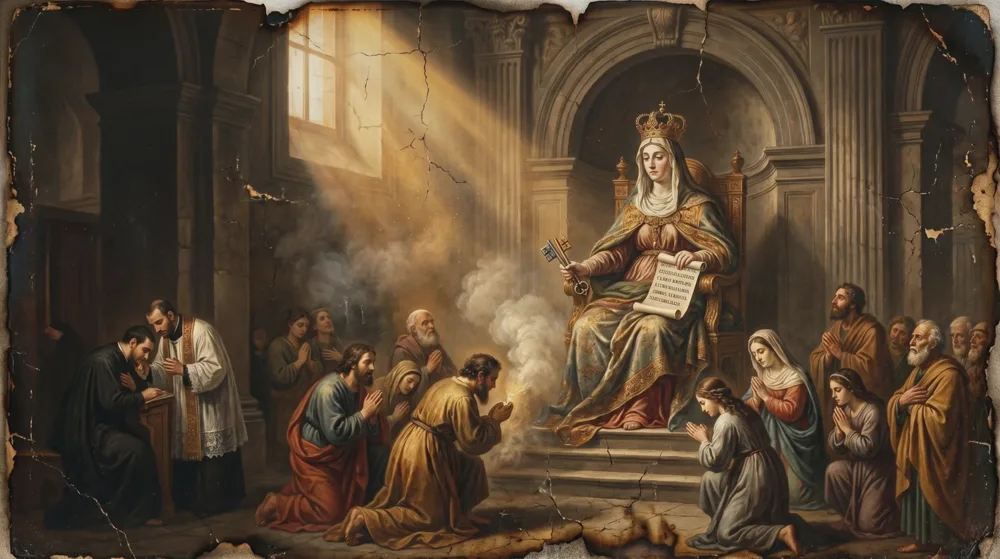
Besides the Ten Commandments of God, every Catholic is bound to observe the precepts of the Church — the commandments which the Church, by her authority from Christ, lays upon the faithful. The traditional catechism numbers them as five: to hear Mass on Sundays and holy days, to fast and abstain on the appointed days, to confess at least once a year and receive Communion at Easter, to support the Church, and not to solemnise marriage at the forbidden times. We owe obedience to these because Christ Himself gave the Church the power to command, and because the precepts help us keep the Commandments of God.
What are the precepts of the Church
The precepts of the Church are commandments that come not directly from God in the Decalogue but from the Church, to whom Christ gave authority to bind and to loose. The catechism puts the distinction plainly: "Besides the Commandments of God, we must also observe the precepts of the Church." They do not stand apart from God's law — they serve it. As the Catechism of St. Pius X teaches, we are bound to obey the Church "because Jesus Christ Himself commands it, and because the precepts of the Church help us to observe the Commandments of God."
Two consequences follow from this authority. First, the obligation is real and grave: "Deliberately to transgress a precept of the Church in a grave matter is a mortal sin." These are not counsels or suggestions but commandments binding under sin. Second, because the Church gave them, the Church can lift them: "Only the Pope can dispense from the precepts of the Church, and those to whom he has given the power to do so." The obligation begins, as a rule, when a person reaches the use of reason.
Five, six, or seven precepts of the Catholic Church?
A reader searching for the five precepts, the six precepts, or even the seven precepts of the Catholic Church will find that the older catechisms do not agree on a single count, even while teaching the same matter. The number changes; the substance does not. The reason is simple: a catechism may join two duties into one precept or split one into two, and the total rises or falls accordingly. No Catholic precept is ever dropped or added — only the manner of dividing them differs. We follow the Catechism of St. Pius X, which enumerates five.
This applies equally whether one searches for the precepts of the "Catholic Church" or of the "Roman Catholic Church": these name the same Church and the same precepts. The traditional enumeration here is that of the Latin (Roman) rite as traditionally taught.
The five precepts of the Catholic Church
The Catechism of St. Pius X gives five precepts, listed in full below. This is the enumeration we follow throughout this article, and the one most readers mean by the precepts of the Church.
The six precepts of the Catholic Church
Many traditional manuals number six. They do so chiefly by separating "to confess your sins at least once a year" from "to receive Holy Communion at Easter" — two duties the Pius X catechism joins into a single third precept. Counted apart, they yield a sixth precept. A few older lists reach six instead by adding the duty not to read or keep forbidden books (the obligation of the Index), which Pius X folds into the broader duty of obedience rather than listing as a separate precept.
The seven precepts of the Catholic Church
A smaller number of catechisms and devotional lists count seven, combining both of the above expansions: they split confession from Easter Communion and add the precept against forbidden books, sometimes also listing the support of the Church's ministers and the obligation to marry only within the Church as distinct items. Again, nothing new is taught — the same five duties of Pius X are simply parsed into seven headings. If you have seen a list of seven precepts, you have seen the same law of the Church, more finely divided.
Here are the five precepts of the Church as the catechism gives them:
- To hear Mass on all Sundays and other commanded feasts.
- To fast during Lent, on the Ember days and on the commanded Vigils; to abstain from meat on the forbidden days.
- To confess at least once a year, and to communicate at Easter, each one in his own parish.
- To pay the tithes due to the Church, according to custom.
- Not to celebrate marriages at the forbidden times, that is to say, from the first Sunday of Advent to the Epiphany, and from the first day of Lent to the Octave of Easter.
The first precept: to hear Mass on Sundays and holy days
The first precept binds us "to assist with devotion at Holy Mass on all Sundays and other feasts of precept." Sunday holds the chief place: the word means the day of the Lord, the day consecrated to the divine service, and it is "the principal feast among Christians, as the Sabbath was the principal feast among the Jews, by the institution of God Himself." To these the Church has joined the feasts of Our Lord, of the Most Blessed Virgin, of the Angels and of the Saints — instituted in memory of the divine mysteries, and that we may honour the saints, imitate their example, and obtain the help of their prayers.
The catechism adds that the faithful should assist, as far as possible, at the parish Mass: so that the parishioners may pray united with their pastor, share more fully in the Holy Sacrifice offered for them, hear the truths of the Gospel expounded, and learn the notices published at that Mass.
The second precept: fasting and abstinence
The second precept commands the works of penance the Church appoints: to fast during Lent, on certain days of Advent where it is prescribed, on the Ember days, and on certain Vigils; and to abstain from meat on the forbidden days. Fasting, in the traditional discipline, "consists in taking only one meal a day, and in abstaining from the forbidden foods," though by the Church's condescension a small collation is permitted in the evening. Its purpose is threefold: to prepare us better for prayer, to do penance for sins committed, and to preserve us from committing new ones.
Lent itself was instituted to imitate the forty days' fast Our Lord kept in the desert and to dispose us, by penance, to celebrate Easter holily. Even those excused from the strict fast are not freed from all mortification, the catechism notes, "because we are all bound to do penance." Abstinence from meat on Friday is kept in honour of the Passion, and on Saturday in memory of Our Lord's burial and in honour of the Blessed Virgin. This is the same spirit of penance that confession serves, and a sincere examination of conscience prepares us to keep both well.
The third precept: yearly confession and Easter Communion
The third precept is the one most bound up with this section of our writing, for it commands the Sacrament of Penance and the Holy Eucharist. By its first words — to confess at least once a year — the Church "obliges all Christians who have come to the use of reason to approach the sacrament of Penance at least once a year." The most fitting time is Lent, by the custom of the whole Church.
The Church says at least deliberately, "in order to make known to us her desire that we should approach the sacraments more often." Frequent confession is strongly commended, "especially because it is difficult to make a good confession and to keep oneself far from mortal sin if one confesses but rarely." If it has been long since your last confession, our guide on how to go to confession walks through it step by step.
By its second part — to communicate at Easter — the precept obliges those who have reached the age of discretion to receive the Most Holy Eucharist each year, in their own parish, during the Paschal season. We are bound to communicate also when in danger of death. And the precept is not satisfied by a sacrilegious confession or Communion — that is, one made in mortal sin or without due dispositions — "because the intention of the Church is that these sacraments be received for the end for which they were instituted, that is to say, for our sanctification."
The fourth precept: to support the Church
The fourth precept, to pay the tithes due to the Church, is kept "by paying the offerings or contributions which have been established to acknowledge the sovereign dominion of God over all things, and to provide for the honest subsistence of His ministers." It is to be observed upon such things, and in such manner, as the custom of the place requires.
The fifth precept: not to solemnise marriage at forbidden times
The fifth precept does not forbid the Sacrament of Matrimony itself at any season; it forbids the solemnity of marriage during the penitential seasons — from the first Sunday of Advent to the Epiphany, and from the first day of Lent to the Octave of Easter. This solemnity consists in the nuptial Mass for the spouses, the nuptial blessing, and the extraordinary pomp of weddings. Such celebration is not fitting, the catechism explains, "because these are times specially consecrated to penance and to prayer."
How the precepts relate to the commandments of God
The precepts of the Church are not a second law set beside the law of God but a help toward keeping it. The Decalogue commands us to keep holy the Lord's Day; the Church's first precept tells us how — by hearing Mass. God commands repentance; the third precept fixes a minimum so that no soul drifts a lifetime from the sacraments. To grasp the precepts rightly, then, is to see them as the Church's practical hand laid upon the Ten Commandments, giving them flesh in the ordinary year of a Catholic's life.
Conclusion
Five precepts, one purpose: to bind the faithful to the rhythm of worship, penance, and the sacraments that keeps a soul in the friendship of God. To know them is the first step; to keep them, the work of a lifetime. They are the Church's commandments, and through them we keep the commandments of God.
Frequently Asked Questions
What are the precepts of the Catholic Church?
The precepts of the Church are the commandments which the Church, by her authority from Christ, lays upon the faithful besides the Ten Commandments of God. The traditional Catechism of St Pius X numbers them as five: (1) to hear Mass on all Sundays and commanded feasts; (2) to fast and abstain on the appointed days; (3) to confess at least once a year and receive Communion at Easter; (4) to support the Church by the tithes due according to custom; and (5) not to solemnise marriage at the forbidden times.
What are the 5 precepts of the Catholic Church?
The five precepts of the Catholic Church, as enumerated by the Catechism of St Pius X, are: (1) to hear Mass on all Sundays and commanded feasts; (2) to fast and abstain on the appointed days; (3) to confess at least once a year and receive Holy Communion at Easter; (4) to support the Church by paying the tithes due according to custom; and (5) not to solemnise marriage at the forbidden times — Advent to Epiphany, and Lent to the Octave of Easter.
What are the six precepts of the Catholic Church?
The six precepts taught in many traditional manuals are the same as the five above, with the third precept split into two: (1) hear Mass on Sundays and holy days; (2) fast and abstain on the appointed days; (3) confess at least once a year; (4) receive Holy Communion at Easter; (5) support the Church; and (6) not to solemnise marriage at the forbidden times. Some lists instead reach six by adding the duty not to read forbidden books.
How many precepts of the Church are there — five, six, or seven?
The older catechisms teach the same matter but do not agree on a single count. The Catechism of St Pius X enumerates five. Other traditional presentations list six, usually by separating yearly confession from Easter Communion (which Pius X joins into one third precept), or by adding the duty not to read forbidden books; a few number seven by combining both expansions. No precept is dropped or added — only the manner of dividing them differs.
Are the precepts of the Roman Catholic Church the same as the precepts of the Catholic Church?
Yes. "Roman Catholic Church" and "Catholic Church" name the same Church, and the precepts are identical. The enumeration given here follows the Latin (Roman) rite as taught in the Catechism of St Pius X.
Are the precepts of the Church binding under sin?
Yes. Deliberately to transgress a precept of the Church in a grave matter is a mortal sin. These are not counsels or suggestions but commandments binding under sin, because Christ gave the Church the power to bind and to loose. The obligation begins, as a rule, when a person reaches the use of reason. Only the Pope, and those to whom he grants the power, can dispense from them.
What is the difference between the precepts and the Ten Commandments?
The Ten Commandments come directly from God in the Decalogue; the precepts come from the Church, to help us keep that law. They are not a second law set beside God's but a practical hand laid upon it: the Decalogue commands us to keep holy the Lord's Day, and the first precept tells us how — by hearing Mass; God commands repentance, and the third precept fixes a minimum so that no soul drifts a lifetime from the sacraments.
What are the days of fasting and abstinence in the second precept?
The second precept commands us to fast during Lent, on the Ember Days, and on the commanded Vigils, and to abstain from meat on the forbidden days. Fasting in the traditional discipline means taking only one full meal a day and abstaining from forbidden foods, with a small evening collation permitted by the Church's condescension. Abstinence from meat is kept on Fridays in honour of the Passion, and on Saturdays where no dispensation is granted, in memory of Our Lord's burial.
The Iter Fidei app keeps the precepts of the Church before you — the Sundays and holy days of obligation, the days of fasting and abstinence, and a guided examination so that the yearly confession and Easter Communion are never neglected. Get the app link by email here.
Sources. Catechism of St. Pius X, Part III, ch. 4 ("The Precepts of the Church"), §§ 1–6.