
Scripture
Hail Mary, Full of Grace: The Words of Luke 1:28
The Douay-Rheims reads 'Hail, full of grace, the Lord is with thee: blessed art thou among women' (Luke i. 28). The angel Gabriel's gratia plena — the scriptural root of the Hail Mary and the ground of the Immaculate Conception.
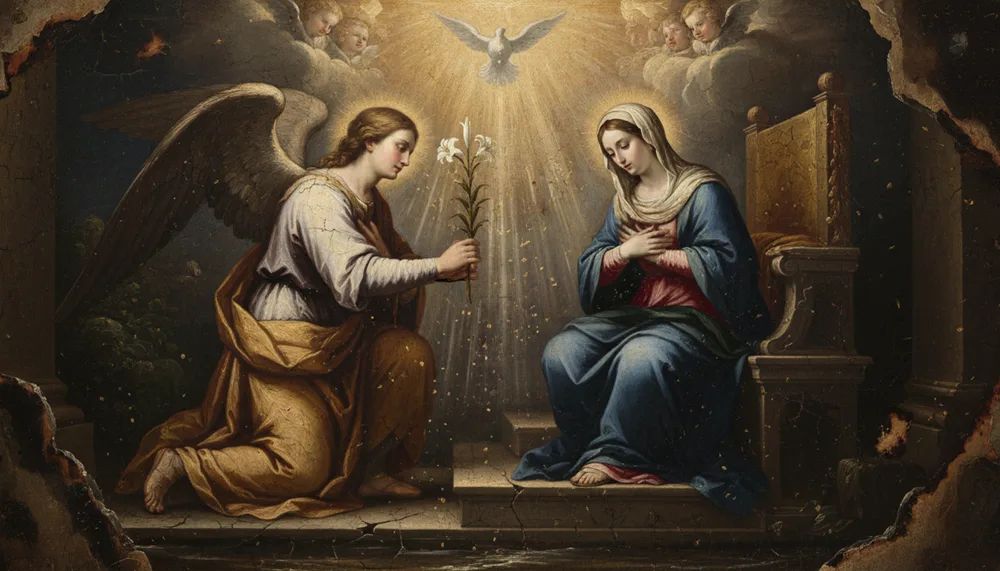
"Hail Mary, full of grace" are not first the words of a prayer but the words of an angel. In the Douay-Rheims, the traditional Catholic English Bible drawn from the Latin Vulgate, Luke i. 28 reads:
And the angel being come in, said unto her: Hail, full of grace, the Lord is with thee: blessed art thou among women. (Luke i. 28)
This is the salutation of the Archangel Gabriel to the Virgin Mary at the Annunciation, the moment he came from God to announce the Incarnation. The Latin of the Vulgate is Ave, gratia plena, Dominus tecum: benedicta tu in mulieribus — and it is from gratia plena, "full of grace," that the whole of Marian devotion takes its first words. Mary is not merely greeted; she is named by Heaven for what God has made her: full of grace, and therefore, as the Church reads it, free of sin.
Luke 1:28: what the angel actually said
The verse belongs to the Annunciation, recounted in the first chapter of Saint Luke. Gabriel is sent from God (Luke i. 26) to a virgin espoused to a man whose name was Joseph (Luke i. 27), and his first word to her is Ave — Hail. He does not address her by her name, but by a title: gratia plena. Mary, Saint Luke records, was troubled at his saying (Luke i. 29), for no creature had been greeted so. The angel then unfolds it: Fear not, Mary, for thou hast found grace with God (Luke i. 30), and the Holy Ghost shall come upon thee, and the power of the most High shall overshadow thee (Luke i. 35).
So the salutation is not a courtesy. It is a revelation of Mary's state before God at the instant He chose her to bear His Son, and the Church receives it as the very speech of an angel sent from God. These words are also, word for word, the opening of the Hail Mary — which is why the prayer is rightly called the Angelic Salutation. This verse stands among the great Catholic Bible verses precisely because the Church has built a prayer directly upon it.
What does "full of grace" mean?
To be full of grace is to be filled with the supernatural life of God — what the tradition calls sanctifying grace, the grace that makes the soul holy and pleasing to God and is the opposite of the state of sin. Gabriel does not say Mary has grace, as every soul in friendship with God has grace; he names her full of it, gratia plena. The fullness is the point. There is in her no admixture of its contrary, no stain, no defect of the supernatural life — she is filled with grace as a vessel is filled to the brim, leaving no room for sin.
This is why the Church has always read Luke i. 28 as more than a compliment to a holy woman. The greeting marks Mary out, in the catechism's words, by "the singular gifts and privileges with which God favoured her in preference to all other creatures." To be greeted by Heaven as full of grace is to be set apart from every other creature, for of no one else does Scripture record such a salutation. The fullness Gabriel announces is the same the Church later defined: a soul preserved from all sin and adorned with grace from her first instant.
Gratia plena and the Immaculate Conception
The traditional Catholic reading draws a straight line from gratia plena to the Immaculate Conception — the dogma that Mary, from the first instant of her conception, was preserved free from all stain of original sin. If Mary is full of grace, then there was no moment in which grace was absent and sin present. A vessel cannot be full and empty at once. The fullness Gabriel announces is incompatible with any reign of sin in her, and the Church reads in his greeting the scriptural seed of what she would define: that the Mother of God was never, for an instant, in the power of the enemy.
This is not a late invention read back into the text. The Annunciation itself supplies the reason: she who was to be the very dwelling of the Son of God, in whom the Holy Ghost shall come upon thee (Luke i. 35), was fittingly prepared by a fullness of grace excluding all sin. The God who spared not even his own Son did not entrust His Incarnation to a soul ever held by His enemy. Full of grace is the angel's word for that preparation. On why the Church honours and turns to her in consequence, see why Catholics pray to Mary.
"Blessed art thou among women": the rest of the verse
The salutation does not end at gratia plena. Gabriel continues: the Lord is with thee: blessed art thou among women. The first clause, the Lord is with thee, is the ground of all the rest — God is present to her in a manner given to no other, and soon present within her in the flesh. The second, blessed art thou among women, is then repeated by Saint Elizabeth at the Visitation, when, filled with the Holy Ghost, she cries out: Blessed art thou among women, and blessed is the fruit of thy womb (Luke i. 42). The Hail Mary joins the two: the angel's greeting and Elizabeth's, both given under the inspiration of God.
So the first half of the Hail Mary is pure Scripture — Gabriel's words from Luke i. 28 and Elizabeth's from Luke i. 42 — and only the second half, the petition Holy Mary, Mother of God, pray for us sinners, was added by the Church. We salute the Virgin, the catechism teaches, "with the very words of the Archangel" in order to "rejoice with her, recalling the singular gifts and privileges with which God favoured her." To pray the Hail Mary is to repeat after an angel.
The Ave Maria meaning: a misreading, charitably corrected
A popular reading, common outside the Church, would soften Luke i. 28 into a mere greeting — "highly favoured one," and no more — and treat the fullness of grace as ordinary favour shown to a devout girl. We do not say this in mockery; many who read it so are seeking to honour Christ and to guard against excess. But the text resists the reduction. Gabriel does not say Mary is favoured as the faithful are favoured; he gives her a name, gratia plena, and Scripture records that she was troubled at a greeting unlike any other. The fullness is in the word, and the Church has never been free to empty it.
Nor does honouring the fullness of grace in Mary diminish her Son; it magnifies Him. Every grace in her is His gift, the first and greatest fruit of His redemption, applied to her by anticipation. The catechism is exact about where her power lies: she is "so powerful because she is the Mother of God," and her office is to bring us to Him — "through her they are certain to find Jesus." To say the Virgin is full of grace is to confess what Christ did in her. This is one of the genuine points of difference treated in Catholic versus Protestant teaching, and it turns on how one reads this single verse. On the deeper question the Annunciation raises — what it is to be filled with God's grace — see how to love God.
The Hail Mary, full of grace: the prayer in full
Because so many come to these words looking for the prayer itself, here it is in the traditional form, with its scriptural first half and the Church's petition:
Hail Mary, full of grace, the Lord is with thee; blessed art thou amongst women, and blessed is the fruit of thy womb, Jesus. Holy Mary, Mother of God, pray for us sinners, now and at the hour of our death. Amen.
The first half — Hail Mary, full of grace, the Lord is with thee; blessed art thou amongst women, and blessed is the fruit of thy womb, Jesus — is woven from Luke i. 28 (Gabriel) and Luke i. 42 (Elizabeth). The second half — Holy Mary, Mother of God, pray for us sinners, now and at the hour of our death — is the Church's prayer, settling into its present form by the sixteenth century. The full text, its Latin (Ave Maria), and its place in Catholic devotion are set out in our article on the Hail Mary.
"The Lord is with thee" or "the Lord is with you"?
Many search for the line as the Lord is with thee and many as the Lord is with you; both render the same words. The Vulgate's Dominus tecum is rendered the Lord is with thee in the Douay-Rheims and in the traditional English prayer, where thee is the old singular, the form once used to address one person intimately. Modern translations write the Lord is with you, using you as the now-ordinary singular. The meaning is identical: God is present to Mary in a manner given to no other creature. The traditional Catholic prayer keeps thee, as it keeps thou and thy throughout, and that is the form we use here.
Where is "Hail Mary, full of grace" in the Bible?
The opening of the Hail Mary is not a devotional invention but Scripture, drawn from two verses of Saint Luke's first chapter. Hail, full of grace, the Lord is with thee: blessed art thou among women is Gabriel's greeting at the Annunciation (Luke i. 28). Blessed is the fruit of thy womb comes from Saint Elizabeth at the Visitation, who, filled with the Holy Ghost, cried out: Blessed art thou among women, and blessed is the fruit of thy womb (Luke i. 42). So the bible verse behind the prayer is, properly, two verses — both spoken under the inspiration of God, one by an angel and one by a saint. The verse stands among the great Catholic Bible verses because the Church has built a prayer directly upon it.
Why we repeat the angel's words
We pray the Hail Mary because the Church places it, after the Our Father, as the prayer in which "we have recourse to the Most Blessed Virgin," our "most powerful Advocate with Jesus Christ." Having said the prayer Christ Himself taught, we ask His Mother to obtain for us the graces we have asked. The prayer the Church most recommends in her honour, the catechism adds, is the Rosary — the angel's salutation repeated through the mysteries of Christ, and we set out how to pray the Rosary in full. The full text and structure of the prayer itself are given in our article on the Hail Mary.
To begin every Hail Mary with full of grace is therefore not flattery and not excess. It is to take Heaven's own estimate of the Virgin and make it our own — to greet her as the angel greeted her, and through her, as the catechism promises, to be "certain to find Jesus." The first words of the prayer are the first words of an angel.
Frequently Asked Questions
What does "full of grace" mean?
To be full of grace (Latin gratia plena) is to be filled with the supernatural life of God — sanctifying grace — with no admixture of its contrary. Gabriel does not say Mary merely has grace; he names her full of it (Luke i. 28), a fullness that leaves no room for sin. The Church reads in this word the scriptural seed of the Immaculate Conception: a soul preserved from all stain and adorned with grace from her first instant.
What does it mean to be full of grace?
It means to be filled, with no room left for its opposite, by the grace that makes a soul holy and pleasing to God. Every soul in friendship with God has grace; only of Mary does Scripture record that she is full of it. The fullness is the whole point: a vessel filled to the brim, in which there is no stain, no defect, no reign of sin.
Who said "Hail, full of grace"?
These are the words of the Archangel Gabriel, sent from God (Luke i. 26), to the Virgin Mary at the Annunciation. He does not address her by name but by a title — gratia plena, full of grace — and the Church receives the greeting as the very speech of an angel. The first half of the Hail Mary is built directly on this verse, which is why the prayer is called the Angelic Salutation.
What is Luke 1:28 in the Douay-Rheims?
The Douay-Rheims renders it: And the angel being come in, said unto her: Hail, full of grace, the Lord is with thee: blessed art thou among women. The Latin Vulgate reads Ave, gratia plena, Dominus tecum: benedicta tu in mulieribus. From gratia plena the whole of Marian devotion takes its first words.
What does gratia plena mean?
Gratia plena is the Latin of Luke i. 28, "full of grace." It is the angel's name for Mary's state before God at the instant He chose her to bear His Son. The traditional Catholic reading draws a straight line from gratia plena to the Immaculate Conception: if Mary is full of grace, there was no moment in which grace was absent and sin present.
Is "Hail Mary, full of grace" in the Bible?
Yes. The first half of the Hail Mary is pure Scripture: Gabriel's greeting in Luke i. 28 and Saint Elizabeth's words at the Visitation, Blessed art thou among women, and blessed is the fruit of thy womb (Luke i. 42). Only the second half — Holy Mary, Mother of God, pray for us sinners — was added later by the Church.
Does "full of grace" prove the Immaculate Conception?
The Church reads in Gabriel's word the scriptural seed of the dogma, not a late invention read back into the text. A vessel cannot be full and empty at once: if Mary is full of grace, no reign of sin is compatible with that fullness. The Annunciation itself supplies the reason — she who was to be the dwelling of the Son of God was fittingly prepared by a fullness of grace excluding all sin (defined by Pius IX, Ineffabilis Deus, 1854).
What is the Hail Mary, full of grace, prayer?
The traditional prayer reads: Hail Mary, full of grace, the Lord is with thee; blessed art thou amongst women, and blessed is the fruit of thy womb, Jesus. Holy Mary, Mother of God, pray for us sinners, now and at the hour of our death. Amen. Its first half is Scripture (Luke i. 28 and i. 42); its second half is the petition the Church added, in its present form by the sixteenth century.
Is it "the Lord is with thee" or "the Lord is with you"?
Both render the same Latin, Dominus tecum. The Douay-Rheims and the traditional prayer keep the Lord is with thee, using the old singular thee; modern versions write the Lord is with you. The meaning is identical — God is present to Mary as to no other creature. We keep the traditional thee.
Where in the Bible is "Hail Mary, full of grace"?
In Saint Luke's Gospel. Hail, full of grace, the Lord is with thee: blessed art thou among women is Luke i. 28, the angel Gabriel's greeting at the Annunciation; blessed is the fruit of thy womb is from Luke i. 42, Saint Elizabeth at the Visitation. The first half of the prayer is woven from these two verses.
Does honouring Mary as full of grace take away from Christ?
No; it magnifies Him. Every grace in Mary is His gift, the first and greatest fruit of His redemption, applied to her by anticipation. The catechism is exact: she is "so powerful because she is the Mother of God," and her whole office is to bring us to Him — "through her they are certain to find Jesus."
The Iter Fidei app carries the Douay-Rheims Bible, the prayers, and the traditional Faith. Get the app link by email here.
Sources. Holy Scripture, Douay-Rheims version (Luke i. 26–30, 35, 42). Catechism of Saint Pius X (1908), Part II, Chapter 3, The Hail Mary (the Angelic Salutation; the words of the Archangel and of Saint Elizabeth; Mary as Advocate; the Rosary). Catechism of the Council of Trent (1566), on grace and on the prayer of the Church. Bull Ineffabilis Deus (Pius IX, 1854), on the Immaculate Conception.