
The Sacraments
The Last Rites of the Catholic Church
The Last Rites are the sacraments and prayers by which the Church cares for the dying — Confession, the Anointing of the Sick (Extreme Unction), and Holy Viaticum, often with the Apostolic Pardon.
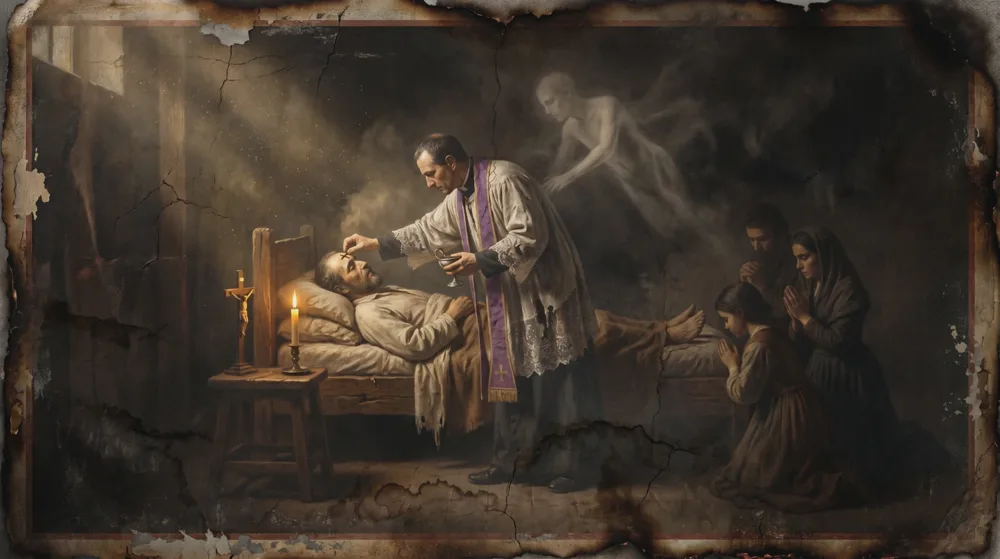
The Last Rites are the sacraments and prayers by which the Catholic Church cares for a Christian who is in danger of death. Properly, the Catholic last rites comprise three sacraments — Confession, by which sins are forgiven; the Anointing of the Sick, traditionally called Extreme Unction; and Holy Viaticum, the Holy Eucharist received as food for the journey out of this life — together with prayers for the dying and, where it can be given, the Apostolic Pardon. This is the answer to what are the last rites: not one rite but a whole, ordered to one end, that the soul should leave the body in the grace of God.
We write this firmly, because the phrase is widely misunderstood. The Last Rites are not a magic formula, nor the mere "anointing" alone. They are the Church bending over her dying child with the very remedies Christ instituted, and they ask of that child faith and repentance.
What are the last rites of the Roman Catholic Church?
When people speak of the last rites of the Roman Catholic Church, they mean the priest's visit to one who is gravely ill or dying. That visit follows an order the Church has always kept. The Roman Catechism, drawn up by the Council of Trent, lays it down plainly: "it is necessary to conform oneself exactly to the constant usage of the Catholic Church of administering the sacraments of Penance and of the Eucharist before that of Extreme Unction."
So the order is: first Confession, that mortal sin be taken away and grace restored; then Viaticum, the Body of the Lord as provision for the passage; then Extreme Unction, which anoints the senses, cleanses the remnants of sin, and strengthens the soul for its last combat. Where the sick person cannot confess, the priest still anoints, for Anointing remits even mortal sin in one who repented, at least habitually, before losing his senses.
These belong to the seven sacraments instituted by Christ, treated more fully in our studies of the Anointing of the Sick and of what Confession is. To grasp why the Church takes such pains over a single deathbed is to meditate on the four last things — death, judgement, heaven, and hell — and on what happens after death.
"Last Rites" is the whole; Extreme Unction is one part
Here we correct the most common error. Many use "last rites" and "Extreme Unction" as if they were the same thing. They are not. Extreme Unction is one sacrament; the Last Rites are the whole of which it is a part.
The name Extreme Unction itself teaches this. The Roman Catechism explains that the sacrament "is called Extreme Unction, because of all the holy Unctions which have been prescribed by Our Lord Jesus Christ to His Church, it is the one that is administered last." Its law was promulgated by the Apostle Saint James: "Is any man sick among you? let him bring in the priests of the Church, and let them pray over him, anointing him with oil in the name of the Lord; and the prayer of faith shall save the sick man" (James 5:14–15, Douay-Rheims). The priest anoints the eyes, ears, nostrils, lips, hands, and feet — the senses being the gates through which sin entered the soul.
To call the whole visit "the anointing" is therefore to name the part for the whole. The anointing is one remedy among the three the dying Christian needs.
Holy Viaticum: Communion as food for the journey
The word Viaticum means provision for a journey. The Roman Catechism gives the reason the Eucharist bears this name when given to the dying: it is "the spiritual nourishment which sustains us in the pilgrimage of this life, and because it prepares and assures for us the way which leads to glory and to eternal felicity." It adds the Church's unbroken practice: "the custom has always been observed in the Church of letting no one die without having fortified him with this Sacrament."
The Catechism of Saint Pius X says the same: "The Communion made by the sick in danger of death is called Viaticum, because it sustains them in the journey which they make from this life to eternity." This is why the same catechism teaches that, beyond the yearly Easter duty, "there is an obligation to communicate … when one is in danger of death." Viaticum is the heart of the Last Rites — Christ Himself, received as the soul sets out. The traditional prayers for the dying that surround it are gathered among our Catholic prayers.
The Apostolic Pardon
To the three sacraments the Church often adds the Apostolic Pardon — a blessing joined to a plenary indulgence at the hour of death, by which the dying who are rightly disposed obtain remission of the temporal punishment due to their sins. The priest gives it after the sacraments. The traditional form runs:
By the faculty which the Apostolic See has given me, I grant thee a plenary indulgence and the remission of all thy sins, in the name of the Father, and of the Son, and of the Holy Ghost. Amen.
This is no magic. Like every sacramental, the Apostolic Pardon works through the Church's prayer and Christ's promise to His Apostles — "whatsoever thou shalt loose upon earth, it shall be loosed also in heaven" (Matthew 16:19) — and it profits only the soul that meets it with faith, sorrow for sin, and resignation to the will of God. Where speech is gone, the dying are counselled to invoke the holy Name at least in the heart. The sacramental is the Church's intercession applied; it is never a charm that compels grace apart from the soul's response.
Who may receive the Last Rites, and who administers them
The Last Rites are for the baptised who, having reached the use of reason, are in danger of death — from sickness, accident, or age. The Roman Catechism is exact about Extreme Unction: it "cannot be given to those who are in good health," nor to those merely in danger from a voyage or a battle, "for these are not sicknesses," nor to infants who could not sin. Confession and Viaticum likewise require their proper dispositions — true contrition for the one, the state of grace for the other.
The minister of all three sacraments is a priest, and a priest alone. Saint James says, "let him bring in the priests of the Church," which the Roman Catechism explains to mean those "lawfully ordained by the bishops." A layman can neither anoint, nor absolve, nor consecrate the Host. This is why the Church urges that the priest be summoned early, while the sick person still has his reason — for, as the Catechism warns, it is "a very great fault" to delay until "all hope of recovery is lost," since the grace is more abundant when received with the mind whole and entire. When no priest can be reached and death is near, the dying are bidden to make an act of perfect contrition, trusting the mercy of God, and to desire the sacraments they cannot receive.
The prayers said at the Last Rites
Around the three sacraments the priest prays the Commendation of a Departing Soul from the Rituale Romanum, that the dying may be helped by the prayer of the whole Church. The litany invokes the saints, and then this petition is repeated:
Go forth, O Christian soul, out of this world, in the name of God the Father almighty, who created thee; in the name of Jesus Christ, the Son of the living God, who suffered for thee; in the name of the Holy Ghost, who was poured forth upon thee.
Short aspirations are placed on the lips or whispered to the ear of one whose strength is failing — the simplest the Church gives: "Jesus, Mary, Joseph, I give you my heart and my soul," and "Jesus, Mary, Joseph, assist me in my last agony." These traditional prayers for the dying are gathered among our Catholic prayers; a soul too weak to speak may form them in the heart.
Are the last rites only for Roman Catholics?
The last rites of the Roman Catholic Church are given to the baptised faithful of the Church, since the sacraments of Penance and the Eucharist presuppose membership in the Church and her unity of faith. A baptised non-Catholic who, near death, sincerely seeks the sacraments, professes the Catholic faith, and is rightly disposed may be received and given them; this is a matter for the priest's prudent judgement in the moment. The Church does not refuse her remedies to a soul that turns to her in good faith, but neither does she treat the sacraments as a public ritual owed to all regardless of belief.
A word against superstition
These rites are holy and efficacious, but not mechanical. A man who has refused God all his life is not saved by a hurried anointing over an insensible body without his repentance. The Church gives them in faith, that the dying may turn to God; she does not coerce a soul. Against the dread of the last hour she sets the words of Scripture — read in the Douay-Rheims of the Catholic Bible: "Blessed are the dead who die in the Lord" (Apocalypse 14:13), and "In all thy works remember thy last end, and thou shalt never sin" (Ecclesiasticus 7:40). The Christian who has confessed, received Viaticum, and been anointed may meet the tribunal of God in peace.
This is the right use of the Last Rites: not a ritual hoarded for the last minute, but the Church's provision, sought in good time and received with a believing, repentant heart.
Frequently Asked Questions
What Are the Last Rites?
The Last Rites are the sacraments and prayers by which the Church tends a Christian in danger of death: Confession, Holy Viaticum, and the Anointing of the Sick (Extreme Unction), often with the Apostolic Pardon. They are not a single rite nor a mere anointing, but a whole ordered to one end — that the soul leave the body in the grace of God. They ask of the dying faith and repentance, not a passive reception.
Can Anyone Give the Last Rites in an Emergency?
No. The minister of Confession, Viaticum, and Anointing is a priest, and a priest alone, for Saint James bids the sick "bring in the priests of the Church" (James 5:14, Douay-Rheims). A layman can neither absolve, nor anoint, nor consecrate the Host, even in an emergency. Where no priest can be reached and death is near, the dying are to make an act of perfect contrition, trusting the mercy of God and desiring the sacraments they cannot receive.
Can the Last Rites Be Given After Death?
The sacraments are for the living and cannot be given to one truly dead, since the soul has departed and grace can no longer be received. Because the moment of death is often uncertain, however, a priest may anoint conditionally for a short while after apparent death, in case life secretly remains. Beyond that, the Church does not anoint a corpse but commends the soul through prayers and Masses for the dead.
What Are the Catholic Last Rites Called Now?
The traditional name for the anointing is Extreme Unction, the last of the holy unctions Christ gave His Church; in more recent usage it is often called the Anointing of the Sick. The fuller provision for the dying — Confession, Viaticum, and Anointing together — is still rightly called the Last Rites. We hold to the traditional names and the order the Church has always kept, whatever later terms may be in fashion.
The Iter Fidei app carries the Douay-Rheims Bible, the catechism, and the traditional prayers and devotions. Get the app link by email here.
Sources. Catechism of the Council of Trent (Roman Catechism, 1566), Part II, "On the Sacrament of the Eucharist" and "On the Sacrament of Extreme Unction"; Catechism of Saint Pius X (1908), Part IV, on the Holy Eucharist and on Extreme Unction; Epistle of Saint James 5:14–15; Saint Matthew 16:19; Apocalypse 14:13; Ecclesiasticus 7:40 (Douay-Rheims). The form of the Apostolic Pardon and the Commendation of a Departing Soul ("Go forth, O Christian soul…") follow the Rituale Romanum, Title VI ("On the Visitation and Care of the Sick" and "The Order of Commending a Departing Soul").