
Apologetics
Eucharistic Miracles: The Evidence of the Real Presence
What is a Eucharistic miracle? When the Sacred Host or the Precious Blood is found to take on the appearance of true Flesh and Blood — Lanciano, Buenos Aires, Bolsena — confirming the Real Presence the Church has always taught.
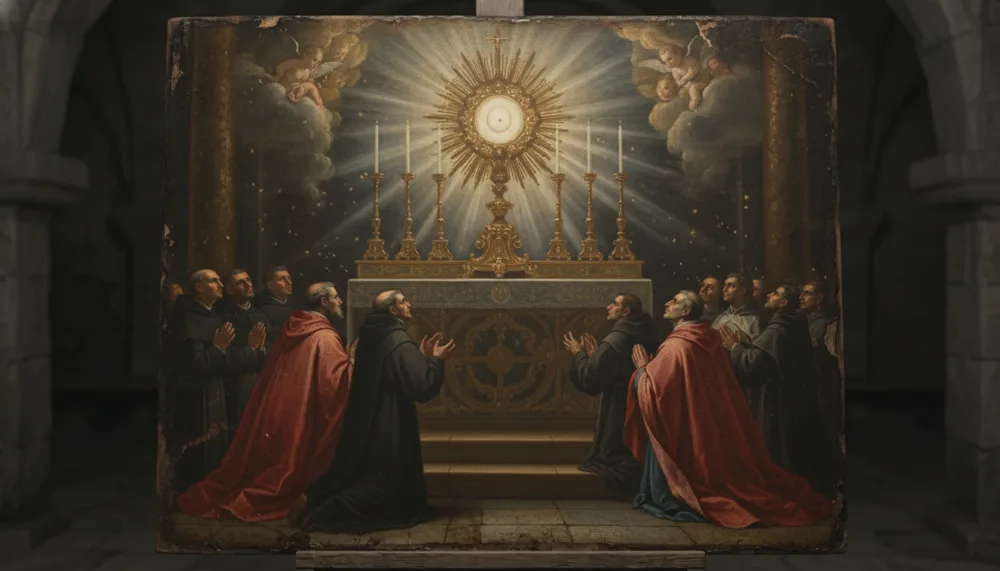
A Eucharistic miracle is an event in which the Sacred Host or the Precious Blood is found, by God's permission, to take on the visible appearance of true Flesh and Blood — or to behave in a way no bread or wine could. These events do not establish the Real Presence; the Church believed it long before any of them occurred, on the word of Christ Himself. What they do is confirm, in the order of the senses, what faith already holds: that under the appearances of bread and wine our Lord Jesus Christ is present truly, really, and substantially.
What is a Eucharistic miracle?
What is a Eucharistic miracle? It is a sign granted around the Blessed Sacrament that exceeds the powers of nature — most often, the consecrated Host visibly becoming flesh, or the consecrated wine visibly becoming blood. In the Eucharist this change is ordinarily hidden. As the Catechism of St Pius X teaches, the Eucharist "contains truly, really, and substantially the Body, the Blood, the Soul, and the Divinity of Jesus Christ Our Lord, under the species of bread and wine." The substance is changed; the appearances of bread and wine remain. A Eucharistic miracle is the rare occasion on which God lifts that veil and lets the appearance follow the substance, so that the eyes see what the soul already believes.
This is why such events are called confirmations and not proofs in the strict sense. The doctrine rests on Christ, who at the Last Supper took bread and said, "This is my body" (St Matthew xxvi. 26, Douay-Rheims), and who in the synagogue at Capharnaum declared, "For my flesh is meat indeed: and my blood is drink indeed" (St John vi. 56). The Council of Trent defined the doctrine and bound it with an anathema against any who would deny it. The miracle adds nothing to the definition. It is a mercy to our weakness, the same mercy our Lord showed when He let Thomas touch His risen wounds.
Proof of the Real Presence: what these signs do and do not do
The Real Presence is taught, before any miracle, by Scripture and the constant faith of the Church. We set out that doctrine in full in our articles on the Real Presence, on the Eucharist, and on transubstantiation. The Catechism of St Pius X states the ground of belief plainly: "I believe that in the sacrament of the Eucharist Jesus Christ is truly present, because He Himself has said it and because holy Church teaches it to me."
So a Eucharistic miracle is not the foundation of the faith but a buttress to it — much as the relics of the Passion, the Shroud of Turin and the Sudarium of Oviedo, do not prove the Resurrection but bear witness to the Passion that preceded it. The Christian rests first on the testimony of the Apostles, who died rather than recant what they had seen. A miracle of the altar belongs to the same order of sign: God condescending to confirm, in the flesh, the words "This is my body."
A Eucharistic miracles list: the most famous cases
The Church counts many reported Eucharistic miracles across the centuries. We report here only what is genuinely documented, and we distinguish the well-attested cases from pious legend. Catalogues such as the Carlo Acutis exhibit gather over a hundred reported cases from across the world; below we set out the few that are best attested, and which answer the search for authentic, scientifically proven eucharistic miracles. The three most documented — Lanciano, Bolsena, and Buenos Aires — are also, notably, all bound up with Italy and Argentina; two of the three are eucharistic miracles in Italy.
Lanciano (8th century)
The oldest and most celebrated is Lanciano, in Italy, traditionally dated to the eighth century. A monk-priest doubting the Real Presence found, at the words of Consecration, that the Host had become flesh and the wine had become blood. The flesh and five clots of blood have been preserved there ever since. In 1970–1971 the relics were examined by Professor Odoardo Linoli, a specialist in anatomy and pathology, with Professor Ruggero Bertelli. Their reported findings were that the flesh is real human heart tissue (myocardium) and the blood is real human blood, both of type AB, with the blood containing normal proteins and minerals. We treat this case at length, with the documented results, in our article on the Miracle of Lanciano.
Bolsena–Orvieto (1263) and the origin of Corpus Christi
In 1263, at Bolsena, a priest who doubted the Real Presence is said to have seen the Host bleed at Mass, the blood staining the corporal. The cloth was brought to nearby Orvieto, where it is venerated still. This event is bound up with the institution of Corpus Christi: Pope Urban IV extended that feast to the whole Church in 1264, and entrusted its Office and hymns to St Thomas Aquinas. The exact historical relation between the Bolsena miracle and the bull establishing the feast is debated by historians, and the Church has never required belief in the miracle itself. What is certain is that the feast of the Body of Christ stands as the Church's perpetual confession of the doctrine these signs attend.
Buenos Aires (1992–1996)
In the parish of Santa María in Buenos Aires, between 1992 and 1996, consecrated Hosts that had been placed in water after being found discarded did not dissolve but took on the appearance of bloody flesh. Samples were examined; the reported analyses, including work associated with Dr Frederick Zugibe, described human heart muscle from the left ventricle, with white blood cells, indicating living tissue under stress. We treat the documented account in our article on the Eucharistic Miracle of Buenos Aires. As with every such case, we report the findings without overstating them: what is established is the analysis on record, not more.
The eucharistic miracles of Buenos Aires and the blood type
Both at Lanciano and at the parish of Santa María in Buenos Aires the reported analyses returned the blood type AB. This is the fact behind the frequent question about the blood type of eucharistic miracles: the documented Lanciano study by Professor Linoli (1970–1971) gave type AB, and the AB type has been reported for the Buenos Aires Hosts of the 1990s as well. Type AB is the rarest of the four major groups and is also the type reported for the Shroud of Turin and the Sudarium of Oviedo.
We must be exact here, for this is a point on which enthusiasm easily outruns evidence. A shared blood type across several relics is a documented coincidence of the analyses on record; it is not, by itself, proof that the samples share a single origin, and the Church has defined no such thing. We report it as what it is — a recurring finding in the laboratory reports — and we let it confirm faith, not replace it. The doctrine of the Real Presence does not stand or fall on a blood group; it stands on the word of Christ, "This is my body."
Eucharistic miracles by Carlo Acutis: the website and the exhibit
The young Italian Carlo Acutis (1991–2006), a teenager who loved the Blessed Sacrament and called it "my highway to Heaven," catalogued reported Eucharistic miracles from around the world and built a website to make them known. That work became a travelling exhibit — The Eucharistic Miracles of the World — which has been shown in parishes, schools, and cathedrals on every continent, with panels for each case. It is the source many people mean when they search for the Carlo Acutis eucharistic miracles website or the list of eucharistic miracles by Carlo Acutis.
We commend the devotion that animated this catalogue while keeping the same caution we apply to every list: it gathers reported cases, of widely varying documentation, and inclusion in it is not Church approval. Carlo's own holiness — the thing the Church has examined — does not certify each marvel he recorded. The exhibit is a fine school of Eucharistic faith precisely when it leads the visitor past the panels to the tabernacle, where the same Lord is present without any visible sign. Those who wish to seek his prayers may make a novena to Blessed Carlo Acutis, the young apostle of the Eucharist.
Is there an official Carlo Acutis website on eucharistic miracles?
The exhibit and its panels are distributed through Catholic dioceses and apostolates rather than from a single official source, and several sites reproduce the material. Readers searching for the eucharistic miracles of the world or the eucharistic miracles book drawn from it should weigh each case on its own documentation, as we do throughout this article, and treat the catalogue as a devotional gathering of reports, not a register of approved facts.
Recent and latest eucharistic miracles
When people ask for the recent or latest eucharistic miracles, they usually mean Buenos Aires (1992–1996), the most thoroughly examined modern case, treated above. Other twentieth- and twenty-first-century reports circulate — from various parishes around the world — but most remain under investigation or have been left without ecclesiastical approval, and some have been judged inconclusive or not miraculous at all.
Here our editorial rule matters most. A recent report is, by definition, one the Church has not yet had time to test, and several widely shared modern cases were later set aside by the competent bishop. We therefore name no marvel as established until the documentation is in hand. The faithful lose nothing by waiting: the Mass of today is itself the standing miracle, and a sign unconfirmed is better left unclaimed than urged before its time.
Eucharistic miracles in India and beyond
Reports of Eucharistic phenomena have come from India and from many other countries, and they appear among the cases gathered in the Carlo Acutis catalogue. We mention them to be complete and to answer the search honestly, but we do not endorse particular Indian cases here: several lack the kind of documented examination that Lanciano and Buenos Aires possess, and some have not received the approval of the local Ordinary.
The point holds for every nation. A Eucharistic miracle does not become more credible by being far away or recent; it becomes credible by surviving the Church's investigation. We report the well-attested cases in detail and name the rest as reported, neither dismissing nor certifying what we cannot document.
Orthodox eucharistic miracles
Eucharistic miracles are also reported within the Orthodox churches, which hold a true belief in the Real Presence and possess valid Holy Orders and therefore a valid Eucharist. From the Catholic side we can say that where the Body and Blood of Christ are truly present, God may grant such signs, and the Fathers East and West confess the same mystery of the altar. We treat Orthodox reports with the same evidentiary caution as any other: documented before believed, and never imposed as an article of faith.
The Church's caution in approving them
The Church is slow and severe in these matters, and rightly so. She does not multiply marvels; she tests them. A reported Eucharistic miracle is examined by the local bishop, the natural explanations weighed, fraud and error ruled out, before any cult is permitted. Even when approved, a Eucharistic miracle is never imposed as an article of faith. The doctrine of the Real Presence is de fide, defined at Trent; a particular miracle is a matter of human testimony, which the faithful may hold with prudent confidence but are not bound to believe as they believe the Creed.
This caution is itself a mark of the Church that Christ founded. She has no need to manufacture wonders, for she possesses the greatest wonder daily and openly: the Sacrifice of the altar, in which the same Body born of the Virgin and offered on the Cross is made present. As the Catechism of St Pius X teaches, in the Eucharist "there is truly the same Jesus Christ who is in heaven and who was born of the most Blessed Virgin upon the earth." The miracle of Lanciano happens once; the Mass happens everywhere, every day. The traditional rite that guards this mystery is the subject of our article on the Tridentine Mass.
What the miracles ask of us
A Eucharistic miracle asks of us exactly what the Host asks of us without one: faith and adoration. The Catechism of St Pius X teaches that "the Eucharist ought to be adored by everyone because it contains truly, really, and substantially Our Lord Jesus Christ." Whether or not we have seen flesh upon the corporal, the One present is the same.
The Roman Catechism counsels the faithful not to inquire "with too much curiosity how such a change can take place," but to rest on the power and the word of God. The doubting priest at Bolsena and the doubting monk at Lanciano were granted a sign because they doubted; the saints needed none. We do well to ask for the faith of the saints, and to receive the signs, where God grants them, as what they are — a mercy, confirming the truth that on the altar is the Lord Himself.
Frequently Asked Questions
What are Eucharistic miracles?
A Eucharistic miracle is an event in which the consecrated Host or the Precious Blood is found, by God's permission, to take on the visible appearance of true Flesh and Blood, or to behave in a way no bread or wine could. They do not establish the Real Presence, which the Church holds on the word of Christ alone, "This is my body" (St Matthew xxvi. 26, Douay-Rheims); they confirm it to the senses. The best-known are Lanciano, Bolsena, and Buenos Aires.
How many Eucharistic miracles are there?
The Church has never fixed an official number, for she does not require belief in any of these signs and tests each one severely before permitting a cult. Catalogues compiled over the centuries list well over a hundred reported cases, but only a portion are genuinely documented, and we distinguish those from pious legend. What matters is not the count but the doctrine they attend, which rests on Scripture and the perennial teaching of the Church.
Are Eucharistic miracles real?
Several are exceptionally well attested, and we report only what is documented. Lanciano, preserved since the eighth century, was examined in 1970-1971 by Professor Linoli, who reported real human heart tissue and real blood of type AB; the Buenos Aires Hosts of the 1990s yielded similar findings of living heart muscle. We hold these as documented human testimony, which the faithful may receive with prudent confidence, not as articles of faith, for the Real Presence is defined at Trent and stands whether or not any miracle is granted.
Are eucharistic miracles scientifically proven?
The well-attested cases have been subjected to laboratory examination, and the reports are on record: at Lanciano, human myocardial tissue and human blood of type AB (Linoli, 1970–1971); at Buenos Aires, living heart muscle from the left ventricle. We state these as documented findings, not as proofs of doctrine. Science can describe what is on the slide; it cannot certify that a host became flesh, nor define the Real Presence, which is held on the word of Christ. So we say the analyses are genuine and verifiable, while the miracle, in the strict sense, remains a matter of faith confirmed — not established — by them.
What is the blood type of eucharistic miracles?
The most documented cases — Lanciano and Buenos Aires — both returned type AB in their reported analyses, the same group reported for the Shroud of Turin and the Sudarium of Oviedo. We note this as a recurring laboratory finding, not as proof of a common origin, which the Church has not defined. A shared blood type confirms nothing about doctrine; it is one detail among the documented results.
Who is Carlo Acutis and what is his eucharistic miracles website?
Carlo Acutis (1991–2006) was an Italian teenager devoted to the Eucharist who catalogued reported Eucharistic miracles and built a website to publicise them, which became the travelling exhibit The Eucharistic Miracles of the World. The catalogue gathers reported cases of varying documentation; inclusion is not Church approval, and each case must still be weighed on its own evidence.
How many Eucharistic miracles are there in the world?
There is no official count. Catalogues such as the Carlo Acutis exhibit list well over a hundred reported cases across many countries — Italy, Argentina, India, and others — but only a portion are genuinely documented, and the Church requires belief in none of them. The number is far less important than the doctrine they attend, which rests on Scripture and the perennial faith of the Church.
The Iter Fidei app carries the Douay-Rheims Bible, the catechism, and the prayers of the Church. Get the app link by email here.
Sources. Douay-Rheims Bible (St Matthew xxvi; St John vi); Catechism of St Pius X (1908), Part IV, The Eucharist (the Real Presence, transubstantiation, the same Christ in heaven and on the altar, the duty of adoration); Roman Catechism (Catechism of the Council of Trent, 1566), Part II, On the Sacrament of the Eucharist; Council of Trent, Session XIII, on the Most Holy Eucharist. Documented scientific examinations reported for the cases named: O. Linoli and R. Bertelli on the Lanciano relics (1970–1971); the analyses associated with the Buenos Aires Hosts (1990s). These scientific reports are stated as documented findings, not as articles of faith; the doctrine of the Real Presence rests on Scripture and the perennial teaching of the Church, not on any one miracle.