
Novenas
Novena to St Patrick
The traditional nine-day novena to St Patrick, Apostle of Ireland — the full prayer, St Patrick's Breastplate, how to pray it March 8–17 before his feast, and the life of the saint.
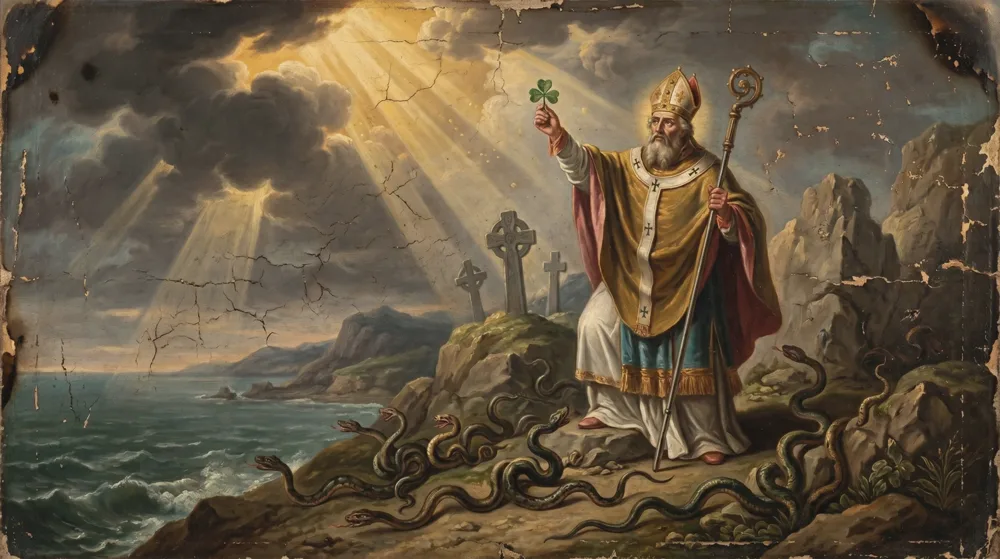
The novena to St Patrick is the nine-day prayer said to the Apostle of Ireland, asking the great missionary bishop to obtain for us the grace "to love God with my whole heart, to serve him with my whole strength, and to persevere in good purposes to the end." It is prayed most often for the faith of Ireland and of Irish families across the world, for perseverance in the faith he planted, and for any grace commended to the shepherd "who wouldst have laid down a thousand lives to save one soul."
The nine days are traditionally kept from 8 March through 16 March, the eve of his feast on 17 March, and below we give the full novena prayer, the famous Breastplate of St Patrick, and the life of the saint who converted a nation. If you are new to this form of prayer, see first our short guide to what is a novena.
The novena prayer to St Patrick
This is the heart of the devotion — the traditional novena prayer, said once on each of the nine days, with your intention named as you begin. It is the same prayer every day; what changes is the soul that says it, drawing nearer over nine days to the saint and to God.
Blessed Saint Patrick, glorious Apostle of Ireland, who didst become a friend and father to me for ages before my birth, hear my prayer and accept, for God, the sentiments of gratitude and veneration with which my heart is filled. Through thee I have inherited that faith which is dearer than life. I now make thee the representative of my thanks, and the mediator of my homage to Almighty God.
Most holy Father and patron of my country, despise not my weakness; remember that the cries of little children were the sounds that rose, like a mysterious voice from heaven, and invited thee to come amongst us. Listen, then, to my humble supplication; may my prayer ascend to the throne of God, with the praises and blessings which shall ever sanctify thy name and thy memory. May my hope be animated by the patronage and intercession of our forefathers, who now enjoy eternal bliss and owe their salvation, under God, to thy courage and charity.
Obtain for me grace to love God with my whole heart, to serve him with my whole strength, and to persevere in good purposes to the end. O faithful shepherd of the Irish flock, who wouldst have laid down a thousand lives to save one soul, take my soul, and the souls of my countrymen, under thy special care. Be a father to the Church of Ireland and her faithful people. Grant that all hearts may share the blessed fruits of that Gospel thou didst plant and water.
Grant that, as our ancestors of old had learned, under thy guidance, to unite science with virtue, we too may learn, under thy patronage, to consecrate all Christian duty to the glory of God. I commend to thee my native land, which was so dear to thee while on earth. Protect it still, and, above all, direct its chief pastors, particularly those who teach us. Give them grace to walk in thy footsteps, to nurture the flock with the word of life and the bread of salvation, and to lead the heirs of the Saints thou hast formed to the possession of that glory which they, with thee, enjoy in the kingdom of the Blessed: through Christ Jesus, our Lord. Amen.
V. Pray for us, O glorious Saint Patrick.
R. And obtain for us the intention of this novena.
Name your intention here, and close with the Our Father, Hail Mary, and Glory Be. Many join to it the Breastplate below, and end the nine days with the Litany of the Saints, in which the Church calls upon the whole company of heaven with Patrick among them.
St Patrick's Breastplate (the Lorica)
The great prayer attributed to St Patrick himself is the Breastplate, or Lorica — the "armour" prayer he is said to have sung as he went to preach before the pagan kings of Ireland. It is not part of the nine-day novena strictly speaking, but it is the saint's own prayer, and countless souls add it to the novena because nothing better expresses his faith in the Blessed Trinity. Its opening binds the soul to God:
I arise today
Through a mighty strength, the invocation of the Trinity,
Through belief in the Threeness,
Through confession of the Oneness
of the Creator of creation.
And its most beloved passage wraps Christ around the one who prays it on every side:
Christ with me, Christ before me, Christ behind me,
Christ in me, Christ beneath me, Christ above me,
Christ on my right, Christ on my left,
Christ when I lie down, Christ when I sit down, Christ when I arise,
Christ in the heart of every man who thinks of me,
Christ in the mouth of everyone who speaks of me,
Christ in every eye that sees me,
Christ in every ear that hears me.
Because the Breastplate is a hymn to the Holy Trinity — the very mystery St Patrick taught the Irish with the three-leaved shamrock — it makes a fitting daily companion to the novena. For that central mystery, see the Holy Trinity.
Variants of the novena
A short novena prayer to St Patrick
If time is short, the novena may be kept in its briefest form: on each of the nine days, ask simply, St Patrick, obtain for me grace to love God with my whole heart, to serve him with my whole strength, and to persevere in good purposes to the end, name your intention, and close with Pray for us, O glorious St Patrick, and obtain for us the intention of this novena. An Our Father, Hail Mary, and Glory Be complete the day. The full prayer above is better where you can give it the time, but the Church has never measured a novena by its length.
The novena for a particular intention
The novena to St Patrick carries any need a soul rightly brings to God, but it is prayed above all for the faith — for a lapsed child or friend to return, for the conversion of a household or a country, for perseverance in trials, for missionaries and the spread of the Gospel, and for the Church in Ireland and among the Irish everywhere. Name your intention plainly at the start of the prayer, and add it again at the versicle: and obtain for us the intention of this novena.
The novena to St Patrick of Ireland — nine days before the feast
The proper time to pray the 9-day novena to St Patrick is the nine days ending on his feast: 8 March through 16 March, so that the last day falls on the eve of 17 March, St Patrick's Day. This is how most parishes and confraternities keep it, though the novena is fruitful whenever a real need calls for it. Nine days, one intention, the same prayer each day — that steadiness is the whole discipline of a novena.
Is there a PDF of the St Patrick novena?
The complete text you would print onto a St Patrick novena PDF is exactly what is given above — the daily prayer, the versicle and response, and the Breastplate — said once a day for nine days with your intention named. You may copy the prayer to keep beside you, or pray the whole devotion from your phone: the Iter Fidei app carries it in full, in Latin and your own language, with audio and a reminder for each of the nine days.
How to pray this novena
A novena to St Patrick is prayed simply and steadily. Choose your nine days — the classic run is 8 to 16 March, closing on his feast, but any nine consecutive days will serve. Pray at a fixed hour each day so the devotion does not slip. Begin by naming your intention, say the novena prayer above (adding the Breastplate if you wish), and close with the Our Father, Hail Mary, and Glory Be.
Where you can, join the novena to Holy Mass and Communion, or to a decade of the Rosary. Above all, ask in submission to God's will: a novena does not bend God to us; it commends our need to a saint who will obtain what is truly best. Pray it, as St Patrick prayed on the mountain of his captivity, "in snow and frost and rain," with a spirit fervent within.
Who is St Patrick? The Apostle of Ireland
St Patrick (c. 389 – c. 461) is the Apostle of Ireland and, with St Brigid and St Columba, one of its three patron saints. Butler's Lives of the Saints opens his account with the observation that "the name of St Patrick is rendered illustrious by the lights of sanctity with which the Church of Ireland shone during many ages, and by the colonies of saints with which it peopled many foreign countries." He was of Romano-British birth; his father Calpurnius was a deacon and municipal official, his grandfather a priest, in the days before strict clerical celibacy in the West.
At about sixteen, Patrick — by his own account still living thoughtlessly, so that he "knew not the true God" — was carried off by raiders and sold into slavery among the pagan Irish. For six years he served as a herdsman, most likely on the slopes of Slemish in Antrim, and it was in that bondage that his soul was made. He tells us himself that "the love of God and His fear increased more and more, and my faith grew," so that "in a single day I said as many as a hundred prayers and at night nearly as many." Warned in a dream, he escaped, travelled two hundred miles to a waiting ship, and after an arduous journey was restored to his family.
But he could not stay. In the watches of the night he heard "the voices of those who dwelt beside the wood of Foclut," the Irish crying with one mouth, "We beseech thee, holy youth, to come and walk among us once more." He prepared for the work with years of study in Gaul — on the island of Lérins and under St Germanus at Auxerre — and, tradition holds, was sent on his mission and consecrated bishop with the blessing of Rome.
Returning to the land of his captivity, he preached the Gospel to its kings and people, is honoured as Archbishop of Armagh, and by his courage and charity brought a whole nation to the faith. He is famous for teaching the mystery of the Holy Trinity by the three leaves of a single shamrock. He died about the year 461, and his feast is kept on 17 March, the day of his death.
Patrick is invoked as the patron of Ireland and of the Irish throughout the world, against evils of body and soul, and as the model of the missionary who spends himself utterly for souls. Because he is so mighty an apostle, his novena stands beside those of the Church's other great evangelists — see, for instance, the novena to St Francis Xavier, the Apostle of the Indies. For the fuller life and prayers of the saint, see St Patrick.
Frequently Asked Questions
When do you pray the novena to St Patrick?
The novena is traditionally prayed on the nine days leading to his feast: 8 March through 16 March, so that it closes on the eve of St Patrick's Day, 17 March. That said, a novena to St Patrick may be prayed at any time a real need calls for his intercession — the nine days before the feast are the custom, not a rule.
How many days is the St Patrick novena?
Nine. The word novena comes from the Latin novem, "nine," and recalls the nine days the Apostles and Our Lady spent in prayer between the Ascension and Pentecost. You say the same prayer once on each of the nine consecutive days, naming one intention throughout.
What is St Patrick the patron saint of?
St Patrick is the principal patron of Ireland and of the Irish people wherever they have settled. He is invoked as the Apostle of Ireland, the patron of the faith he planted there, and a protector against evils of body and soul. He is honoured together with St Brigid and St Columba as one of the three patrons of Ireland.
What is St Patrick's Breastplate?
The Breastplate, or Lorica, is the great prayer attributed to St Patrick — a hymn of protection which he is said to have sung on his way to preach before the pagan kings. It binds the soul to the strength of the Holy Trinity and wraps Christ around the one who prays it: Christ with me, Christ before me, Christ behind me. Many pray it alongside the novena, since it is the saint's own prayer and a perfect confession of the Trinity he taught the Irish.
Why is St Patrick associated with the Trinity and the shamrock?
Because tradition holds that Patrick used the three-leaved shamrock — three leaves on one stem — to teach the Irish the mystery of the Blessed Trinity: three Persons in one God. His Breastplate begins with "the invocation of the Trinity, belief in the Threeness, confession of the Oneness." The devotion to St Patrick is therefore always a devotion to the Holy Trinity he preached.
How did St Patrick die, and when is his feast?
St Patrick died about the year 461, and the Church keeps his feast on 17 March, the day of his death — as with the saints generally, their feast is the day of their entry into heaven. His feast falls within Lent, which is why the novena that ends on it begins on 8 March.
Can I pray the novena for someone who has left the faith?
Yes — this is one of the most fitting of all intentions to bring to St Patrick, who spent his life bringing souls to God and would, in the novena's own words, "have laid down a thousand lives to save one soul." Name the person plainly, ask the Apostle of Ireland to obtain their return to the faith, and pray the nine days in trust, resigned to God's will and God's timing.
The Iter Fidei app carries the novenas, chaplets, and litanies — including the novena to St Patrick and his Breastplate — in Latin and your own language, with audio and a reminder for each of the nine days. Download it here.
Sources. The Confession of St Patrick (the saint's own words on his captivity, escape, and call); Alban Butler, Lives of the Saints, 17 March (St Patrick, Archbishop of Armagh, Apostle of Ireland); the traditional novena prayer to St Patrick (Blessed Saint Patrick, glorious Apostle of Ireland) and the Lorica or Breastplate of St Patrick, as carried in traditional Irish prayer-books; the feast of St Patrick, 17 March.