
Scripture
The Proverbs 31 Woman: Strength and Dignity in Catholic Tradition
The Douay-Rheims reads 'Strength and beauty are her clothing, and she shall laugh in the latter day' (Proverbs xxxi. 25). The valiant woman of Proverbs 31 — the traditional Catholic ideal: industrious, God-fearing, devoted to her household and the poor, whose true worth is the fear of the Lord.
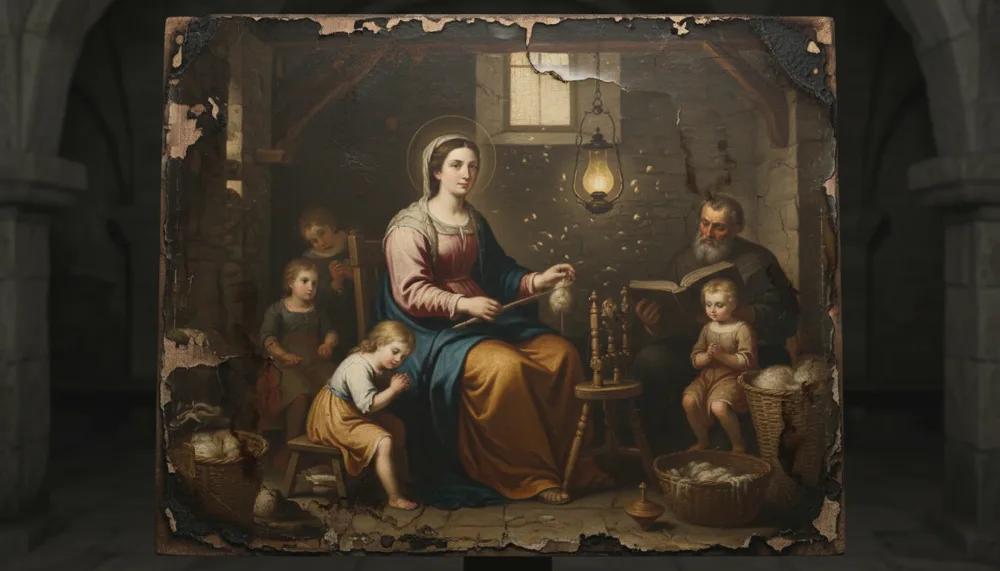
A Proverbs 31 woman is, in the traditional Catholic reading, the valiant woman — the wife and mother whose strength is industry and whose dignity is the fear of God. In the Douay-Rheims, the traditional Catholic English Bible drawn from the Latin Vulgate, the famous line of Proverbs 31:25 reads:
Strength and beauty are her clothing, and she shall laugh in the latter day. (Proverbs xxxi. 25)
The popular phrase "she is clothed with strength and dignity" is a paraphrase of this verse from later versions; the Douay text our tradition reads says strength and beauty are her clothing. The meaning is the same, and it is no slogan of self-assertion. The chapter is an acrostic poem on the mulier fortis, the valiant or strong woman, and the whole portrait is gathered up in its last lines: the woman that feareth the Lord, she shall be praised (Proverbs xxxi. 30). Her strength and dignity are real, but they are the fruit of charity, labour, and the fear of God — not of self-promotion.
What does Proverbs 31:25 mean?
Strength and beauty are her clothing, and she shall laugh in the latter day. The image is of a woman clothed — not in vanity, but in virtue. Strength here is the Latin fortitudo: the firmness of soul that bears burdens, governs a household, works with her hands, and does not give way under hardship. Beauty, set beside it, is the comeliness of an ordered life, not the cosmetic beauty the same chapter calls vain a few verses later.
The second half of the verse is the key the slogans drop: she shall laugh in the latter day. Her clothing of strength is not for display now; it is for the end. She can laugh at the latter day — at the future, at old age, at the day of judgment — because her life is built on something that will stand. This is the laughter of a soul without fear of what is coming, the opposite of the anxiety Scripture answers elsewhere when it bids us be anxious for nothing. Her confidence is not in herself but in God, whom she fears, and so the "strength and dignity" of Proverbs 31 is finally a strength against the day of reckoning — a quiet courage that looks at death and is not afraid.
What is the Proverbs 31 woman? The valiant woman of Scripture
The chapter opens not with a slogan but with a question: Who shall find a valiant woman? far and from the uttermost coasts is the price of her (Proverbs xxxi. 10). She is rare and precious, harder to find than far-fetched riches. What follows is a portrait drawn entirely from deeds. She hath sought wool and flax, and hath wrought by the counsel of her hands (Proverbs xxxi. 13). She hath risen in the night, and given a prey to her household, and victuals to her maidens (Proverbs xxxi. 15). She hath girded her loins with strength, and hath strengthened her arm (Proverbs xxxi. 17). She buys a field, plants a vineyard, weaves, sells, and provides — and her husband is honourable in the gates because of her (Proverbs xxxi. 23).
The traditional Catholic ideal of womanhood is in these lines, and it is sober. The valiant woman is industrious: she works, and her work is praised. She is devoted to her household: her first sphere is the home she governs and the children she feeds. And she does not stop at her own walls — She hath opened her hand to the needy, and stretched out her hands to the poor (Proverbs xxxi. 20). Strength turned outward becomes mercy. This is the same charity the Church names as the proof of true faith, for faith without works is dead; the valiant woman's faith is visible in her hands.
Proverbs 31 woman meaning: the fear of the Lord, not self-empowerment
The whole portrait turns on its conclusion, and the conclusion overturns every reading that stops at strength:
Favour is deceitful, and beauty is vain: the woman that feareth the Lord, she shall be praised. (Proverbs xxxi. 30)
Scripture itself tells us not to rest in the surface. Favour is deceitful, and beauty is vain — charm passes, and good looks deceive. What endures, and what earns praise, is one thing: that she feareth the Lord. This is the heart of the Proverbs 31 woman's meaning. Her strength and dignity are not self-generated; they flow from the fear of God, which the catechism of Pope Saint Pius X defines as the gift "which makes us respect God and fear to offend His divine Majesty, and which turns us away from evil by leading us to good." The valiant woman is strong because she fears God and is therefore turned away from evil and toward good in everything her hands do.
We say this charitably, because the verse has been pressed into service it cannot bear. Read as a banner of self-empowerment, "she is clothed with strength and dignity" becomes a slogan about a woman's confidence in herself — her ambition, her independence, her right to be admired. Read as mere sentiment, it becomes a greeting-card tribute to a busy mother. Both come from a real reverence for the passage, yet both quietly delete the line that orders the rest. Scripture does not praise her for her self-assurance or even for her industry as such. It praises her because she feareth the Lord. Strip that, and the strong, dignified woman of Proverbs 31 becomes the very figure the chapter warns against — clothed in a favour that is deceitful and a beauty that is vain.
Is Proverbs 31 a literal checklist for women?
The valiant woman is not a checklist every wife must complete to be approved. The Fathers read the chapter on two levels. Literally, she is the model of a holy wife and mother, to be imitated in spirit — diligence, mercy, modesty, the fear of God — not copied detail for detail across every age and station. Spiritually, they saw in the mulier fortis a figure of the Church herself, the Bride who labours, clothes her children, opens her hand to the poor, and fears the Lord. On either reading the point is one: the woman is valiant because she is faithful, and faithful because she fears God.
This is why the chapter belongs among the great Catholic Bible verses on the holy life and not among the maxims of self-help. Its closest kin is Trust in the Lord with all thy heart (Proverbs iii. 5), which we treat under trust in the Lord with all your heart. The valiant woman is the practical portrait of that trust: a whole life ordered by the fear of the Lord, which is the beginning of wisdom. To live it, a soul must set out on the spiritual life and learn how to love God above the favour and beauty that deceive.
Strength, dignity, and the Catholic vocation of woman
The valiant woman does not stand alone; she stands within the order the Church teaches for marriage and the home. The Catechism of the Council of Trent, expounding Saint Paul, sets out the mutual duties of husband and wife — the husband to love his wife as Christ loved the Church, the wife to love and respect her husband — an order of charity, not of contempt. The strength of Proverbs 31 is exercised within this order and dignifies it: her husband trusteth in her, and he shall have no need of spoils (Proverbs xxxi. 11). Her strength is not rivalry with him but the building-up of a common house.
And the supreme model of this valiant womanhood is not abstract. The Church has always read the mulier fortis with her eyes on the Blessed Virgin Mary, the woman of perfect strength and perfect humility, whose dignity is wholly from God. The strength and dignity of Proverbs 31 are seen in their fullness in her who said behold the handmaid of the Lord; on her place in the Faith, see why do Catholics pray to Mary.
The traditional reading therefore neither inflates the valiant woman into a self-made heroine nor empties her into a sentiment. It takes the chapter whole. Strength and beauty are her clothing, and she shall laugh in the latter day — because, and only because, she feareth the Lord. The strength is real and the dignity is real, and both are gifts: the harvest of a life of industry, mercy, and the fear of God, which alone shall be praised.
Frequently Asked Questions
What does "she is clothed with strength and dignity" mean?
It is a paraphrase of Proverbs xxxi. 25, which the Douay-Rheims renders Strength and beauty are her clothing, and she shall laugh in the latter day. The strength is fortitudo, the firmness of soul that bears burdens and governs a household; the dignity is the comeliness of an ordered life. Both are the fruit of charity and the fear of God, not of self-promotion.
Is the Proverbs 31 woman a literal checklist for wives?
No. The Fathers read the chapter on two levels: literally, the valiant woman is a model of a holy wife and mother to be imitated in spirit — diligence, mercy, modesty, the fear of God — not copied detail for detail across every age and station. Spiritually, the mulier fortis is a figure of the Church herself. On either reading she is valiant because she is faithful, and faithful because she fears the Lord.
Why does the chapter say beauty is vain?
Proverbs xxxi. 30 reads Favour is deceitful, and beauty is vain: the woman that feareth the Lord, she shall be praised. Scripture is warning that charm passes and good looks deceive; what endures is the fear of God. The verse orders the whole portrait, so that her strength and dignity are praised only because they flow from reverence for the Lord.
Who is the perfect model of the valiant woman?
The Church has always read the mulier fortis with her eyes on the Blessed Virgin Mary, the woman of perfect strength and perfect humility, whose dignity is wholly from God. The strength and dignity of Proverbs 31 are seen in their fullness in her who said behold the handmaid of the Lord.
The Iter Fidei app carries the Douay-Rheims Bible, the prayers, and the traditional Faith. Download it here.
Sources. Holy Scripture, Douay-Rheims version (Proverbs xxxi. 10-31, especially 10, 11, 13, 15, 17, 20, 23, 25, 30, 31; Proverbs iii. 5). Catechism of the Council of Trent (1566), on the Sacrament of Matrimony and the duties of husband and wife. Catechism of Saint Pius X (1908), on the gift of the Fear of God among the gifts of the Holy Ghost.