
The Faith
What Does God Say About Animals?
God made the animals good and gave them to man for his use and care (Genesis i). They have sensitive, mortal souls — not the rational, immortal souls of men. The traditional Catholic answer on whether animals go to heaven, whether animals have souls, and what the Bible says about God's creatures.
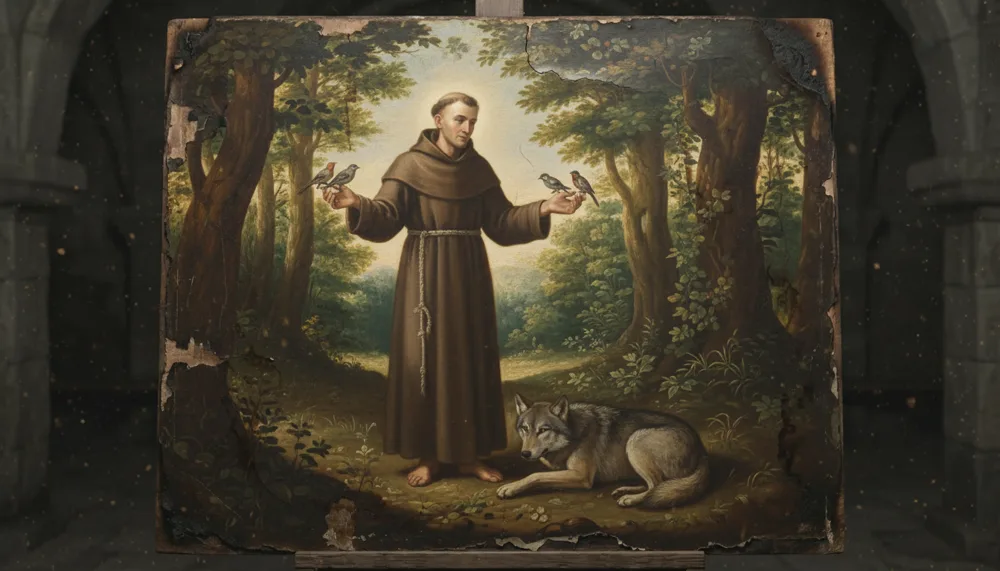
God says that the animals are His creatures, made good, and given to man for his use and his care (Genesis i. 26-31). They have life and sense — a sensitive, mortal soul — but not the rational, immortal soul that God breathed into man, who alone is made to His image (Genesis i. 27). So animals are neither little gods to be worshipped nor mere machines to be abused: they are good creatures entrusted to us, and we owe them the care God's own providence shows them.
What does the Bible say about animals?
The Bible opens with God making the beasts and calling them good. And God made the beasts of the earth according to their kinds, and cattle, and every thing that creepeth on the earth after its kind. And God saw that it was good (Genesis i. 25). The animals are not an accident and not an evil; they come from the hand of God and bear His judgment that they are good.
In the same chapter God gives them to man, and gives man rule over them. Let us make man to our image and likeness: and let him have dominion over the fishes of the sea, and the fowls of the air, and the beasts, and the whole earth (Genesis i. 26). This dominion is real. After the flood it is stated plainly: they are delivered into your hand (Genesis ix. 2). Man may keep beasts, work them, and eat them; Scripture nowhere forbids this, and the Law of Moses regulated the eating of animals rather than condemning it.
Yet the same Scripture forbids us to be cruel. The just regardeth the lives of his beasts: but the bowels of the wicked are cruel (Proverbs xii. 10). The Law ordered the ox not to be muzzled as it treads out the corn (Deuteronomy xxv. 4). Dominion is not licence; it is a stewardship under God, who Himself feeds what He has made.
Does God care about animals?
He does. Our Lord makes the point unforgettable: Are not two sparrows sold for a farthing? and not one of them shall fall on the ground without your Father (Matthew x. 29). Even the cheapest bird is within the Father's providence. And He uses this very care to teach us our own worth before correcting any sentimentality: Fear not therefore: better are you than many sparrows (Matthew x. 31). God numbers the sparrows — and ranks us above them.
The Psalms sing the same providence over the whole animal creation. God giveth to beasts their food: and to the young ravens that call upon him (Psalm cxlvi. 9); the beasts all expect of thee that thou give them food in season (Psalm ciii. 27). So when we ask what does God say about us and our place in His world, the answer is set within a wider goodness: the God who feeds the ravens cares, in His order, for every creature He has made. To care for animals is therefore not weakness but an imitation of God's own providence.
Do animals have souls?
Yes — but not the kind of soul man has, and the whole Catholic answer turns on this distinction. In traditional theology a soul is simply the principle of life in a living thing, and the Church, following Saint Thomas Aquinas and Aristotle before him, teaches three grades. Plants have a vegetative soul (growth and nourishment). Animals have a sensitive soul, which adds sense, appetite, and movement: a beast sees, feels pain, seeks food, fears, and remembers. Man has a rational soul, which adds intellect and free will — the power to know truth, to love God, and to choose.
The decisive difference is that the animal's sensitive soul is material and mortal: it is bound up with the body and perishes with it. Man's soul is spiritual and immortal. The catechism of Pope Saint Pius X says it exactly: man is made to God's image "because the human soul is spiritual and reasonable, free in its acts, capable of knowing and loving God and of enjoying Him eternally." No beast knows God, prays, sins, or is called to eternal life. This is why the Fifth Commandment guards human life as it does not guard animal life, and why the malice of murder has no parallel in the killing of a beast — a distinction we draw out under the Ten Commandments. The animal has a soul; it does not have an immortal soul.
Do animals go to heaven?
The traditional Catholic answer is sober, and we give it plainly because charity does not lie to the grieving. Heaven, properly speaking, is the beatific vision — the direct sight and possession of God, the everlasting joy for which the rational soul was made. A beast cannot possess what it can never know: having no intellect and no immortal soul, the brute animal is not the subject of the beatific vision, and at death its sensitive soul ceases to be. So we cannot promise that a particular pet now sees God as the saints do. To teach otherwise would be to flatter sorrow rather than console it, and to soften doctrine into sentiment.
This is firm; it is not harsh, and it is not the whole of what God reveals. Scripture also promises a renewal of all things. For behold I create new heavens, and a new earth (Isaias lxv. 17); Saint Paul writes that the creature also itself shall be delivered from the servitude of corruption (Romans viii. 21), and Saint John sees a new heaven and a new earth (Apocalypse xxi. 1). What that restored creation will hold, He has not told us in detail, and we will not invent an answer He has withheld. The renewal of all things is left to His wisdom and His goodness — the same goodness that called the beasts good in the beginning and lets not one sparrow fall without Him.
Stewardship, not sentimentality
Two errors press on this topic from opposite sides, and we correct both. The first treats animals as nothing — things to be used carelessly or made to suffer for sport. Scripture condemns this: the bowels of the wicked are cruel (Proverbs xii. 10), and cruelty hardens the soul and offends the God whose creatures we abuse. The second error treats animals as everything — sets them in the place of human beings, or lets love of beasts crowd out love of God and neighbour. This too Scripture answers: better are you than many sparrows (Matthew x. 31). A man owes his soul, his family, and the poor a care he can never owe a pet, for faith without works is dead and those works are first owed to persons.
The Catholic mean is stewardship. The animals are good, they are God's, and they are ours to govern with mercy and use with gratitude — never to worship, never to abuse. Kindness to a beast belongs to the ordered charity of spiritual combat, where every love is set in its right place under the love of God. To learn that order is part of what Catholics believe: that one God made all things, ranked them wisely, and gave to man alone, of all the living things of earth, a soul that does not die.
So what does God say about animals? That they are good, that He feeds them, that He gave them to us — and that He gave to us, and not to them, the destiny of seeing Him for ever. We hold that whole teaching together: tender toward the creatures, firm about the truth, and content to leave the rest to the wisdom of God. For the wider answer to the "what does God say about" questions, see our hub on what God says and the great Catholic Bible verses that ground it.
Frequently Asked Questions
What does God say about eating animals?
God permits it. After the flood He told Noe of the beasts, they are delivered into your hand. And every thing that moveth and liveth shall be meat for you (Genesis ix. 2-3). The Law of Moses regulated which animals the Israelites might eat rather than condemning the eating of flesh, and our Lord declared all foods clean (Mark vii. 19). We may eat animals with gratitude, killing them without cruelty.
What does God say about killing animals?
Scripture nowhere forbids the lawful killing of animals for food, work, or need; God Himself clothed Adam and Eve in skins (Genesis iii. 21) and delivered the beasts into man's hand. But this dominion is not licence: the just regardeth the lives of his beasts, but the bowels of the wicked are cruel (Proverbs xii. 10). The malice of murder has no parallel in the killing of a beast, for the Fifth Commandment guards human life as it does not guard animal life — yet wanton cruelty to a creature still hardens the soul and offends its Maker.
What does God say about animals in heaven?
Heaven, properly speaking, is the beatific vision — the direct sight of God for which the rational soul was made. A beast has only a sensitive, mortal soul, which perishes with the body, so it cannot possess what it could never know, and we may not promise that a particular pet now sees God as the saints do. Yet Scripture promises a renewal of all things — behold I create new heavens, and a new earth (Isaias lxv. 17) — and what that restored creation will hold we leave to the wisdom and goodness of God rather than invent an answer He has withheld.
The Iter Fidei app carries the Douay-Rheims Bible, the catechism, and the prayers. Get the app link by email here.
Sources. Holy Scripture, Douay-Rheims version (Genesis i. 25-27, 31; Genesis ix. 2; Deuteronomy xxv. 4; Proverbs xii. 10; Psalm ciii. 27; Psalm cxlvi. 9; Isaias lxv. 17; Matthew x. 29, 31; Romans viii. 21; Apocalypse xxi. 1). Catechism of Saint Pius X (1908), on the creation of man and the spiritual, immortal soul made to the image of God. Saint Thomas Aquinas, Summa Theologiae I, qq. 75-78, on the grades of soul (vegetative, sensitive, rational) and on the corruptibility of the souls of brute animals.