
Prayer
Catholic Prayers: The Essential Traditional Prayers
The essential Catholic prayers every Catholic should know — the Our Father, Hail Mary, Glory Be, the Creed, and an Act of Contrition — with daily, morning, night, healing, and prayers for the dead, each linked in full.
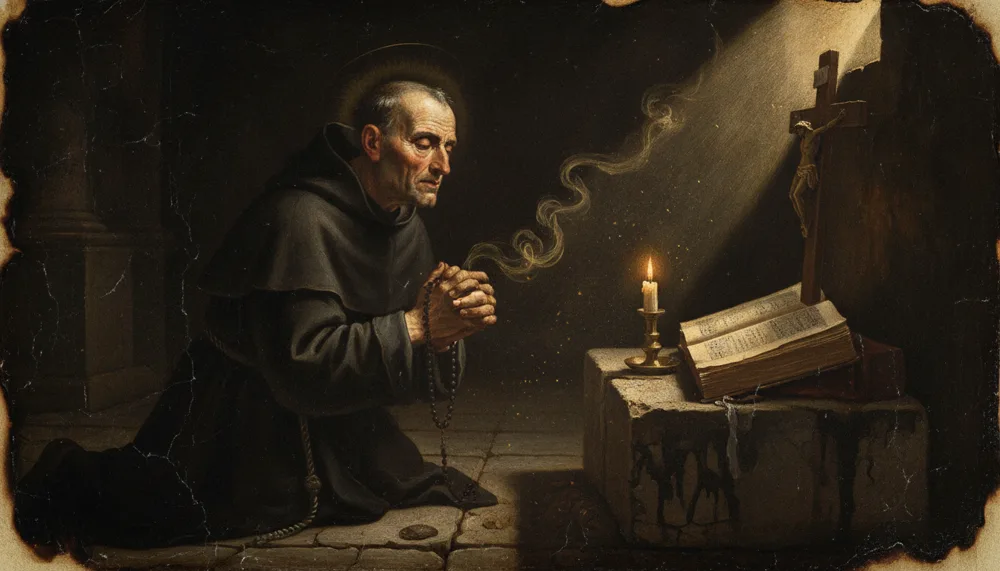
The essential Catholic prayers every Catholic should know by heart are the Our Father, the Hail Mary, the Glory Be, the Apostles' Creed, and an Act of Contrition — the prayers the Church has handed down for generations and teaches her children first. Around these stand the daily prayers of the Christian life: the Morning Offering to begin the day, prayers at night before sleep, the Rosary, prayers for the sick and for the dead. This page gathers the traditional Catholic prayers in one place and sends you to each in full.
Prayer itself, the Catechism of St Pius X teaches:
Prayer is a raising of the mind to God to adore Him, to thank Him, and to ask of Him what we need.
It is divided into mental prayer, made with the mind alone, and vocal prayer, "made with words accompanied by the attention of the mind and the devotion of the heart." The prayers below are vocal prayers — the fixed words the Church puts on our lips so that, even when we do not know how to pray, we may still pray well.
The essential prayers every Catholic should know
These are the bedrock. A Catholic learns them as a child and carries them to the grave. Every prayer begins and ends with the Sign of the Cross, the first prayer a child is taught. The Lord's Prayer — the Our Father — is the prayer Christ Himself taught, "the most excellent of all prayers," containing in seven petitions everything we may rightly ask of God. The Hail Mary joins the angel's greeting — Hail Mary, full of grace — and Elizabeth's words to the Church's own petition, pray for us sinners; it is the prayer of the Rosary, repeated more than any other. The Glory Be — the Gloria Patri — is the Church's short doxology, praising the Holy Trinity and closing nearly every decade, psalm, and devotion. The Apostles' Creed is not a petition but a confession: the twelve articles of the faith, the whole of what we believe gathered into one prayer; the Nicene Creed sung at Mass professes the same faith at greater length. And the Act of Contrition is the prayer of the sorrowing sinner, said in confession and every night, by which we tell God we are sorry for having offended Him. Learn these and you possess the heart of Catholic prayer.
Catholic morning prayers: the Morning Offering
The day belongs to God before it belongs to us. The Church counsels that "it is good to pray morning and evening and at the beginning of the important actions of the day," and the morning prayer that gathers the whole day into a single act is the Morning Offering. By it we offer God our prayers, works, joys, and sufferings of the coming day, uniting them to the sacrifice of the Mass offered everywhere on earth. A morning rule may add the sign of the cross on waking, a few words of thanks for the night's rest, an Our Father, a Hail Mary, and the prayer to one's Guardian Angel, who watches over us through the day.
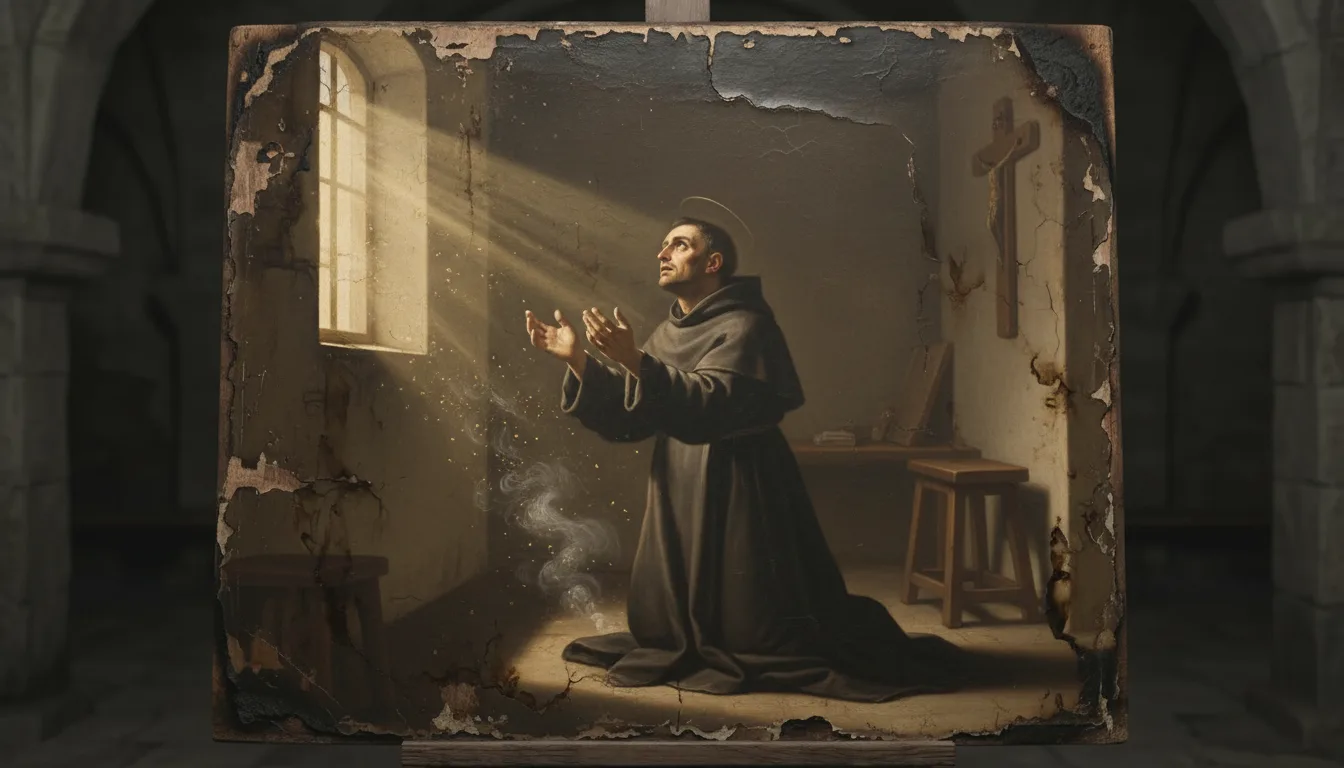
Catholic night and evening prayers
As we offer the morning, so we close the night. Evening prayer is the time to thank God for the day, to make an examination of conscience, and to ask pardon for the day's faults before sleep — which is why the Act of Contrition belongs above all to the night. We commend ourselves again to our Guardian Angel for protection through the dark hours, and many add the Prayer to St Michael against the enemy, and a closing Hail Mary or the Hail Holy Queen, the great evening antiphon of Our Lady. Before sleep many also commit the soul to Christ with the Anima Christi, the prayer St Ignatius set at the head of his Exercises:
Soul of Christ, sanctify me. Body of Christ, save me. Blood of Christ, inebriate me.
Sleep is a small death, and the Christian lies down each night as one ready, if God wills, not to wake on earth.
Daily Catholic prayers
Beyond morning and night, the Church marks the whole day with prayer. The Angelus is prayed at morning, noon, and evening — at the sound of the bell — recalling the Incarnation three times a day. Grace before and after meals sanctifies our food. The Rosary is the great daily devotion of the Catholic home. And short aspirations — the Memorare to Our Lady in any need, a Glory Be, an act of love — may be said at any moment, raising the mind to God amid work. Daily Catholic prayer is not a burden of many words but a rhythm: the day begun, broken, and ended in God.
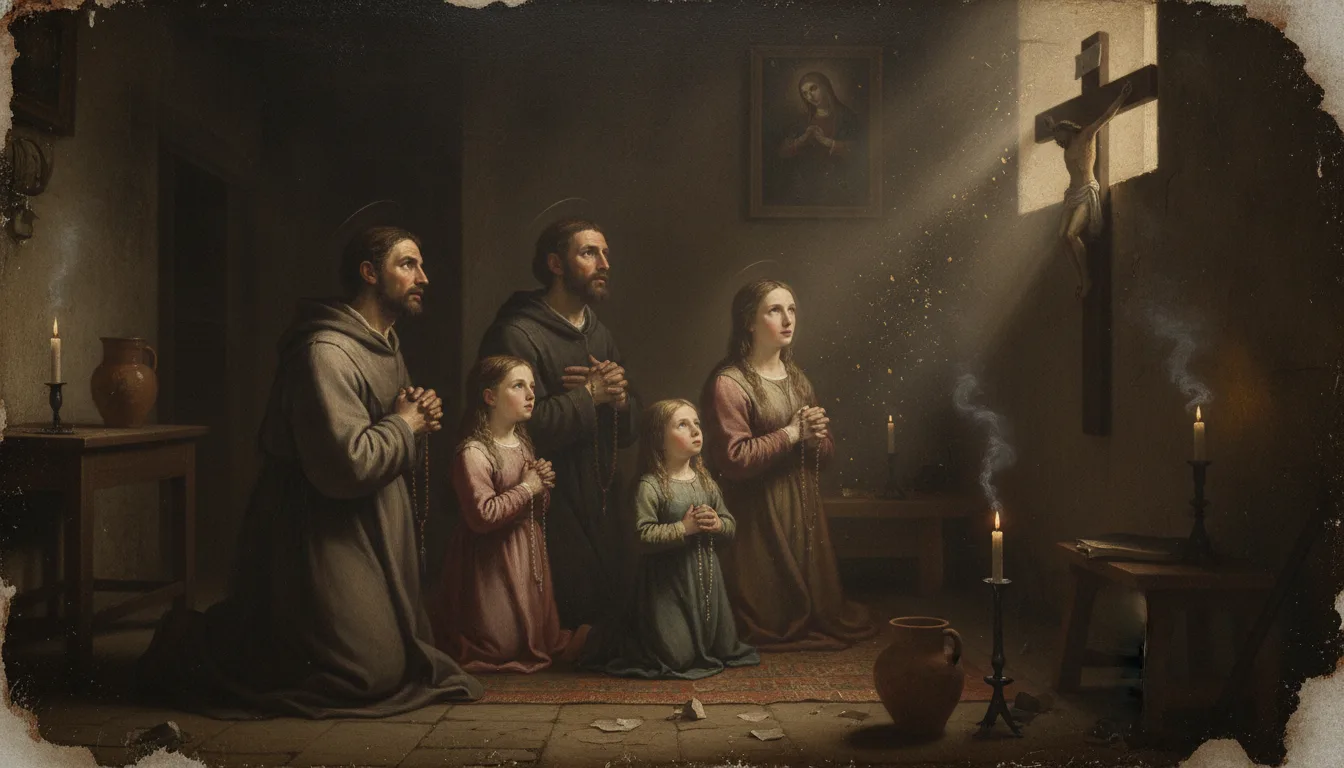
Catholic prayers for healing and the sick
When sickness comes, the Christian turns first to God, the giver of life and health. The Church does not promise that every prayer for the body will be granted as we wish, for God "always hears prayers well made, but in the manner that He knows to be most useful for our eternal salvation." We pray with confidence and with resignation to His will. For the sick we invoke the saints heaven has given as patrons of healing — St Peregrine for cancer, St Raphael the Archangel whose name means God heals, St Rita and the Prayer to St Jude in desperate and hopeless cases — and above all we ask the Blessed Virgin, Our Lady of Lourdes, health of the sick. The Memorare is the prayer of those who have nowhere else to turn:
Never was it known that anyone who fled to thy protection, implored thy help, or sought thy intercession, was left unaided.
The greatest help for the gravely ill remains the sacrament of Anointing, and the prayers of the Church around the sick-bed.
Catholic prayers for the dead and the dying
To pray for the dead is one of the surest acts of charity a Christian can perform. The souls in purgatory can no longer help themselves; their time of meriting ended at death, and they wait, being purified, for the vision of God. We who are still in the fight can offer for them. The short prayer always within reach is Eternal Rest:
Eternal rest grant unto them, O Lord, and let perpetual light shine upon them. May they rest in peace.
The old Catholic habit was, at the sound of a passing bell, to say "a De profundis or a Requiem for the soul of the deceased" — the De profundis being Psalm 129, the great penitential cry out of the depths for the departed. We are bound to pray, the Catechism teaches, "for the holy souls in purgatory," especially through November and on All Souls' Day — the Litany of the Poor Souls in Purgatory and a Novena for the Dead are the Church's longer forms of this charity. For the dying, the Church asks the grace of final perseverance and a holy death, and commends the soul to Mary, now and at the hour of our death.
The Rosary
The Rosary is the prayer most bound up with the Catholic people — Our Lady's own psalter, in which we contemplate the mysteries of the life, death, and glory of Christ while our lips repeat the Hail Mary. We have set out how to pray the Rosary step by step, from the sign of the cross to the closing Hail Holy Queen, explained the parts of a Rosary, and we treat the mysteries of the Rosary — the Joyful, the Sorrowful, and the Glorious — by which the Rosary becomes a school of the whole Gospel. It is the daily prayer the saints urged above all others for the home and the family.
Prayers at Mass and Eucharistic devotions
The highest prayer of the Church is the Holy Sacrifice of the Mass, the offering of Christ Himself. No private prayer equals it, and the faithful unite their own prayers to the priest's at the altar. Beyond the Mass, the Church keeps the Blessed Sacrament for adoration, and Eucharistic Adoration is among the most fruitful of devotions — to kneel before Our Lord truly present. Bound to this is the practice of the First Fridays, the devotion to the Sacred Heart with its promise to those who receive Communion on the first Friday of nine consecutive months.
Catholic Mass prayers and responses
At Mass the people are not silent spectators but answer the priest, and the chief Mass prayers and responses are worth knowing by heart:
The Lord be with you (Dominus vobiscum). — And with thy spirit (Et cum spiritu tuo).
At the Gospel: Glory be to Thee, O Lord. — And after it: Praise be to Thee, O Christ.
Lift up your hearts. — We have lifted them up unto the Lord.
Let us give thanks to the Lord our God. — It is meet and just.
The great fixed prayers of the Mass are the Confiteor (the confession of sin at the foot of the altar), the Gloria (Glory to God in the highest), the Nicene Creed, the Sanctus (Holy, Holy, Holy), the Agnus Dei (Lamb of God), and the Domine, non sum dignus (Lord, I am not worthy) said three times before Communion. Knowing these prayers of the Catholic Mass lets the faithful pray with the Church and not merely beside her.
Prayers to the saints
The Catholic does not pray alone but in the Communion of Saints, asking those already crowned in heaven to pray with him and for him. Each saint has his patronage, and the Church has handed down a prayer for every need. The Prayer to St Joseph invokes the patron of the universal Church, of fathers, of workers, and of a happy death; the Prayer to St Anthony of Padua is the prayer for what is lost — St Anthony, St Anthony, please come around — and for the recovery of grace lost by sin. To these the faithful add patrons of their state and trouble, and turn often to the lives of the saints for companions on the road. The fuller forms of saintly intercession are the novena, nine days of prayer for a grace, and the chaplet, a set of beads counting fixed prayers — both gathered with the Church's other Catholic devotions on their own pages.
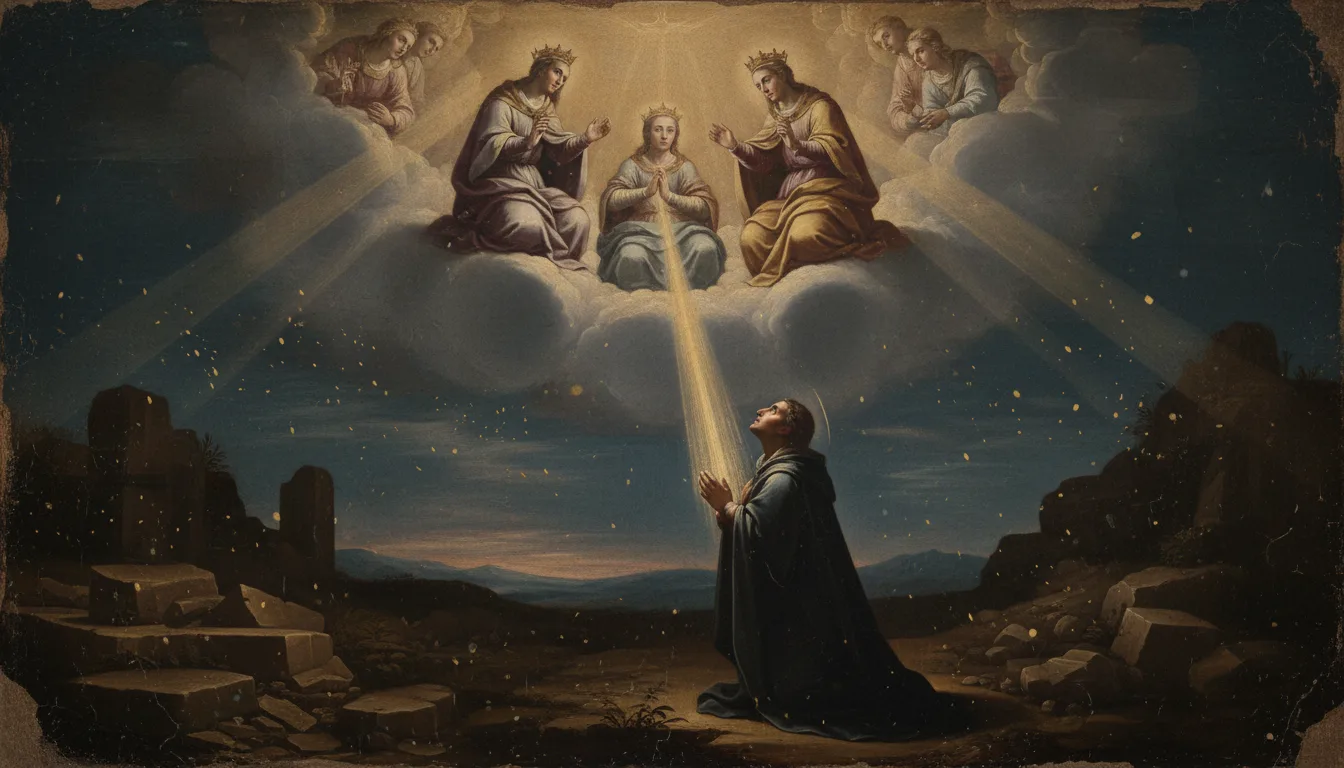
Chaplets, novenas, and devotions
Beyond the fixed prayers, the Church offers her people countless Catholic devotions — pious exercises that nourish the spirit between Mass and Mass. A chaplet is a prayer counted on beads, like the Rosary in form: the Divine Mercy Chaplet, the Chaplet of St Michael, the Chaplet of the Sacred Heart, and many more are treated in full. A novena is nine days of prayer for a particular grace — the Novena to St Joseph, the Novena to St Michael, the Pentecost Novena the Apostles themselves first kept, and others for every need. Among the great formula-prayers of the Church are also the Magnificat, Our Lady's own canticle; the Te Deum of thanksgiving; the Veni Creator to the Holy Ghost; the Divine Praises said at Benediction; and a constant turning to the Holy Name of Jesus, the name at which every knee shall bow.
Litanies
A litany is one of the oldest forms of prayer: a series of short invocations, each answered by the people — pray for us, have mercy on us. The mind is carried, name by name, into a single act of supplication. The Church has given a handful of Catholic litanies for public use — the Litany of the Blessed Virgin Mary (Loreto), the Litany of the Sacred Heart, the Litany of St Joseph, the Litany of the Saints, the Litany of the Holy Name of Jesus, and the Litany of Humility — each prayed for generations and treated in full on its own page.
Catholic prayers of thanksgiving and protection
Two needs return so often that the Church has given them settled forms. For thanksgiving — when a grace is received, a danger passed, a benefit granted — the great hymn is the Te Deum, sung in gratitude for every public mercy, and the short Deo gratias, Thanks be to God, on the lips at every turn; after meals the Church gives grace after meals, and Our Lady's own thanksgiving is the Magnificat, My soul doth magnify the Lord. The first Catholic prayer of thanksgiving, though, is the Mass itself, for Eucharist means thanksgiving. For protection — against the dangers of soul and body, and against the enemy — the Church puts on our lips the Prayer to St Michael, defend us in battle, the prayer to one's Guardian Angel, ever this day be at my side, and the St Patrick's Breastplate — Christ before me, Christ behind me — the ancient morning prayer of protection. Holy water, the Sign of the Cross, and a blessed medal or scapular are the Church's sacramentals that go with these prayers. We ask protection trusting not in formulas but in God, who alone keeps body and soul.
Catholic prayers in Latin
Latin is the Church's own tongue, and for centuries the faithful prayed the chief prayers in Latin the world over — the same words in Rome and in the missions. To learn the Catholic prayers in Latin is to pray with the whole Church across the ages: the Pater Noster (Our Father), the Ave Maria (Hail Mary), the Gloria Patri (Glory Be), the Credo (the Creed), the Confiteor, the Salve Regina (Hail Holy Queen), the Anima Christi, the Veni Creator, and the Te Deum. The Latin texts are not relics but living prayer; we give each in Latin alongside the English on its own page, with the pronunciation, so that the Rosary and the responses at Mass may be prayed in the Church's own voice.
Catholic prayers in Spanish and other languages
The Church prays in every tongue. For Spanish-speaking households the same traditional prayers are handed down word for word — the Padre Nuestro (Our Father), the Ave María (Hail Mary), the Gloria (Glory Be), the Credo, and the Acto de Contrición — and the Rosary, el Santo Rosario, is among the most beloved devotions of the Spanish-speaking world. We carry these Catholic prayers in Spanish, and in seven languages besides, each set beside the Latin and the English. A prayer does not change when its language changes; the Church's one faith is prayed in many tongues, and the family that prays together prays best in its own.
A Catholic book of prayers: what belongs in it
Catholics have long kept a book of prayers — the old name was a manual or prayer book, and before it the medieval Book of Hours — gathering in one place the prayers of the day and the year. What belongs in a good Catholic prayer book is, in order: the essential prayers (Sign of the Cross, Our Father, Hail Mary, Glory Be, Creed, Act of Contrition); the morning and night prayers; the Ordinary of the Mass with the responses; the Rosary and its mysteries; the chief litanies and devotions; prayers for confession and Communion; prayers for the sick and the dead; and the seasonal prayers of Advent, Lent, and Easter. This page, with the pages it links, is such a book gathered online — and the Iter Fidei app puts the same collection in your pocket.
Seasonal prayers: Advent, Lent, Easter
The Church's prayer follows her calendar, and each season has its own note. In Advent we pray with longing for the coming of the Lord, the Angelus taking on the weight of the Incarnation we await. In Lent prayer joins fasting and almsgiving, and the penitential psalms — the De profundis among them — and the Stations of the Cross fill the season of repentance. At Easter the note turns to joy, the Regina Caeli of Our Lady replacing the Angelus through Paschaltide, and the alleluia returning to every prayer. To pray with the Church through her year is to let her seasons form the soul.
Why we pray, and how to pray well
Prayer is necessary, the Church teaches, and "we ought especially to pray in dangers, in temptations, and at the hour of death." But God "wills that we pray to Him, in order to acknowledge that it is He who gives all good things, to show Him our humble submission, and to merit His favours" — so prayer is for us, not for His information. The dispositions that make prayer fruitful are five: recollection, humility, confidence, perseverance, and resignation — to mean what we say, to know our nothingness, to trust we are heard, not to give up, and to leave the answer to God, "who knows better than we what is necessary for our eternal salvation." Pray these prayers, and pray them with these dispositions, and prayer will do its work: it "strengthens us in temptations, comforts us in tribulations, helps us in our needs, and obtains for us the grace of final perseverance."
Frequently Asked Questions
What are the basic Catholic prayers?
The basic Catholic prayers every Catholic should know by heart are the Sign of the Cross, the Our Father (the Lord's Prayer), the Hail Mary, the Glory Be, the Apostles' Creed, and an Act of Contrition. These are the prayers the Church teaches her children first and from which the Rosary and the daily prayers of the Christian life are built.
What are the Catholic morning prayers?
The chief Catholic morning prayer is the Morning Offering, by which we give God our prayers, works, joys, and sufferings of the coming day, uniting them to the Mass offered everywhere on earth. A morning rule may add the Sign of the Cross on waking, an Our Father and a Hail Mary, and the prayer to one's Guardian Angel.
What are the Catholic night prayers?
Evening or night prayer thanks God for the day, makes an examination of conscience, and asks pardon for the day's faults — which is why the Act of Contrition belongs above all to the night. Many add the Prayer to St Michael against the enemy, the Hail Holy Queen as the evening antiphon of Our Lady, and the Anima Christi before sleep.
What are the Catholic prayers for the dead?
The short prayer always within reach is Eternal Rest:
Eternal rest grant unto them, O Lord, and let perpetual light shine upon them.
The Church's longer forms of this charity are the Litany of the Poor Souls in Purgatory, a Novena for the Dead, and the De profundis (Psalm 129), prayed especially through November and on All Souls' Day.
What is the most powerful Catholic prayer?
The highest prayer of the Church is the Holy Sacrifice of the Mass, the offering of Christ Himself, which no private prayer equals. Among private prayers, the Rosary is the daily devotion the saints urged above all others, and the Memorare is the prayer of those who have nowhere else to turn:
Never was it known that anyone who fled to thy protection, implored thy help, or sought thy intercession, was left unaided.
What are the prayers and responses at Catholic Mass?
At Mass the people answer the priest:
The Lord be with you. — And with thy spirit.
At the Gospel: Glory be to Thee, O Lord. — Praise be to Thee, O Christ.
Lift up your hearts. — We have lifted them up unto the Lord.
The great fixed prayers of the Mass are the Confiteor, the Gloria, the Nicene Creed, the Sanctus, the Agnus Dei, and Domine, non sum dignus before Communion.
What are the Catholic prayers in Latin?
The chief Catholic prayers in Latin are the Pater Noster (Our Father), the Ave Maria (Hail Mary), the Gloria Patri (Glory Be), the Credo (Creed), the Confiteor, the Salve Regina (Hail Holy Queen), the Anima Christi, and the Te Deum. These are the words the whole Church prayed in common for centuries, and we give each in Latin beside the English on its own page.
Are there Catholic prayers in Spanish?
Yes. The same traditional prayers are handed down in Spanish — the Padre Nuestro (Our Father), Ave María (Hail Mary), Gloria (Glory Be), Credo (Creed), and Acto de Contrición — and the Holy Rosary, el Santo Rosario, is among the most beloved devotions of the Spanish-speaking world. A prayer does not change when its language changes; the Church's one faith is prayed in many tongues.
What is a Catholic prayer of thanksgiving?
The great Catholic prayer of thanksgiving is the Te Deum, sung in gratitude for every public mercy, together with the short Deo gratias (Thanks be to God) and Our Lady's Magnificat. The first thanksgiving of all is the Mass itself, for the word Eucharist means thanksgiving.
The Iter Fidei app carries these prayers, and the lives and prayers of the saints, in Latin and your own language, in your pocket — with audio to pray along — ready to download.
Sources. Catechism of St Pius X (1908), Part Two, Chapter 1, "Prayer in General" (the definition and division of prayer; the dispositions for praying well; when and for whom we ought to pray; the effects of prayer), and on the Pater Noster and on the pious exercises counselled (the De profundis and Requiem at the passing bell). Catechism of the Council of Trent (1566), on the Lord's Prayer as the most excellent of prayers, and on the fire of purgatory and the Communion of Saints. The traditional Catholic prayers and litanies as approved for public use, and the Roman liturgical books.