
The Sacraments
First Holy Communion: A Catholic Guide
First Holy Communion is a child's first reception of the Blessed Sacrament, at the age of reason, after a first Confession and in a state of grace.
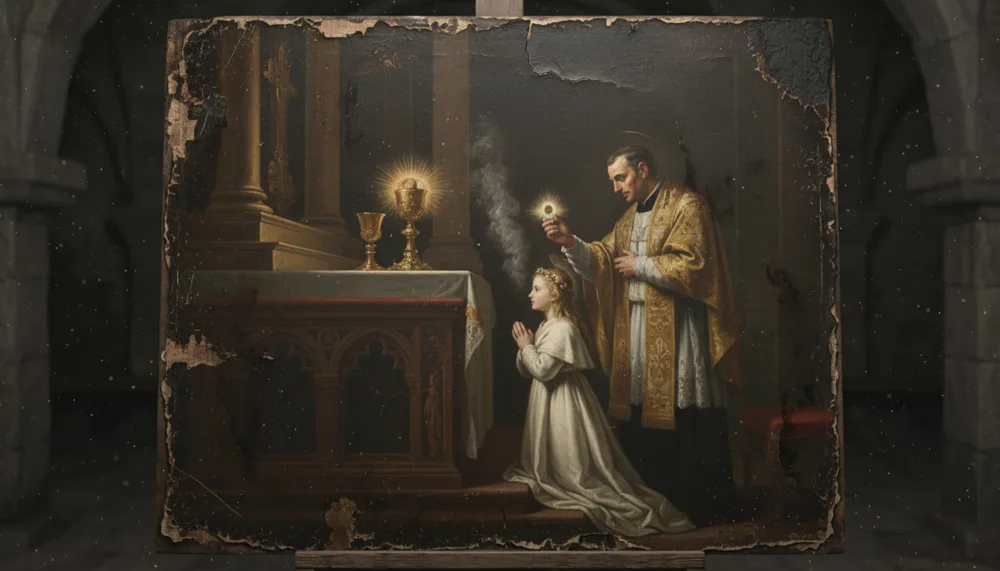
First Holy Communion is the day a child first receives the Body and Blood of Our Lord Jesus Christ in the Blessed Sacrament, having reached the age of reason and made a good first Confession. It is not a graduation or a family festivity but the soul's first reception of God Himself, and the Church requires that the child be in the state of grace and understand, however simply, that the Host is truly Christ.
What is First Holy Communion?
Holy Communion is the reception of the Eucharist, the sacrament that, by the change of the whole substance of the bread into the Body of Jesus Christ and of the wine into His Blood, contains "truly, really, and substantially the Body, the Blood, the Soul, and the Divinity of Jesus Christ Our Lord, under the species of bread and wine" (Catechism of St. Pius X, The Eucharist). The same Christ who is in heaven, and who was born of the Blessed Virgin, is received in this sacrament.
First Holy Communion is simply the first time a baptised child receives Him. Everything that is true of the Eucharist for the lifelong communicant is already true on that first day: the child does not receive bread, nor a symbol, but God. For the full doctrine of what is received, the Real Presence, and the change the Fathers and the Council of Trent call transubstantiation, see our article on the Eucharist. The present guide concerns the child's first reception: the age at which it is given, the preparation it requires, and the dispositions without which no one may approach the holy table.
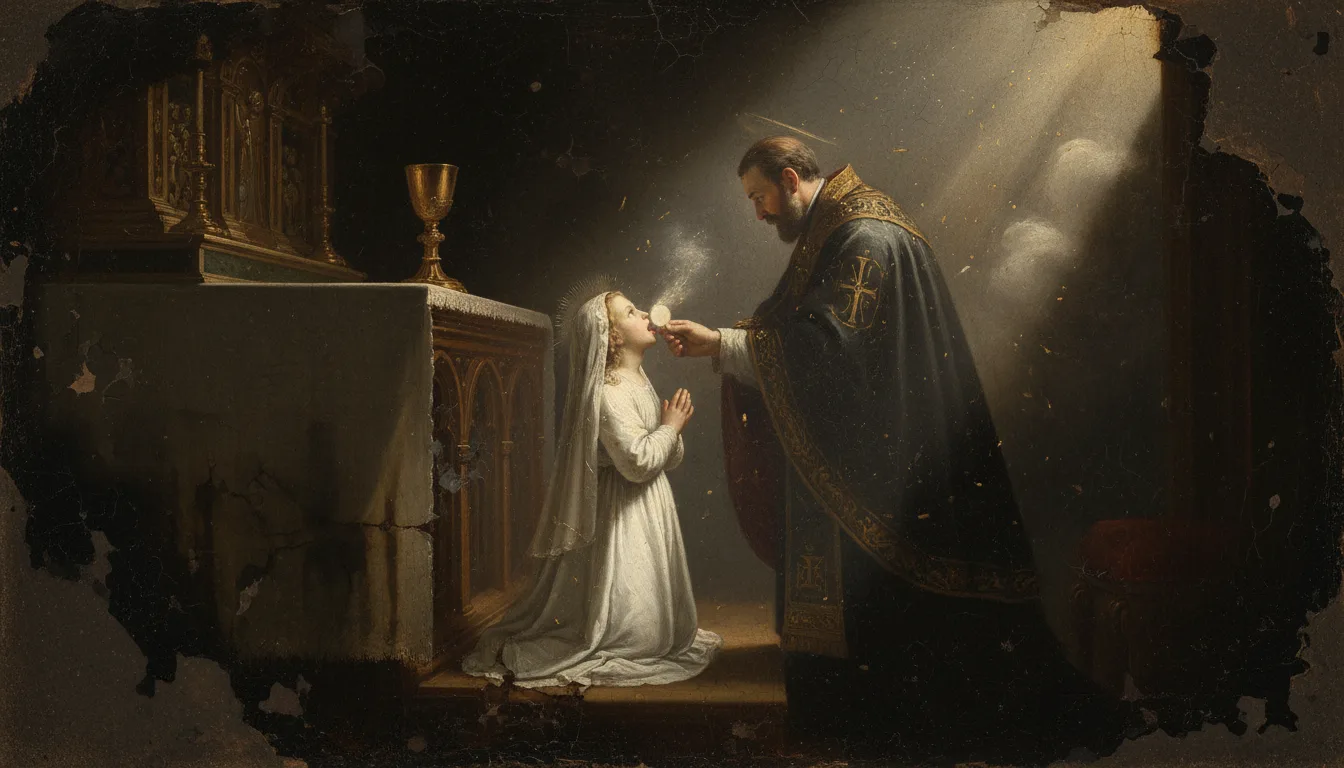
This is the third of the sacraments of Christian beginning. Baptism gives the life of grace; first Confession restores it where it has been lost; First Communion nourishes it. Later, Confirmation strengthens the soul to profess and defend the Faith, completing the sacraments of Christian initiation.
What is the age of reason for First Communion?
The Church does not give the Eucharist to infants. Those who have not yet the use of reason are excepted from the obligation to communicate "by reason of the weakness of their age," for "they are indeed incapable of discerning the Holy Eucharist from an ordinary and profane bread, and consequently of receiving it with the sentiments of religion and piety which it demandeth" (Roman Catechism of the Council of Trent, On the Communion of the Eucharist). Our Lord said in instituting the sacrament, "Take ye and eat" — words which suppose one able to take and to eat with understanding.
This age of reason, also called the age of discretion, is reached about the seventh year, though it is not measured by birthdays alone. The Catechism of Trent leaves the judgment to those who know the child:
As to the age at which the holy Mysteries ought to be given to children, no one can better determine it than their parents and the Priest to whom they confess their sins. To them it belongeth to examine and to question the children in order to know whether they have a sufficient knowledge of this admirable Sacrament, and whether they are capable of relishing its fruits.
The mark of that age is not cleverness but the dawn of moral and doctrinal reason: the child can tell right from wrong, knows he can offend God, and can grasp that the Host is not bread but Our Lord. The first communion age, then, is the age at which a child can approach "with the required dispositions" (Catechism of St. Pius X, The Precept of Communion) — ordinarily around seven.
First Confession comes first
A child who has reached the use of reason can sin, and therefore needs the sacrament that washes sin away. The Church obliges "all Christians who have come to the use of reason to approach the sacrament of Penance at least once a year" (Catechism of St. Pius X, The Precepts of the Church). For this reason, First Confession precedes First Communion.
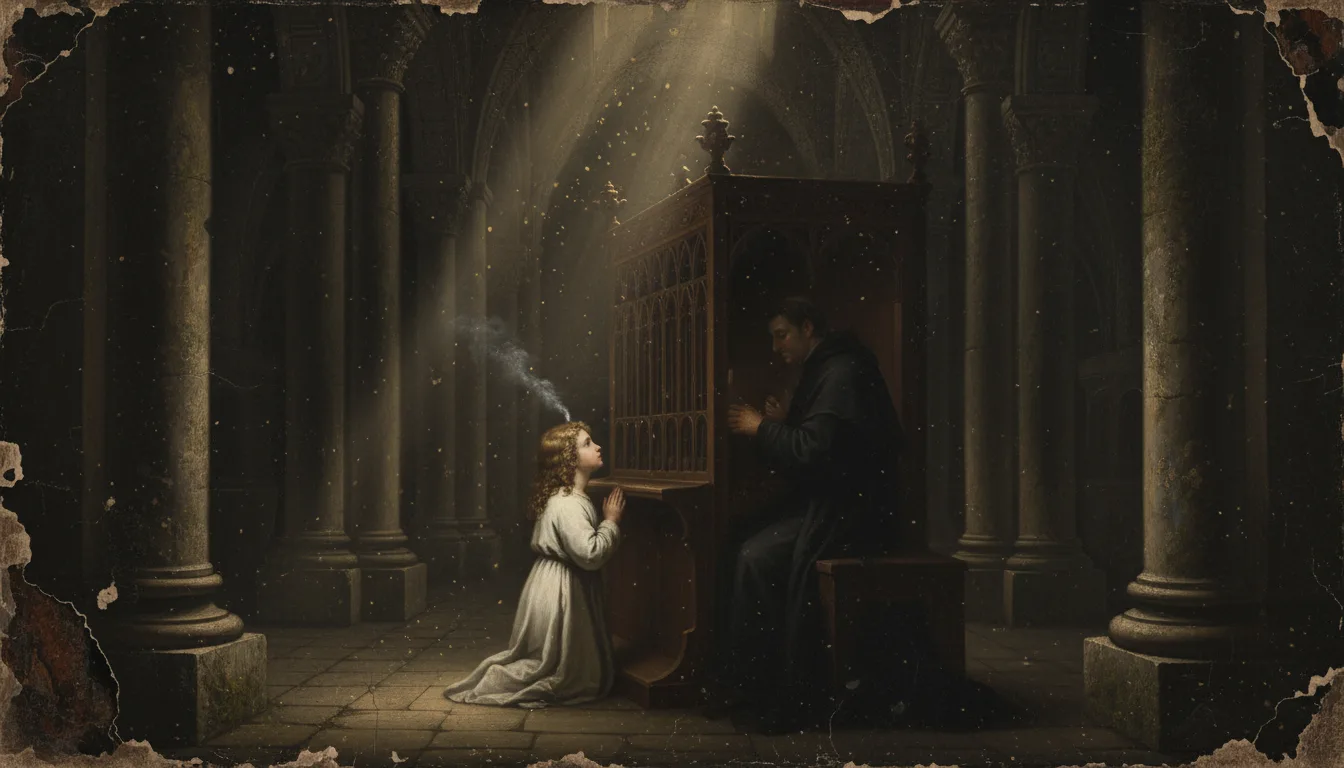
There is a graver reason still. No one in the state of mortal sin may receive Holy Communion, and the act of perfect contrition alone does not suffice for him: "the Church has established, out of reverence for this sacrament, that he who is guilty of mortal sin should not go to make holy Communion if he has not first confessed" (Catechism of St. Pius X, Dispositions necessary for communicating well). The child must therefore be taught to examine his conscience, to be sorry for his faults, and to confess them before he first approaches the altar. Our guide on how to go to Confession sets out the examination, contrition, and accusation a child must learn.
First Communion preparation
Preparation for First Communion is not the assembling of a celebration but the forming of a soul. Two things must be taught: what the child is about to receive, and how to receive it.
Knowing what is received
To communicate well one must "know what one is about to receive," which means "to know what Christian Doctrine teaches concerning this sacrament and to believe it firmly" (Catechism of St. Pius X, Dispositions necessary for communicating well). The first disposition the Roman Catechism names is "to discern this sacred table from profane tables, this heavenly Bread from ordinary bread," believing "firmly that the Eucharist containeth the true Body and the true Blood of the same God whom the Angels adore in heaven." A child ready for First Communion must be able to say, and to mean, that the Host is Jesus.
The state of grace and the dispositions
The Catechism of St. Pius X teaches that "in order to make a good Communion three things are necessary": to be in the state of grace, to be fasting, and to know what one is about to receive and approach with devotion. To be in the state of grace "is to have one's conscience pure of all mortal sin." This is why First Confession comes first, and why the warning is grave: "He who should communicate in the state of mortal sin would receive Jesus Christ, but he would not receive His grace; he would even commit a sacrilege."
The fast required is the natural fast, "broken by the least thing taken by way of meat or drink." And the child should be taught the brief preparation of the soul — "acts of faith, hope, charity, contrition, adoration, humility, and desire to receive Jesus Christ" — and the thanksgiving afterward, "remaining in recollection, honouring the presence of the Lord within us."
A word to parents
The obligation, and the fault if it is neglected, fall first on parents. The Catechism of St. Pius X warns that children of age to communicate who do not, through their own fault or through want of instruction, "certainly sin," and adds: "Their parents, or those who take their place, sin on their part if the delay of the Communion comes about through their fault, and they will have to render a great account thereof to God." To prepare a child for First Communion is therefore a duty, not a custom.
First Holy Communion classes and the course of preparation
A First Communion course, or the parish First Communion classes, exist for one purpose: to teach the child what he is about to receive and how to receive it worthily. They are not a graduation track but a catechesis. The matter to be learned is fixed, and a faithful catechism sets it out plainly: that the Eucharist is "truly, really, and substantially" the Body, Blood, Soul, and Divinity of Our Lord (Catechism of St. Pius X, The Eucharist); that one must be in the state of grace to receive Him; that mortal sin must first be confessed; and that the natural fast and a recollected, devout heart are required.
A child who can say and mean that the Host is Jesus, who can examine his conscience and be sorry for his sins, and who knows the acts of faith, hope, charity, and contrition, has the substance of the preparation. The course serves the child; the child is not made for the course.
Invitations to First Holy Communion
An invitation to a child's First Holy Communion rightly invites others to the Mass at which he will receive Our Lord, not merely to a party afterward. The day's centre is the altar, and the invitation does well to say so — naming the church, the date, and the hour of the Mass before any mention of a meal. A line of Scripture befits it: "Suffer the little children to come unto me" (Mark 10:14, Douay-Rheims), or the Lord's own words at the institution, "Take ye and eat" (cf. Matthew 26:26). Those invited are asked first of all to pray for the child on the morning he first approaches the holy table.
First Holy Communion cards and sayings
A First Communion card should keep before the soul what the day truly is: the first reception of Our Lord, not a graduation. Rather than bare congratulation, write a word of prayer and Scripture. Fitting sayings for a card include:
- "May Jesus, whom you receive today, dwell always in your heart."
- "Suffer the little children to come unto me" (Mark 10:14, Douay-Rheims).
- "He that eateth this bread shall live for ever" (John 6:59, Douay-Rheims).
- "Lord, I am not worthy that thou shouldst enter under my roof" (Matthew 8:8, Douay-Rheims) — the words the Church places on the communicant's lips before Communion.
A promise to pray for the child, and an encouragement to keep the state of grace and to communicate often, is the most fitting thing a card can carry.
A First Holy Communion prayer
The child should be taught a short prayer to make after receiving Our Lord, while He is sacramentally present within. A simple act of thanksgiving and love suffices:
O Jesus, I believe that Thou art truly present within me. I adore Thee, my God and my all. I thank Thee for coming into my soul. I love Thee with my whole heart, and I give myself entirely to Thee. Keep me ever in Thy grace, that I may receive Thee often and remain Thine for ever. Amen.
The traditional dispositions name the same acts the child should make: "acts of faith, hope, charity, contrition, adoration, humility, and desire to receive Jesus Christ" before Communion, and afterward to remain "in recollection, honouring the presence of the Lord within us" (Catechism of St. Pius X, Dispositions necessary for communicating well). For more prayers before and after Communion, see our guide to Catholic prayers.
First Communion dress, veil, and outfit: modesty before display
It is an old and good custom that children come to their First Communion in white, the colour of innocence and of the baptismal garment, and that girls wear a veil. The white dress and the veil are signs, not finery: they recall the purity of the soul in the state of grace, which is the only adornment the day requires. The Church has never made the white dress an obligation, and where simplicity is needed, simplicity is no defect; what matters is that the soul be clothed in grace.
Whatever is worn — a girl's dress and veil, a boy's plain suit, the outfit of mothers and family who attend — modesty governs the choice, the more so in a church and before the Blessed Sacrament. A First Communion outfit ordered to display rather than reverence mistakes the day. The veil, in particular, is a sign of reverence before Our Lord and not an ornament; it is worn for Him. Let the dress be white and modest, the veil simple, and the heart whiter still.
A word on hair and the like: there is no harm in a tidy, becoming arrangement for the day, but the care spent on the outward should never exceed, still less replace, the care spent on the soul's preparation — the first Confession, the state of grace, the acts of faith and contrition. The white garment is a sermon on innocence; let it not be contradicted by vanity.
First Holy Communion gifts
A gift for a child's First Communion does best to serve the life of grace just begun. Fitting gifts are those that nourish piety: a rosary, a missal or child's prayer book, a crucifix, a holy medal or scapular, an image of Our Lord or Our Lady for the child's room, a good catechism. Such things keep before the child what the day means and help him to communicate often and well. To give for a First Communion is rightly to give toward heaven, not merely to mark an occasion; the best gift is one the child will use to pray.
After-celebration: the cake and the feast
That families gather and rejoice on the day is right and ancient — the reception of Our Lord is cause for true gladness, and a meal and a cake to mark it are no fault. Only let the order be kept: the Mass and the Communion are the day; the celebration follows from them and does not eclipse them. A First Communion cake or party is the lesser joy serving the greater. Where the festivity is allowed to become the point, and the Sacrament an occasion for it, the day has been turned upside down. Rejoice, then — but rejoice because the child has received God.
Confirmation and First Holy Communion
First Communion and Confirmation are distinct sacraments, and in the traditional Roman discipline they are received in a settled order: Baptism, then first Confession and First Communion at the age of reason, and Confirmation thereafter. They are not the same rite and are not conferred together. First Communion nourishes the life of grace; Confirmation strengthens the soul to profess and defend the Faith, completing the sacraments of Christian initiation. A child is not confirmed in order to receive Communion, nor does First Communion confer the grace of Confirmation; each has its own matter, form, and effect.
Frequently Asked Questions
What is First Holy Communion?
First Holy Communion is the first time a baptised child receives the Holy Eucharist — the true Body and Blood of Our Lord Jesus Christ under the species of bread — having reached the age of reason and made a good first Confession. It is not a graduation or a family festivity but the soul's first reception of God Himself, who is "truly, really, and substantially" present in the Sacrament (Catechism of St. Pius X). Everything true of Holy Communion for the lifelong communicant is already true on that first day.
What is Holy Communion?
Holy Communion is the reception of the Blessed Sacrament, in which, by the change of the whole substance of the bread into the Body of Christ and of the wine into His Blood, the communicant receives "truly, really, and substantially the Body, the Blood, the Soul, and the Divinity of Jesus Christ Our Lord" (Catechism of St. Pius X). It is not bread, nor a symbol, but the same Christ who is in heaven and was born of the Blessed Virgin. For the full doctrine of the Real Presence and transubstantiation, see our article on the Eucharist.
What age is First Holy Communion?
The age of reason, also called the age of discretion, is reached about the seventh year, though it is not measured by birthdays alone. The Catechism of Trent leaves the judgment to the parents and the priest who confesses the child, that they may know "whether they have a sufficient knowledge of this admirable Sacrament." The true mark is not cleverness but moral and doctrinal reason: the child can tell right from wrong, knows he can offend God, and can grasp that the Host is not bread but Our Lord.
How to Receive Holy Communion
One should approach the altar in the state of grace, fasting from the prescribed time, and recollected in faith, hope, and charity, having made acts of contrition, adoration, and desire for Our Lord. At the rail the communicant kneels, and receiving the Host upon the tongue, answers nothing but adores in silence Him who comes. Afterward one remains in thanksgiving, "honouring the presence of the Lord within us" (Catechism of St. Pius X). For the dispositions in full, see the section on the state of grace above.
What is Holy Communion for a Child?
For a child it is the very same Sacrament received by every Catholic: not bread and not a token, but the true Body and Blood of Our Lord Jesus Christ. A child does not receive a lesser Communion because he is small; he receives God Himself, which is why the Church requires that he first reach the age of reason and know, however simply, that the Host is truly Christ. Our Lord said, "Suffer the little children to come unto me" (Mark 10:14, Douay-Rheims), and in this Sacrament they come to Him indeed.
Can You Receive Holy Communion Twice in One Day?
The traditional discipline permits a second Communion on the same day only as Viaticum — that is, when one is in danger of death — even though Communion has already been received that morning. Apart from that necessity, the faithful communicate once a day, that the reception of so great a Sacrament not be lessened by frequency without need. In every case the same dispositions are required: the state of grace, the prescribed fast, and faith in the Real Presence.
What to Write in a First Holy Communion Card?
A card for a child's First Communion should keep before the soul what the day truly is: the first reception of Our Lord. Rather than mere congratulation, write a word of prayer and Scripture — for example, "May Jesus, whom you receive today, dwell always in your heart," or the Lord's own words, "Suffer the little children to come unto me" (Mark 10:14, Douay-Rheims). A promise of prayer for the child, and an encouragement to keep the state of grace and to communicate often, is the most fitting gift.
What should a child wear for First Holy Communion?
The old and good custom is white — the colour of innocence and of the baptismal garment — a white dress and veil for girls, a plain suit for boys. These are signs of the soul's purity in the state of grace, not finery; the white dress is not an obligation, and simplicity is no defect. Whatever is worn, modesty governs the choice, the more so before the Blessed Sacrament. The veil is a sign of reverence worn for Our Lord, not an ornament. Let the garment be white and modest, and the soul whiter still.
What is a good First Holy Communion gift?
A gift that serves the life of grace just begun: a rosary, a child's missal or prayer book, a crucifix, a holy medal or scapular, an image of Our Lord or Our Lady, a good catechism. Such things keep before the child what the day means and help him to communicate often and well. To give for a First Communion is rightly to give toward heaven, not merely to mark an occasion.
Is Confirmation the same as First Holy Communion?
No. They are distinct sacraments with distinct effects. In the traditional Roman order they come in sequence: Baptism, then first Confession and First Communion at the age of reason, and Confirmation thereafter. First Communion nourishes the life of grace; Confirmation strengthens the soul to profess and defend the Faith. A child is not confirmed in order to receive Communion, and First Communion does not confer the grace of Confirmation.
After the first: a life of Communion
First Holy Communion is a beginning, not an end. The Church binds every Christian who has come to the age of discretion "to receive every year the Most Holy Eucharist… during the Paschal season," the Easter duty, while desiring far more: it is "very good to communicate often, and even every day… provided that one does so with the required dispositions" (Catechism of St. Pius X). The dispositions that made the first Communion worthy — the state of grace, recourse to Confession, faith in the Real Presence — are the same that must guard every Communion to the last, the Viaticum that sustains the soul "in the journey which they make from this life to eternity."
The Iter Fidei app carries the prayers, the catechism, and a guide to the Faith — the acts before and after Communion, the examination of conscience, and the doctrine of the sacraments, ready for a child's preparation. Get the app link by email here.
Sources. Catechism of the Council of Trent (Roman Catechism, 1566), On the Communion of the Eucharist and on the Sacrifice of the Mass (dispositions necessary for Communion; the use of reason and the age of children); Catechism of St. Pius X (1908), The Eucharist (nature and Real Presence; dispositions necessary for communicating well; the precept of Communion), Penance, and The Precepts of the Church (annual Confession; Easter Communion at the age of discretion); Holy Gospel according to St. John, ch. 6 (Douay-Rheims).