
News
Leo XIV in Metz: an interreligious "Appeal" signed in the name of the Church
In Metz, Christian, Jewish and Muslim leaders signed an "Appeal" for peace before Leo XIV; we measure it against the perennial doctrine on the one true religion.
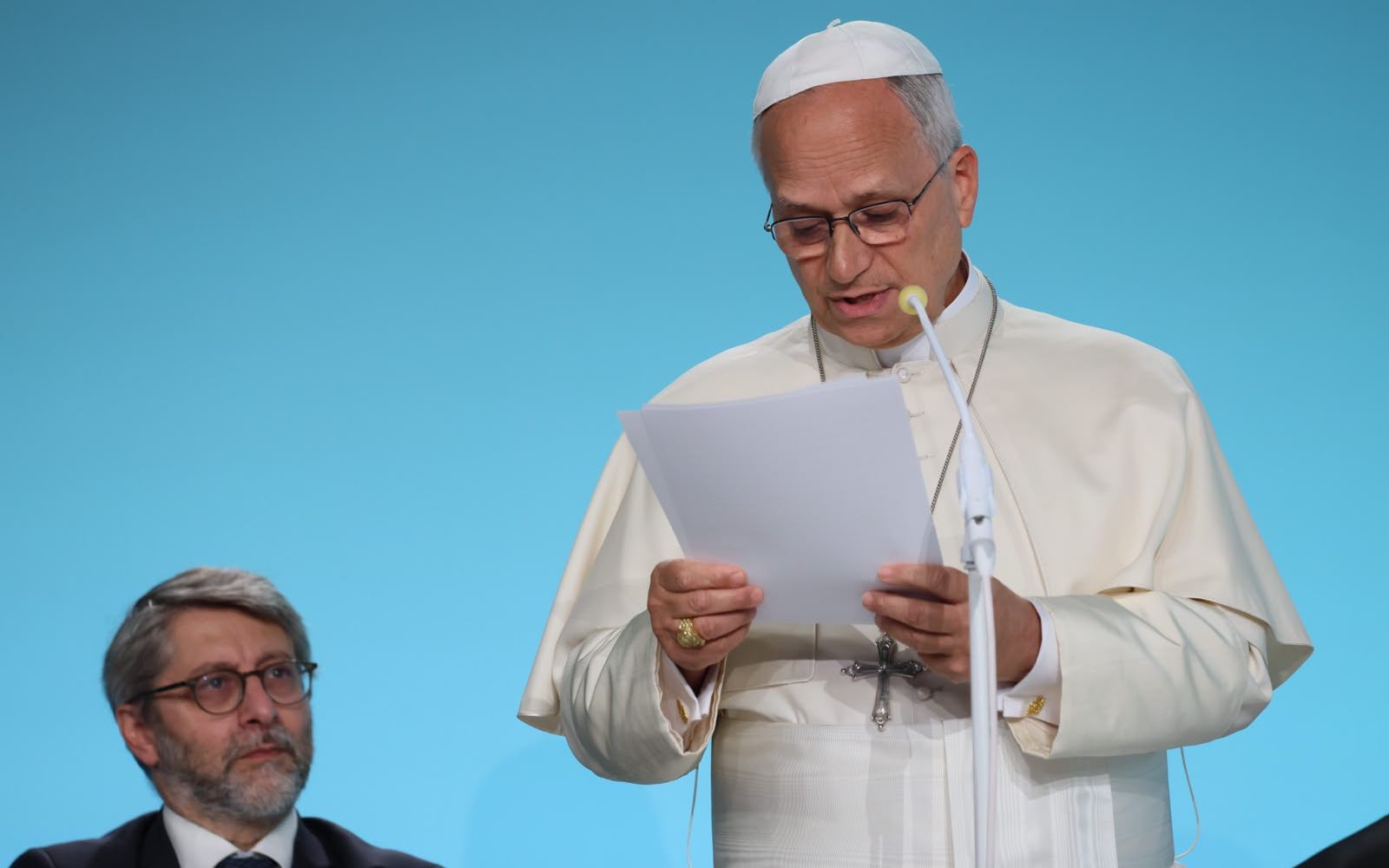
On 28 September 2026, the last day of his journey through France, Leo XIV presided over an interreligious meeting at the Robert-Schuman Congress Centre in Metz. Christian, Jewish and Muslim leaders of France there signed a common text, the "Appeal of Metz," for peace. The manifesto was signed in the name of the Catholic Church by Cardinal Jean-Marc Aveline, president of the Bishops' Conference of France, alongside Christian Krieger for the Protestant Federation of France, Chief Rabbi Haïm Korsia, and Chems-Eddine Hafiz, rector of the Grand Mosque of Paris.
The Appeal warns that humanity is passing through "a new tipping point" owing to the multiplication of wars, and declares: "We oppose in particular the poison of totalitarianism from which this land of Lorraine has so greatly suffered." It holds that "the name of God, no more than any religious truth or spiritual tradition, can ever be invoked to justify violence and hatred," and binds the signatories to sustained dialogue, to forming the young in the mutual knowledge of the traditions, and to common action. Opening his address with praise of Robert Schuman, the pope grounded his remarks on the encyclical "Fratelli tutti" of his predecessor and on his own encyclical "Magnifica humanitas," presenting the religions as the guardians of life.
The faith knows only one revealed religion, willed and accepted by God, the one Christ entrusted to His Church, outside of which no one is saved. The first commandment forbids honouring other gods and holding for true worship what is not; since the coming of Christ, the worship that refuses the Son refuses the Father also. Against the notion that the religions meet upon a common ground and are worth more or less the same, Pius XI spoke plainly: to gather believers into a single profession around a shared religious sentiment is to slide toward indifferentism and to desert the divinely revealed religion. The Syllabus had already condemned the claim that a man may find salvation in any religion whatever.
That the name of God should never serve to cloak violence, the tradition teaches without reserve, and civil peace among men is a good the Church has always willed. But a text signed jointly by a cardinal, a rabbi and a mosque rector, which sets them up as guardians of one same "name of God" and of life, places the true faith and the cults that reject Christ upon one and the same plane. There lies the indifferentism that the perennial Magisterium condemns. The religions do not form a federation of equivalent truths. The only peace that endures is not the alliance of beliefs, but the return of all to the one fold and the social kingship of Our Lord, to whom belongs the reign over the nations.
Sources. Pius XI, encyclical Mortalium animos (1928); Catechism of the Council of Trent (1566), on the first commandment; Pius IX, Syllabus (1864), props. 15-18; Pius XI, Quas primas (1925).