
News
Death penalty: abolition awarded in Washington, tradition keeps the right of the sword
In Washington, episcopal opposition to the death penalty was given an award; perennial doctrine, however, grants the lawful magistrate the right of the sword.
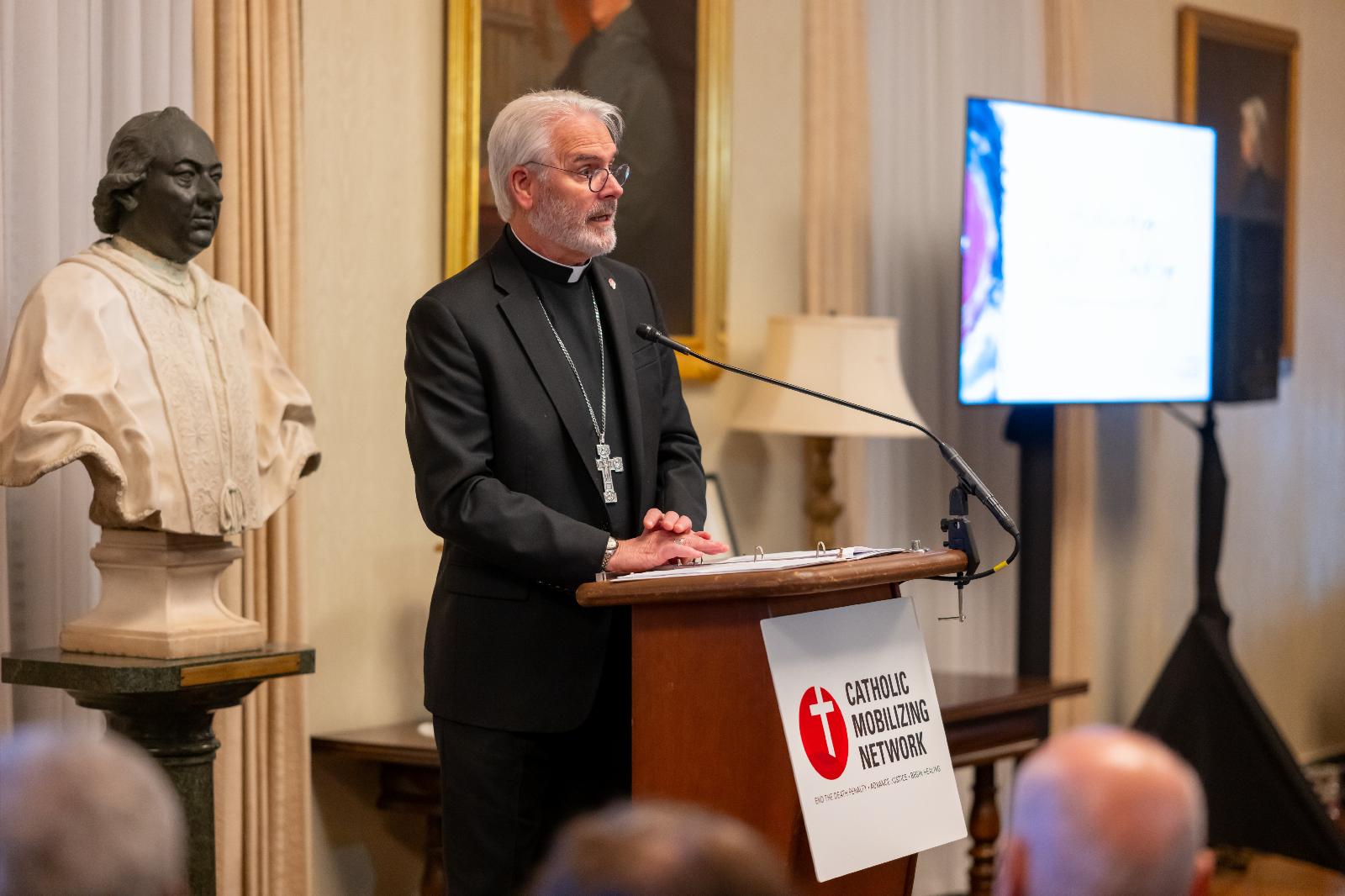
On 21 October 2026, at the apostolic nunciature in Washington, Archbishop Paul Coakley of Oklahoma City, president of the United States bishops' conference, received an award from a Catholic network that campaigns for the abolition of capital punishment. Accepting the distinction, he invoked a botched execution in Tennessee and the announced, then abandoned, plan to livestream the execution of a condemned serviceman as proof of the "inhumanity" of the death penalty; a message read on behalf of the cardinal secretary of state held that the dignity of man "can never be lost."
The perennial doctrine does not draw this conclusion. The Catechism of the Council of Trent, expounding the fifth commandment, teaches that the sword entrusted to the lawful magistrate to punish the guilty and protect the innocent, far from violating the precept "Thou shalt not kill," is on the contrary its execution: he who puts the criminal to death according to justice is no murderer, but the minister of the law. Scripture had fixed this from the covenant with Noah — "Whosoever shall shed man's blood, his blood shall be shed" (Gn IX, 6) — and Saint Paul recalls that the prince "beareth not the sword in vain: for he is God's minister: an avenger to execute wrath upon him that doth evil" (Rom XIII, 4).
Tradition did not for all that license cruelty. The judgment of blood, Innocent III professed, may be exercised "without mortal sin" only "with justice, not out of hatred; with prudence, not precipitation." To make a putting-to-death a broadcast spectacle, or to inflict it with a hand that bungles it, offends this measure. But the fault then lies in the manner, not in the right: it condemns the barbarous execution, it does not strip lawful authority of the power to punish the capital crime.
Now the award conferred, like the message invoking a dignity that "can never be lost," aims at that very right. That a guilty man, however odious his crime, can forfeit nothing — this is precisely what Genesis and the Roman Catechism contradict: the murderer has handed his life over to justice. The magisterium alleged in support of abolition — the 2018 revision declaring the penalty "inadmissible," the 2020 encyclical, a video message sent this year to abolitionists — is wholly later than 1958; we report it as the occasion of the event, not as the rule that judges it. Our rule remains the doctrine received down to the death of Pius XII, which never ceased to recognise the city's right of the sword.
Sources. Catechism of the Council of Trent (1566), on the fifth commandment, on the power of the sword entrusted to the magistrate; Genesis IX, 6 and the Epistle to the Romans XIII, 4, according to the Vulgate (Douay-Rheims); profession of faith prescribed by Innocent III to the Waldensians (c. 1210); constant teaching down to the death of Pius XII.