
News
Lourdes Closes Its Shrine to the Society of St Pius X After the Écône Consecrations
The Bishop of Tarbes and Lourdes has withdrawn from the Society of St Pius X the right to celebrate Mass and hold public prayer in the shrine, following the decree of schism after the Écône consecrations.
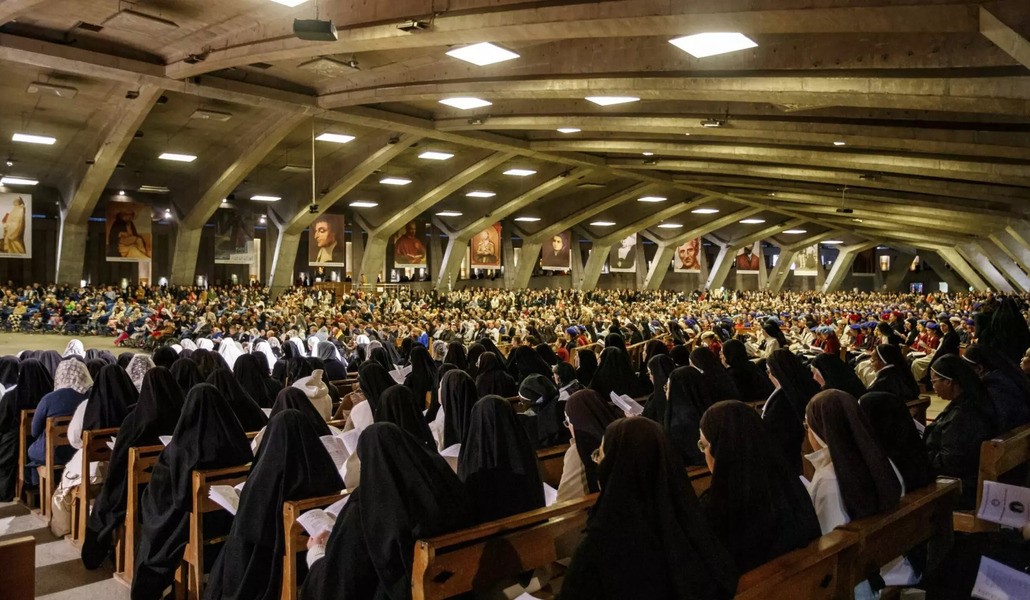
The Bishop of Tarbes and Lourdes has withdrawn from the Society of Saint Pius X the authorization to celebrate Mass, administer the sacraments and hold public prayers inside the shrine of Lourdes. The decision was notified by a letter dated 13 August 2026. The bishop ties it to the decree of schism and latae sententiae excommunication issued by the Holy See after the Society consecrated bishops without pontifical mandate at Écône on 1 July 2026. He made known that, following this decree, he could authorize within the shrine neither the celebration of Mass and the sacraments nor even the public prayers of the Society.
The measure does not forbid the faithful or the members of the Society from going to Lourdes to pray in private, at the Grotto as at the basilica. It concerns public celebrations and prayers, beginning with the international pilgrimage of Christ the King, planned for 23–26 October, which each year gathers some 7,000 pilgrims. On 22 August the Society's District of France, in a communiqué signed by its superior, Father Gonzague Peignot, acknowledged the bishop's authority while voicing its regret and incomprehension, and announced that it would maintain its annual pilgrimage, now in private prayer. The communiqué contrasts this exclusion with a gathering of Christians and Muslims around the figure of Mary that the shrine had hosted in October 2025.
Accounts differ on the number of bishops involved: some count four bishops consecrated at Écône on 1 July, others six bishops struck by automatic excommunication. The Society, for its part, lodged on 11 July 2026 a preliminary canonical appeal with the Dicastery for the Doctrine of the Faith against this decree. On this point the dispute remains open.
What the Church has always held
No one may be raised to the episcopate without the mandate of the Roman Pontiff. This is neither a recent requirement nor an invention of the last decades: it flows from the primacy of jurisdiction that Christ gave to Peter and his successors over the whole Church. The Vatican Council defined it in 1870: all pastors and all the faithful are bound to the Apostolic See by a true obedience and a hierarchical subordination. The law of the Church accordingly reserves to the Roman Pontiff alone the mandate for every episcopal consecration, and Pius XII, in 1958, recalled that an episcopal consecration performed without this mandate is unlawful and struck by the gravest censures.
The measure in the light of Tradition
On the point that grounds the decree — consecrations performed without pontifical mandate — the perennial discipline of the Church is clear and admits of no discussion: the mandate of the Pope is not a formality, it is the condition of visible communion and of jurisdiction. It is not for us to pronounce upon persons the definitive canonical sentence: that belongs to the tribunals of the Church, not to a commentator, and an appeal is precisely pending. We state the act and its relation to Tradition: to consecrate bishops outside the Roman mandate is a grave rupture of the order the Church has always kept.
The grievance the Society raises — to have been set aside where a gathering mingling Christians and Muslims was once welcomed — likewise touches Tradition, and Tradition judges it no less firmly. The Church has always refused to place the true religion on the same footing as the others: Pius XI, in 1928, condemned indifferentism and those assemblies where men pray as if all beliefs were of equal worth. On this ground the reproach holds. The measure of Tradition thus cuts on both sides: it requires the mandate for a consecration, and it refuses religious indifference for a pilgrimage.
What the faithful should retain
Lourdes is the shrine of the Immaculate, that mystery which Pius IX defined in 1854 and which the Virgin herself confirmed to Bernadette. One comes there to honor her who was conceived without sin, not to take sides in a quarrel. The faithful attached to the Roman rite of 1962 will hold firmly to two things that nothing sets against each other: the whole and entire faith, as the Church has always taught it, and visible unity around the See of Peter. Let him pray that the dispute be settled within that unity, without letting himself be drawn either into schism or into the thesis that denies legitimate authority. No one is barred from praying at the Grotto; let us pray there.
Sources. Vatican Council (1870), constitution Pastor æternus, ch. III, on the primacy of jurisdiction of the Roman Pontiff and the hierarchical obedience owed by all pastors and faithful; Code of Canon Law (1917), canon 953, reserving to the Roman Pontiff alone the mandate for every episcopal consecration; Pius XII, encyclical Ad Apostolorum Principis (29 June 1958), on the unlawfulness of episcopal consecrations performed without pontifical mandate; Pius XI, encyclical Mortalium animos (6 January 1928), against religious indifferentism; Pius IX, bull Ineffabilis Deus (8 December 1854), defining the Immaculate Conception, the mystery of the shrine of Lourdes.