
News
Nepal: A Glacial Flood Kills More Than 600, Leo XIV Commends the Dead to the Mercy of God
A glacial flood devastated northern Nepal on 26 August 2026, killing more than 600 and leaving thousands missing; Leo XIV commends the dead to the mercy of God as Caritas responds.
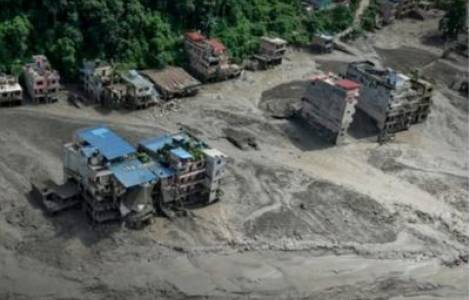
Shortly after half past eight on 26 August 2026, a glacial collapse in Langtang National Park, in northern Nepal, unleashed a torrent of debris that swept down the Trishuli and Bhote Koshi rivers for nearly a hundred kilometres. Three days later the toll exceeds six hundred and twenty dead, with more than two thousand four hundred missing; it climbs by the hour. The overflowing of the morgues forced the authorities to bury the bodies at once. Among the missing are pilgrims and travellers from thirty-two nations, many on their way to Mount Kailash and Lake Manasarovar.
The authorities have mobilised the army, the police, helicopters and specialised teams; they warn that a fresh surge threatens, a lake having formed upstream behind the mass of debris. Leo XIV sent a telegram, signed by Cardinal Pietro Parolin, expressing his sorrow, commending the dead to the mercy of God, offering his condolences to the families and assuring them of his spiritual closeness and his prayers for the rescuers. The apostolic administrator of the Vicariate of Nepal, Father Silas Bogati, reported that no Catholic church was struck, but that he fears some of the faithful may have been swept away, and that Caritas Nepal is already at work. "Although the Church in Nepal is small, with around ten thousand Catholics, the Holy Father's concern for this people has deeply touched and moved us," he said.
What the Church has always taught
Before mass death, tradition knows neither sentimentality nor despair, but two precise duties. The first is charity toward the living and the dead, which the Catechism of the Council of Trent numbers among the corporal works of mercy: to feed the hungry, to harbour the stranger, to bury the dead. To bury the dead is no mere measure of public health: it is an act of religion. The book of Tobias praises the just man who, at the peril of his life, took up the abandoned bodies to give them burial.
The second duty is prayer for the dead. "It is therefore a holy and wholesome thought to pray for the dead, that they may be loosed from sins," says Scripture. The Church, the same Catechism teaches, offers for them the holy Sacrifice and intercedes for the souls in purgatory: such is the communion of saints, which neither distance nor death can break.
The measure
The gesture of the Holy Father and the action of Caritas stand exactly in this line. To commend the dead to the mercy of God, to pray for them and for those who search for them beneath the rubble, to relieve the families: this is the twofold work the Church has always commanded, and it must be recognised as such. A bishop has urged the international community to mobilise greater aid for vulnerable families; a coordinator of the Catholic relief effort said that "the scale of the destruction is almost beyond comprehension." These words are not emotion: they name a duty.
We do not know the eternal fate of a single one of these dead, and it is not ours to fix it. Many were not Christian. But the Church has never confined charity to her own sons alone: the good Samaritan succours the man he does not know, and the just man of Tobias buried whoever lay without a grave. To pray for the dead and to relieve the living does not first require knowing who they were.
For the faithful
The duty of the Catholic before this news is simple and ancient. To pray for the dead, without presuming their salvation nor despairing of the mercy of God. To support, according to his means, the alms that reaches the survivors. And to remember that the earth itself — a glacier that gives way, a river that rises up — recalls to man his frailty and the uncertain hour of his own death, for which he must hold himself ready.
Sources. Catechism of the Council of Trent (1566), on the corporal works of mercy and prayer for the dead; book of Tobias, chapters I and II (Vulgate); II Machabees XII, 46 (Vulgate); parable of the good Samaritan, St Luke X, 30-37.