
News
Lebanon: Leo XIV Receives Joseph Aoun as the Holy See Voices ‘Grave Concerns’
Leo XIV received Lebanese president Joseph Aoun at the Vatican on 20 August 2026; the Holy See voices grave concerns over the application of the Israel-Lebanon agreement.
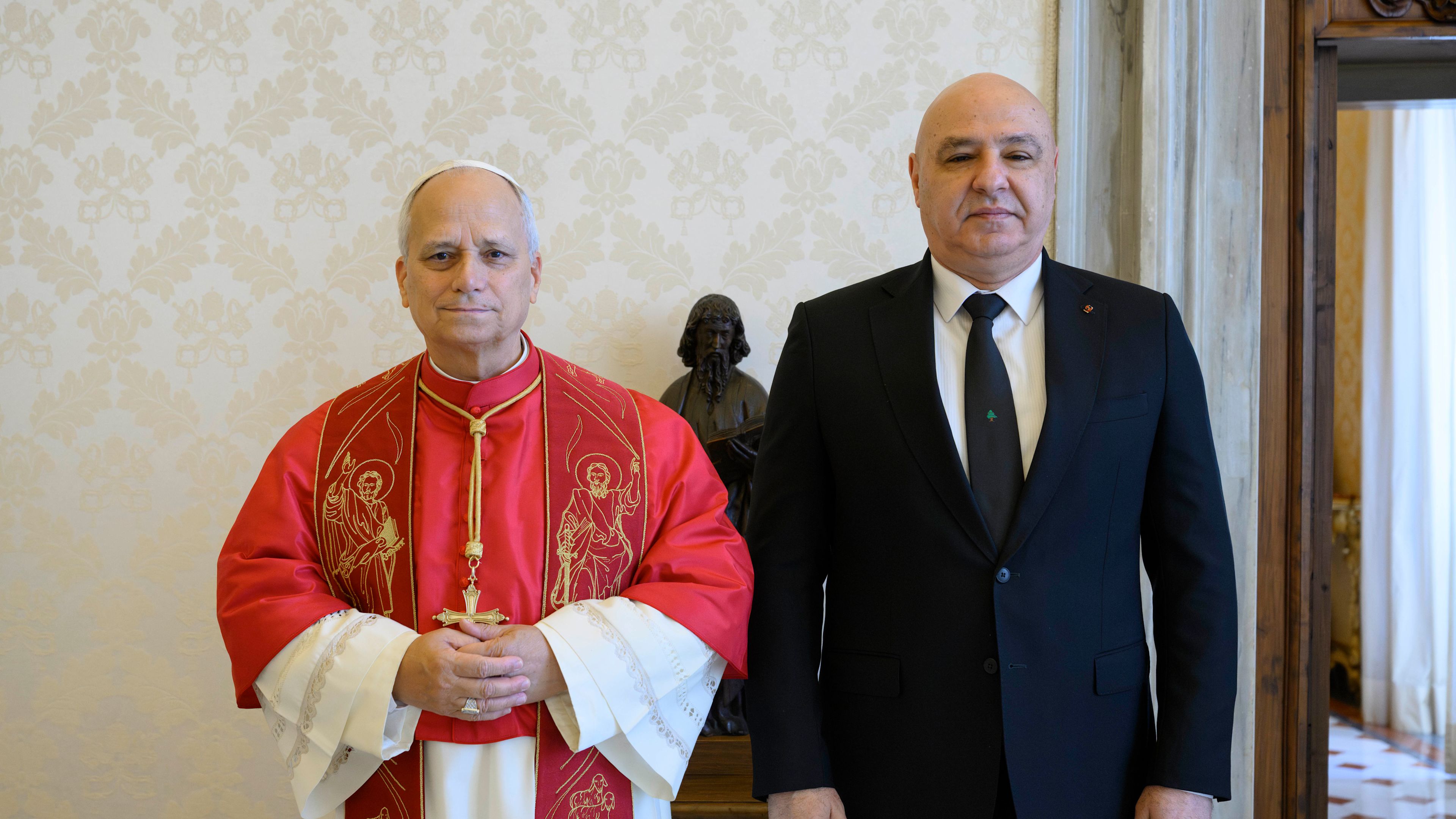
Leo XIV received the Lebanese president Joseph Aoun at the Apostolic Palace on Thursday 20 August 2026, in a private audience of about thirty minutes. The conversation dealt with the challenges facing Lebanon, the security situation in the south of the country, and the implementation of the trilateral framework agreement signed by the United States, Israel and Lebanon on 26 June 2026, which makes a phased Israeli withdrawal conditional upon the disarmament of Hezbollah, the Iran-backed militia, in the south of the country. The president, a Maronite, was also received by the Cardinal Secretary of State Pietro Parolin and by Archbishop Paul Gallagher, Secretary for Relations with States.
In a communiqué, the Holy See said it welcomed the signing of the document while expressing “grave concerns” about the difficulties encountered in its application, and pledged to support efforts to that end. According to the Lebanese presidency, the head of state for his part asked the Holy Father to continue pressing Israel to apply the agreement, to bring an immediate halt to the attacks on the villages, infrastructure and civilians of the south, and to withdraw from the occupied areas. He called on the Holy See to support “a complete Israeli withdrawal from occupied Lebanese territory, opening the way to the rebuilding of what Israel has destroyed and to the return of the displaced to their lands and their villages.”
A month before the June agreement, it was estimated that about a fifth of Lebanese territory had been rendered uninhabitable, through occupation and through evacuation orders begun during a ground invasion of the south in March. The president presented the pope with a wooden reliquary depicting the patriarch Elias Hoyek, beatified in July 2026. Leo XIV had visited Lebanon at the end of November 2025, on his first international journey, calling on the region to “change course.”
What the tradition teaches
The Church has always held the life of the innocent to be inviolable. The Catechism of the Council of Trent, expounding the fifth commandment, teaches that God forbids the killing of the innocent and ranks the shedding of innocent blood among the crimes that call down divine vengeance. It recalls the word addressed to Cain: “The voice of thy brother’s blood crieth to me from the earth” (Gen 4:10).
This same commandment does not merely forbid murder: it obliges us to protect the life of our neighbour and to maintain peace and concord among men. Thus the Lord proclaims: “Blessed are the peacemakers: for they shall be called the children of God” (Mt 5:9). The tradition acknowledges the right of legitimate authority to defend its people by arms when the cause is just; but that very right binds it to spare non-combatants, for no reason of state makes the killing of the innocent lawful.
By the measure of this standard
An agreement that ties the withdrawal of an occupying army to verifiable stages, and that aims to silence the weapons, is in itself in keeping with the duty to seek peace; and to that extent the support given to the efforts for peace is right. But true peace is not the mere cessation of the noise of arms: it is, in the words of Saint Augustine taken up by the whole tradition, “the tranquillity of order,” an order founded on justice. So long as villages are struck, civilians hit and lands rendered uninhabitable, that order is not restored, and the blood of the innocent goes on crying to Heaven. The “grave concerns” expressed over the application of the agreement are therefore no diplomatic reservation: they touch the very heart of the fifth commandment.
What the faithful should keep in mind
The Christian prays for peace, and he wants it real. He does not mistake the hope of an agreement for the justice that remains to be accomplished. Let the Lebanese, and among them the sons of the ancient Maronite Church, not be forgotten in our prayers; let the shedding of innocent blood cease; and let the powerful remember that they will answer before God for every life they had the duty to protect.
Sources. Catechism of the Council of Trent (1566), on the fifth commandment, “Thou shalt not kill.” Sacred Scripture according to the Vulgate (Douay-Rheims): Genesis 4:10; Gospel according to Saint Matthew 5:9. Saint Augustine, The City of God, Book XIX, on peace as “the tranquillity of order.”