
News
The Synod proposes extending to the laity the exercise of the power of governance in the Church
The final report of the Synod's canon-law commission proposes revising several canons to extend to lay men and women the exercise of the power of governance in the Latin Church.
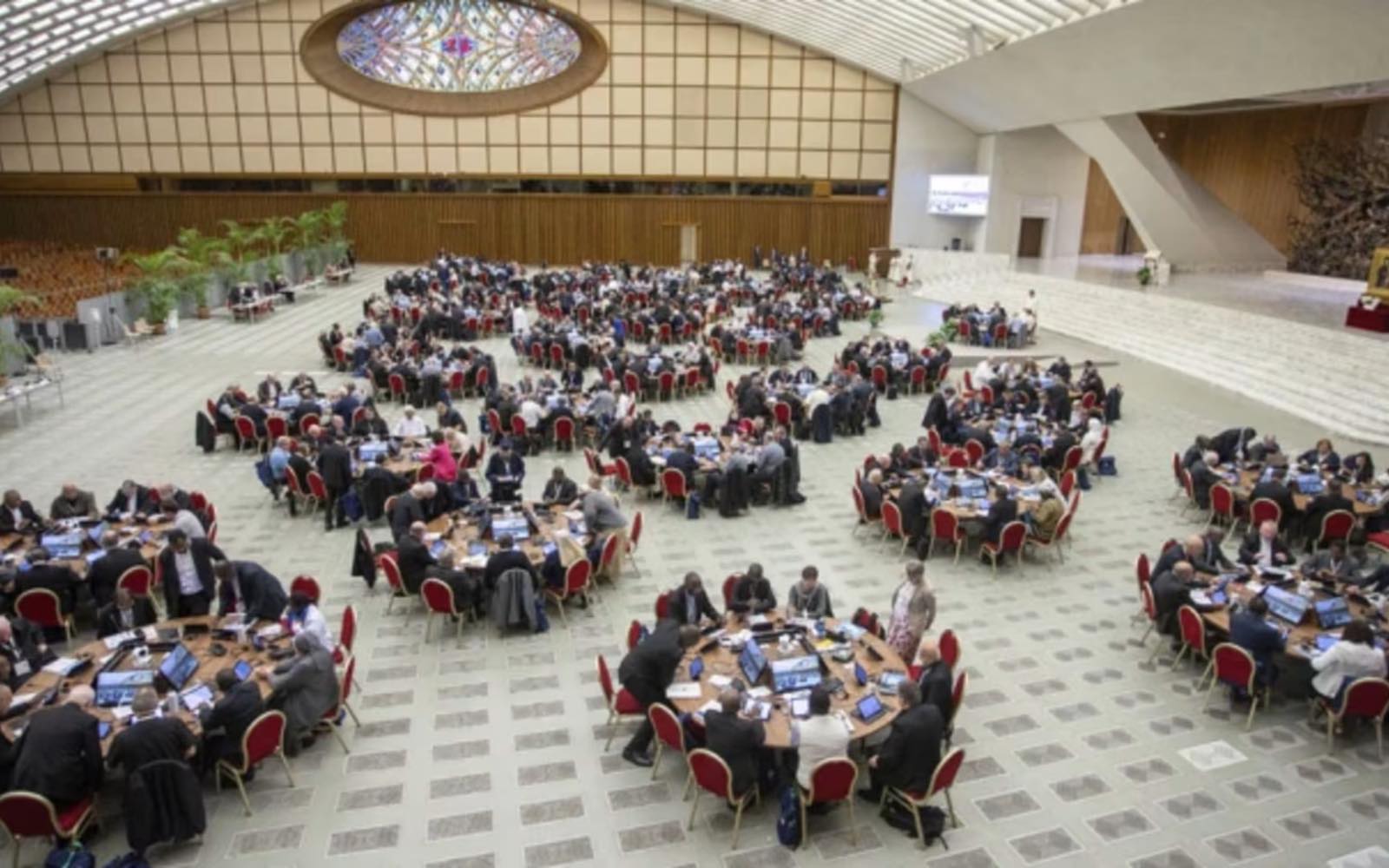
On 30 September 2026, the General Secretariat of the Synod published the final report of its canon-law commission. The text proposes to revise several canons of the Code of the Latin Church in order to broaden the access of lay men and women to the offices, charges and ministries « for which they are suited and competent, including in the domain of ecclesiastical government ». The document has no binding force: it must still be examined by Pope Leo XIV.
The commission was one of the ten study groups instituted in 2024 within the Synod on Synodality, dissolved once their work was published. It distinguishes three horizons: short-term proposals, the object of this report and limited to the Latin Code alone; medium-term work with the dicasteries; and, only in the long term, a complete recasting of both codes. Among the canons concerned are canons 145, 204, 228, 230, 749 and 1421. Canon 749 governs the exercise of the Church's infallible magisterium. Other proposals would remove the Latin word « tantum » (« only »), which today reduces the voice of the members of the People of God in a particular council to a merely consultative vote, and would give them a numerical representation equal to that of the bishops.
What tradition teaches
The Catechism of the Council of Trent distinguishes two powers in the Church with precision: « The ecclesiastical power is twofold; it is divided into, first, the power of Orders, and secondly, the power of Jurisdiction. » The first has for its object the Eucharist; the second, the very one the report calls « government », is exercised upon the mystical Body: « The power of Jurisdiction is exercised wholly upon His mystical Body.
To it belongs the governance of the Christian people, to lead and to direct them in the way of heavenly and everlasting happiness. » This power is not that of the common priesthood of the baptized. The same Catechism separates the interior priesthood, common to all the faithful, from the exterior priesthood, which « belongs not to all the faithful, but only to certain men who have received the imposition of hands in a lawful manner ».
The measurement
The report affirms that the synodal process « does not remove the decision-making competence of the bishop, of the Episcopal College or of the pope, but integrates the contribution of the People of God ». This reserve is just, and it must be taken at its word. But the proposal goes further than a consultation: it intends to entrust to laymen the exercise of the power of government itself, that is, precisely the jurisdiction that Trent attaches to the sacred ministry and not to the priesthood of the baptized. Measured by this standard, the orientation shifts a boundary that tradition holds to be received from God, and not a mere matter of organizational convenience.
For the present, this is only a report without force of law, suspended on the pope's examination. Nothing is decided. We report it as a proposal, not as an act, and we weigh it against the received doctrine: the government of the Christian people belongs to the power of jurisdiction, which Christ entrusted to the Apostles and their successors. The lay faithful retains whole and entire the royal priesthood received at baptism; he does not thereby receive the government of the Church. To hold this distinction is to hold what the Church has always held.
Sources. Catechism of the Council of Trent (1566), on the sacrament of Order, § II (on ecclesiastical power) and § VII (on the priesthood).