
News
Torreciudad: Barbastro disputes the handover of the Virgin to Opus Dei
The diocese of Barbastro-Monzón judges invalid the agreements invoked by Opus Dei and says no original document proves the cession of the statue of Our Lady of the Angels of Torreciudad.
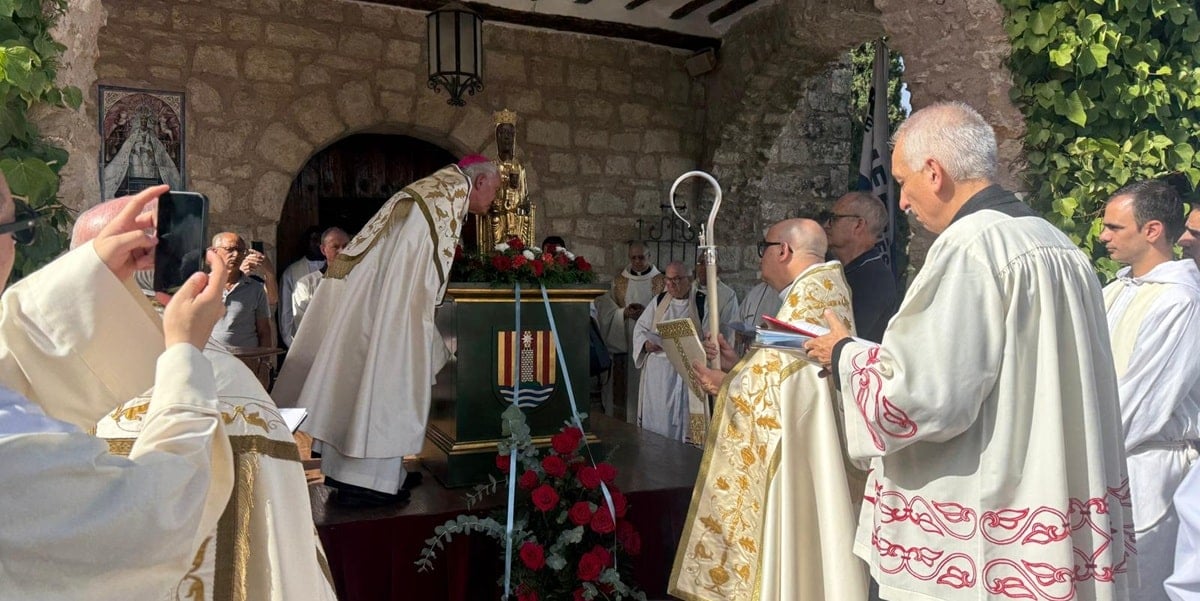
The diocese of Barbastro-Monzón made public, on Friday 11 September 2026, a detailed communiqué affirming that “no original document has been provided attesting to a cession of its use” for the Romanesque statue of Our Lady of the Angels of Torreciudad. Venerated for nearly a thousand years in its original hermitage, the image has since 1975 been transferred to the great neighbouring sanctuary built by Opus Dei. The text appears twenty-four hours before the pontifical commissary appointed to settle the dispute, dean of the Roman Rota, presides on site over the 34th Marian Day of the Family.
Ownership of the image and of the hermitage is contested by no one: both belong to the diocese. The disagreement bears on the validity of the cession of their use. The diocese recalls that the deed constituting the “censo enfitéutico” (emphyteutic lease) of 24 September 1962 expressly required “not to remove the image from the hermitage,” and holds invalid the agreements set against it.
Opus Dei refers to a later agreement, of 8 September 1966, by which the image was said to have been placed in the new temple “with documented authorization from the diocese”; the diocese replies that this document “has not been provided to this diocese, despite repeated requests” and appears neither in the acts of the cathedral Chapter nor in the diocesan archives. The Holy See has not yet ruled; it falls to the commissary to decide on the location of the image, the status of the sanctuary and its management. We therefore report an open dispute, not a judged cause.
The measure of tradition
Tradition does not need to know which deed will prevail to state the rule. The seventh commandment, “Thou shalt not steal,” forbids not only the taking: it obliges the restitution of what one holds without just title. The Catechism of the Council of Trent teaches, after Saint Augustine, that sin is not forgiven so long as what has been taken is not restored: “No remission of sin, without the restitution of the thing taken away” — non remittitur peccatum, nisi restituatur ablatum.
A condition solemnly attached to a pious foundation binds in justice the one who accepted it, and the length of a possession founds no right against the legitimate owner. Likewise, he who binds himself by pact is held not to fail it, even to his own hurt: “He that sweareth to his neighbour, and deceiveth not,” says the Psalm, shall dwell in the tabernacle of the Lord.
What this weighs
Applied to the facts, the rule is simple and does not judge in the judge's place. If the transfer of the image rests on a valid title, it stands; if it has none, the 1962 clause remains, and what is retained against it must be restored. There is no raising a possession into a right: a great temple built a few metres from the hermitage, “even if it can help spread Marian devotion, cannot justify the removal, without the required authorization, of an image of the Virgin that belongs to the people of Barbastro-Monzón.” That the dispute be remitted to the competent ecclesiastical authority, and not left to the force of the fait accompli, is moreover in keeping with the order the Church has always held: a cause is judged on titles, not on the antiquity of possession.
For the faithful, the line is clear. We honour the Virgin wherever her image is venerated, and we do not confuse attachment to a sanctuary with the right to keep there what was entrusted under condition. We await the judgment of the legitimate authority instead of anticipating it, and we hold that justice rendered to a poor Romanesque talla weighs more than the splendour of the place that houses it.
Sources. Catechism of the Council of Trent (1566), explanation of the seventh commandment, on the obligation to restore another's goods (Saint Augustine, Letter 153 to Macedonius). Psalm 14 (15), 1 and 4, according to the Vulgate, on fidelity to the sworn word.