
News
The Traditional Mass Barred from St Peter's for 2026
The traditional pontifical Mass of the 2026 Summorum Pontificum pilgrimage was not authorised in St Peter's Basilica; it will be celebrated at Saint Mary Major.
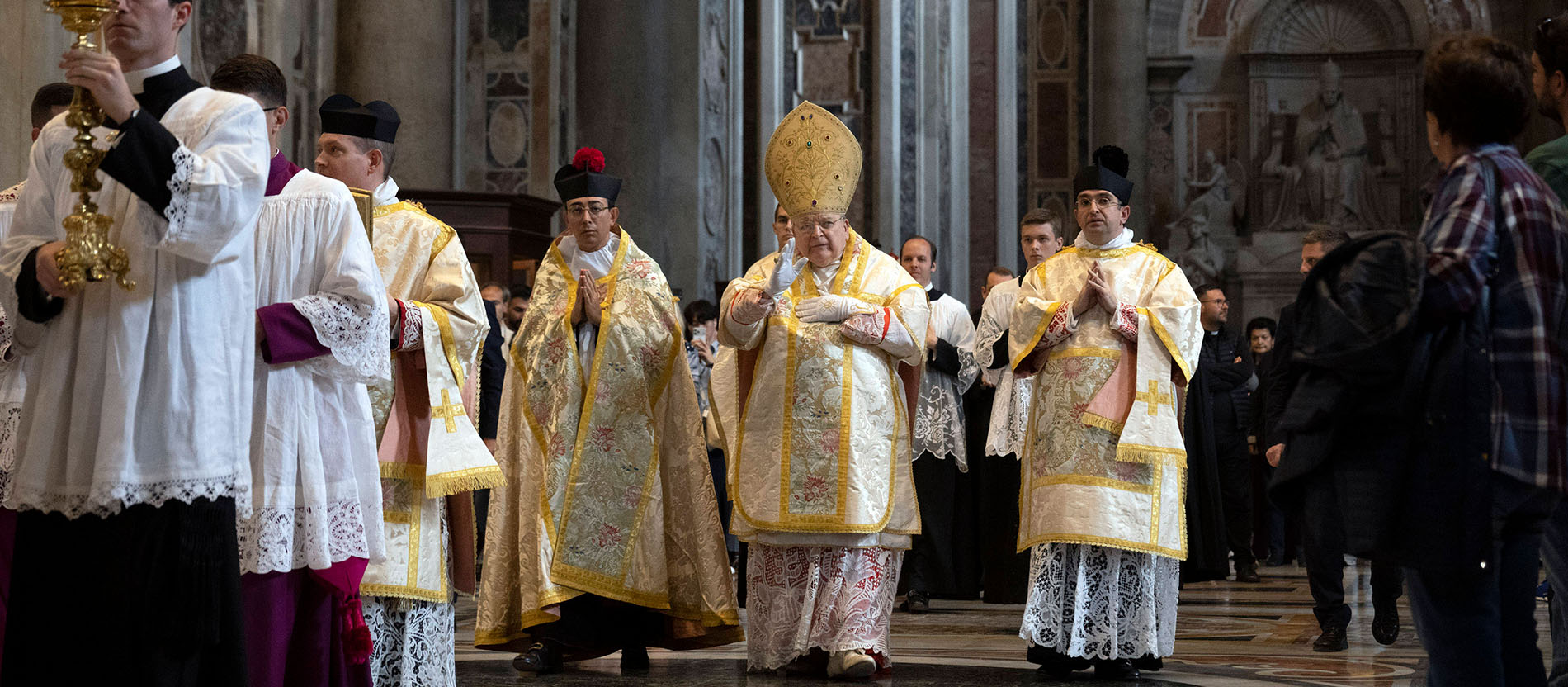
The fifteenth international Summorum Pontificum pilgrimage will be held in Rome from 23 to 25 October 2026. Its principal pontifical Mass will not be celebrated in St Peter's Basilica. A letter of 7 August 2026, transmitted through the Apostolic Nunciature and signed by Archbishop Paolo Rudelli, Substitute for General Affairs of the Secretariat of State, refused the authorisation for “this year.” The Mass will be said on Saturday 24 October at three in the afternoon, at the high altar of the Basilica of Saint Mary Major, under the presidency of Bishop Athanasius Schneider.
The pilgrims are not shut out of St Peter's. On Saturday morning the procession will set out around eleven o'clock from the church of Saints Celsus and Julian, reach the basilica, and the faithful will pray there at one o'clock before making their way to Saint Mary Major. Both pontifical Masses of the pilgrimage will be celebrated by Bishop Schneider, and not by a cardinal as in previous years.
In 2025 the principal Mass had been able to take place in St Peter's for the first time since 2022. The refusal holds, according to the letter, only for “this year,” with no permanent prohibition; the organisers had sought it several times, in December, April and June, without obtaining it. Since 2021 celebrations according to the missal of 1962 have been confined there to reserved hours and to the Clementine chapel, in the grottoes.
What the Church has always held
On 14 July 1570, by the bull Quo primum tempore, St Pius V fixed the Roman Missal and granted “in perpetuity” that this rite might be celebrated freely and licitly in every place. The Council of Trent, in its twenty-second session, had taught that the Mass is the true and proper sacrifice, and struck with anathema anyone who holds the rites and ceremonies received and approved by the Church in the solemn celebration to be incentives to impiety. This rite is not a tolerance granted to a sensibility: it is the worship the Roman Church rendered to God for centuries, at the altar raised over the tomb of the Prince of the Apostles as everywhere else.
The measure
To refuse this rite the high altar of St Peter's, while admitting the pilgrims there for prayer but not for the Sacrifice, stands in tension with the perpetuity St Pius V willed to be inalienable. The difficulty does not bear on any liturgical fault: the missal set aside is the very one Trent canonised and Pius V gave for all time. We report the act, not the hearts of those who took it; and the act, as written, holds only for “this year,” after in 2025 the same Mass had returned to St Peter's. What remains is that the place where the Roman rite was fixed for the whole world is, once again, closed to it.
For the faithful
The value of the holy Sacrifice does not depend on the marble on which it is offered: the Mass said at Saint Mary Major, the oldest Marian basilica in Rome, is the same as the one that would be said at St Peter's. The faithful formed in the tradition hold to the rite because they hold to the faith it expresses, not because they would expect a privilege from it. Let them go to pray at the tomb of Peter in the morning, and offer the Sacrifice at Saint Mary Major in the afternoon, without bitterness and without noise. The Church has known heavier trials; the rite itself remains what St Pius V said of it: perpetual.
Sources. Bull Quo primum tempore of St Pius V (14 July 1570); Council of Trent, XXII session (1562), doctrine on the Holy Sacrifice of the Mass and canon 7; Dom Guéranger, The Liturgical Year, on the Roman worship.