
News
Leo XIV entrusts St Peter's to an architect of Traditionis custodes
Leo XIV names Archbishop Viola, one of the architects of the enforcement of Traditionis custodes, archpriest of St Peter's; we measure his office by the Roman Mass guaranteed by Quo primum.
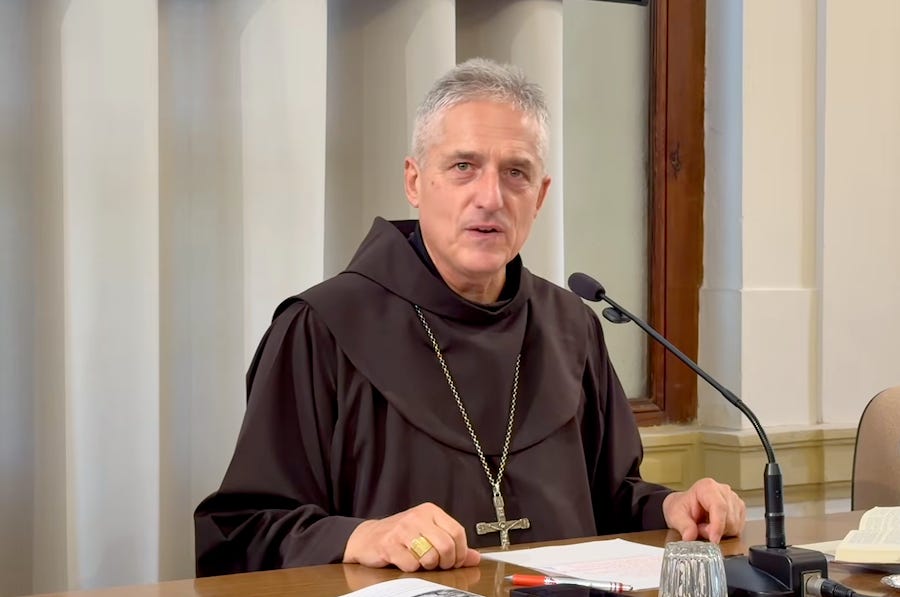
On 10 October 2026, Pope Leo XIV named Archbishop Vittorio Francesco Viola archpriest of St Peter's Basilica, vicar general of His Holiness for Vatican City, and president of the Fabric of St Peter. A 61-year-old Franciscan, born at Biella in 1965, Archbishop Viola had until now been secretary of the Dicastery for Divine Worship and the Discipline of the Sacraments. Appointed to that post in 2021, shortly before the motu proprio Traditionis custodes restricting the traditional Mass, he was afterwards one of the architects of the enforcement of those restrictions. He succeeds Cardinal Mauro Gambetti, named archbishop of Chieti-Vasto on 3 October.
The three offices attached to the archpriest of St Peter's traditionally fell to a cardinal; Archbishop Viola, however, is an archbishop, as were Francesco Marchisano in 2002 and Angelo Comastri in 2005 before they were raised to the cardinalate. Ordained a priest in 1993 by Bishop Luca Brandolini, a close collaborator of Archbishop Annibale Bugnini, the architect of the post-conciliar liturgical reform, he is said to wear Bugnini's episcopal ring, and he took his doctorate at the Sant'Anselmo Liturgical Institute. On the same day the Spanish bishop Aurelio García Macías was promoted secretary of the same dicastery; he spoke of « a new phase [that] now begins, that of adapting certain aspects of the cultures, which may enter into the liturgical celebration of the Roman rite ».
The Roman Mass, an inheritance no one can abolish
The traditional Mass is not one sensibility among others: it is the Roman rite as the Church received and handed it down. By the bull Quo primum (1570), Saint Pius V fixed the Roman Missal and granted it in perpetuity, ruling that no priest could ever be compelled to abandon it. The Council of Trent, in its twenty-second session, teaches that the Mass is a true and proper sacrifice, offered for the living and the dead, and lays its anathema on whoever denies it. A rite so received, guaranteed, and sealed by a council is not a possession left to the discretion of a Roman office.
The measure
A man is judged by his acts, not by forecasts. Under Cardinal Gambetti, the measures of 2021 had banned private Masses in the upper part of the basilica and confined the traditional Masses to the Clementine Chapel in the Vatican Grottoes, with visiting priests required to concelebrate; the number of Masses said each morning is said to have fallen from about seventy-five to fewer than ten. As secretary of the dicastery, Archbishop Viola refused the request of the archbishop of Melbourne to authorize celebrations according to the 1962 Missal, invoking post-conciliar ecclesiological arguments and requiring the diocesan bishop to give priority to the reformed rite of Paul VI. Such are the acts; and measured against the perpetual guarantee of Quo primum, they are an obstacle to what the Church willed to be free for ever.
The bearing of the appointment itself is read in different ways: for some, a simple changing of the guard at the Vatican; for others, a setting in order of the basilica after a troubled tenure; for others again, bad news for the faithful attached to the Mass of all time. We hold it for what it is: contested. No act has decided today what the new archpriest will do tomorrow, and we will not lend to an office a sentence it has not passed. What tradition judges are the acts already done, not the intentions one guesses at.
What the faithful must hold
The Roman Mass does not hang on a favour of the curia: it hangs on what the Church has received and guaranteed for ever. That a man's offices change takes nothing from this right. The faithful keep what the Church has always held, without noise and without rupture, and pray for those who govern her.
Sources. Bull Quo primum of Saint Pius V (1570), granting the Roman Missal in perpetuity. Council of Trent, Session XXII (1562), Doctrine and Canons on the Most Holy Sacrifice of the Mass, canon 1. Dom Guéranger, Institutions liturgiques.