
Novenas
Novena to St Ignatius Loyola
The full nine-day novena to St Ignatius of Loyola — the Suscipe, the Anima Christi, and a day-by-day meditation on his life — with the feast day, the story of the soldier-saint, and answers to the questions people ask.
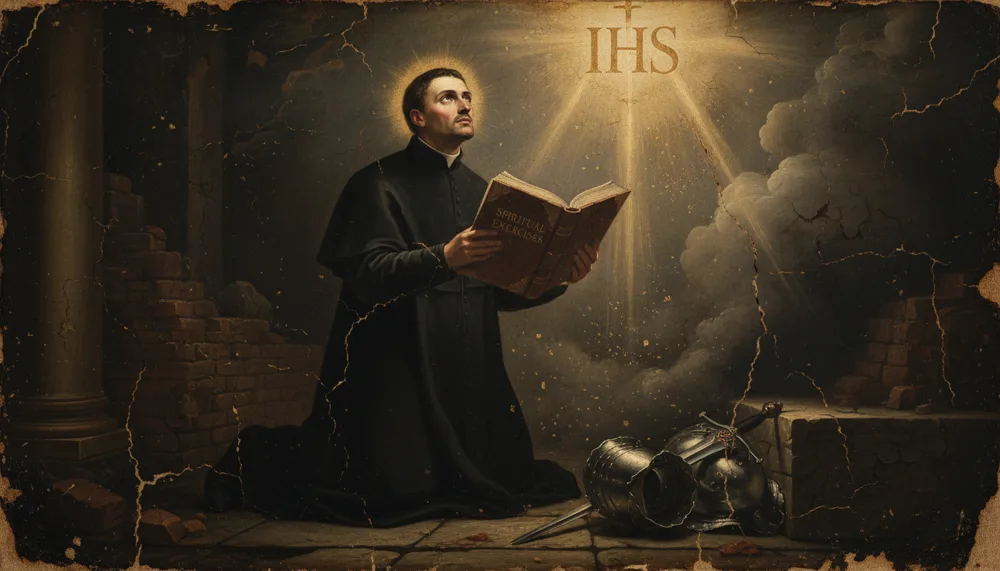
The novena to St Ignatius of Loyola is a nine-day prayer to the soldier who became a saint — the founder of the Society of Jesus, master of the Spiritual Exercises, and patron of retreats and of all who must discern God's will. It is prayed for the grace to give oneself wholly to God, for light in a hard decision, for zeal in His service, and for any need laid at the feet of so mighty an intercessor.
Most keep it as the nine days ending on his feast, 31 July — beginning on 22 July — though it may be said at any time a soul needs it. Below is the full novena, the great prayers Ignatius left us, a day-by-day meditation on his life, and the story of the man himself. If you are new to this form of prayer, see first our guide to what is a novena.
The full novena to St Ignatius of Loyola
The heart of this novena is not a long invented text but the prayers St Ignatius himself taught and prayed — above all the Suscipe, the prayer of total surrender he set at the summit of the Spiritual Exercises, and the Anima Christi, the old prayer to the wounded Christ that he loved and placed at the front of that same book. Say the following each day for nine days, at a fixed hour, naming your intention where marked.
The daily novena prayer
In the name of the Father, and of the Son, and of the Holy Ghost. Amen.
Our Father, who art in heaven...
O glorious St Ignatius, chosen soldier of Christ, who didst hear in the wound of thy body the call of thy Captain and King, and didst leave all things to follow Him: pray with me now in this novena. Obtain for me the grace to seek in all things not my own will, but the greater glory of God, and to labour, as thou didst, ad maiorem Dei gloriam — for the greater glory of God alone.
The Suscipe — the Offering of St Ignatius:
Take, O Lord, and receive all my liberty, my memory, my understanding, and my whole will. All that I have and possess, Thou hast given me; to Thee, O Lord, I restore it. All is Thine; dispose of it wholly according to Thy will. Give me Thy love and Thy grace, for this is enough for me.
Here name your intention.
The Anima Christi:
Soul of Christ, sanctify me.
Body of Christ, save me.
Blood of Christ, inebriate me.
Water from the side of Christ, wash me.
Passion of Christ, strengthen me.
O good Jesus, hear me.
Within Thy wounds hide me.
Suffer me not to be separated from Thee.
From the malignant enemy defend me.
In the hour of my death call me,
and bid me come to Thee,
that with Thy saints I may praise Thee
for ever and ever. Amen.St Ignatius of Loyola, pray for us — that we may be made worthy of the promises of Christ.
Ad maiorem Dei gloriam. Amen.
This is the full daily prayer, and it is enough to say it just so on each of the nine days. What follows adds a distinct meditation for each day, drawn from the life of the saint, for those who wish to pray the novena more deeply.
The nine days: a day-by-day meditation
Where many novena pages give one prayer repeated nine times and nothing more, here, for each of the nine days, is a scene from the saint's own conversion to carry into the daily prayer above — so that praying to Ignatius becomes praying with him.
Day 1 (22 July) — The cannonball
At the siege of Pamplona a cannonball shattered Ignatius's leg and ended his soldier's dreams. Ask the grace to see the hand of God even in the wound that overturns your plans.
Day 2 (23 July) — The two books
Bored in convalescence, he asked for tales of chivalry; only a life of Christ and a book of saints were in the castle. Ask the grace to find in the lives of the saints the true adventure of the soul.
Day 3 (24 July) — The discernment of spirits
He noticed that worldly daydreams left him empty, while thoughts of following Christ left lasting peace. Ask the grace to discern the spirits, and to follow the desires that leave the soul in peace.
Day 4 (25 July) — Montserrat
He laid down his sword before Our Lady's altar and clothed himself as a poor pilgrim. Ask the grace to surrender the weapons of your pride at the feet of the Blessed Virgin.
Day 5 (26 July) — The cave of Manresa
In a year of prayer and fierce temptation he was purified, and began to write the Spiritual Exercises. Ask the grace to persevere in prayer through darkness and scruple until peace returns.
Day 6 (27 July) — The student at forty
He went back to school among schoolboys to learn Latin, that he might better save souls. Ask the grace of humility — to begin again, at any cost, for the love of God.
Day 7 (28 July) — Montmartre
With Francis Xavier and his first companions he vowed poverty and chastity and to spend himself for souls. Ask the grace of true friendship in Christ, and of zeal for the salvation of others.
Day 8 (29 July) — "I will be favourable to you at Rome."
On the road he saw Our Lord bearing His cross and heard those words of promise. Ask the grace to trust the promise of Christ when the road ahead is hidden.
Day 9 (30–31 July) — Ad maiorem Dei gloriam
He governed the young Society for fifteen years and died at Rome, his motto on his lips: all for the greater glory of God. On this last day, offer your whole intention into the hands of God, holding nothing back, for His greater glory. Many keep the ninth day as the vigil of the feast, so that the novena closes on 31 July itself.
A shorter novena to St Ignatius
If time is short, the whole novena can be reduced to its core. Each day, make the Sign of the Cross, say one Our Father, then the Suscipe — Take, O Lord, and receive all my liberty... — name your intention, and close: St Ignatius of Loyola, pray for us. Ad maiorem Dei gloriam. The Suscipe alone, prayed slowly for nine days, is a complete Ignatian novena; it was the very prayer he proposed to penitents as the perfect offering of themselves to God.
The Prayer for Generosity
Many novena booklets attach to this devotion the beloved Prayer for Generosity, and you may add it after the Suscipe if you wish:
Dearest Lord, teach me to be generous; teach me to serve Thee as Thou deservest; to give and not to count the cost; to fight and not to heed the wounds; to toil and not to seek for rest; to labour and not to ask for reward, save that of knowing that I do Thy will. Amen.
It breathes the spirit of Ignatius perfectly, and is widely prayed under his name; in strict truth its authorship is uncertain and later than his own day, whereas the Suscipe and the Anima Christi are genuinely his. Both may be prayed with confidence.
Praying the novena for a particular intention
For depression and inner darkness
Ignatius is a sure patron for those who pray this novena in depression or desolation, for he passed through it himself. At Manresa his soul was "overwhelmed with sadness," tempted to despair, finding "no comfort in prayer, no relief in fasting"; and from that valley he emerged with a rare gift for healing troubled and scrupulous souls. Bring your heaviness to him, and add to the daily prayer his own rule: in desolation, never go back on a resolution made in peace, but hold your ground and wait for the consolation of God to return. For a companion in this same struggle, see also the Litany of Humility and the Litany of Trust.
For joy
Others pray this novena for joy — the deep, settled joy Ignatius called consolation, which the world cannot give. It is not a mood but a fruit: the peace of a soul that has surrendered its will to God and found Him enough. Ask it plainly in the Suscipe — give me Thy love and Thy grace, for this is enough for me — and it will not be refused, though it may come, as it came to Ignatius, on the far side of a purifying trial.
For discernment and a right choice
The whole purpose of the Spiritual Exercises is to help a soul make a good choice — of a state of life or in a particular crisis — "unbiased by any excessive like or dislike, and guided solely by the consideration of what will most conduce to the one end for which we were created." No saint is a surer intercessor when a real decision must be made. Name the choice before you, and beg the light and the freedom Ignatius won at such cost.
How to pray this novena
A novena is nine days of the same prayer, said with the same intention. Choose your start date — the traditional one is 22 July, so the ninth day falls on the feast of 31 July — and keep a fixed hour each day. Name one clear intention and hold to it through all nine days. Where you can, join the novena to Holy Mass or Communion, or to a decade of the Rosary.
Above all, pray it in the spirit of the Suscipe: ask boldly for the grace you need, but surrender the outcome to God, content to receive either the favour you named or the better thing He chooses to send. The novena does not bend God's will; it conforms ours to His, which is the whole of Ignatian prayer. For the wider tradition of the form, see what is a novena; and to keep company with two of his own first sons, the novenas to St Francis Xavier and to that other great Spanish master of prayer, St Teresa of Ávila.
Who is St Ignatius of Loyola?
Ignatius was born about 1491 in the castle of Loyola in the Basque country of Spain, the youngest of a large and noble family, and was trained to arms. His soldier's life ended abruptly on 20 May 1521, when a French cannonball broke his leg at the defence of Pamplona. Carried home to convalesce and craving tales of chivalry, he found only a life of Christ and a book of the saints — and reading them, he was converted. "These men were of the same frame as I," he told himself; "why then should I not do what they have done?"
He hung up his sword before Our Lady at Montserrat, gave a year to prayer and penance in a cave at Manresa — where he began the Spiritual Exercises — and made a pilgrimage to the Holy Land. Then, past thirty, he went back to school, learning grammar among boys and studying at last in Paris, where he gathered his first companions: Francis Xavier, Peter Favre, Laynez, and the rest.
On the feast of the Assumption in 1534, on Montmartre, they vowed poverty, chastity, and the service of souls. Pope Paul III approved their order — the Society of Jesus — by a bull of 27 September 1540, and Ignatius, chosen against his will as the first general, governed it from Rome for the rest of his life. In his fifteen years the Society grew from ten men to a thousand, in nine provinces of Europe and in India and Brazil, and became the spearhead of the Church's Counter-Reformation.
He died suddenly at Rome, early on the morning of 31 July 1556 — so unexpectedly that he did not receive the last sacraments. He was canonized in 1622 by Pope Gregory XV, and Pope Pius XI declared him the heavenly patron of spiritual exercises and retreats. He is honoured too as a patron of soldiers, of educators, and of all engaged in the Church's teaching work. His motto, which he had always on his lips and stamped upon his whole life, was Ad maiorem Dei gloriam — "To the greater glory of God." The prayer he used most often, and proposed to his penitents as the perfect gift of self, was the Suscipe you have prayed above. For his own feast and full life, see St Ignatius of Loyola.
Frequently Asked Questions
When does the novena to St Ignatius of Loyola start?
The traditional novena is prayed on the nine days ending with his feast, so it begins on 22 July and the ninth day falls on 31 July, the feast of St Ignatius. That said, a novena may be prayed at any time of year for any pressing need — the nine-day count and a steady intention are what matter, not the calendar.
What is the feast day of St Ignatius of Loyola?
His feast is kept on 31 July, the day he died at Rome in 1556. It is his day in both the traditional Roman calendar and the modern one.
What is the Suscipe prayer?
The Suscipe (Latin for "receive") is the prayer of total surrender that St Ignatius set at the climax of the Spiritual Exercises — Take, O Lord, and receive all my liberty, my memory, my understanding, and my whole will... It offers everything back to God and asks in return only His love and His grace. It is the truest single prayer of this novena, and one Ignatius prayed daily himself.
Is there a PDF of the novena to St Ignatius of Loyola?
The complete text is on this page — the daily prayer with the Suscipe and Anima Christi, and a distinct meditation for each of the nine days — so you can copy it out or keep it open through the novena without a separate PDF. The Iter Fidei app carries the whole devotion with day-by-day reminders and audio, so it can be prayed from a phone.
Rather than a loose printout, carry it in the Iter Fidei app: each day's text, a reminder at the hour you choose, offline, in Latin and in English. Get the app link by email here.
What did the novena on day 9 mean?
The ninth day of this novena falls on the eve of the feast, or on the feast of 31 July itself. Its meditation is the saint's death and his motto, Ad maiorem Dei gloriam: on the last day you offer your whole intention into God's hands, holding nothing back, for His greater glory — the same total surrender the Suscipe makes each day. It is the fitting close of an Ignatian novena.
What is St Ignatius of Loyola the patron saint of?
He is the patron of spiritual exercises and retreats (so declared by Pope Pius XI), of the Society of Jesus and the Jesuits, and by long custom a patron of soldiers — he was one — and of educators and Catholic education, for the schools and colleges his order founded across the world.
Can I pray this novena for depression?
Yes. Ignatius knew depression and desolation from the inside, at Manresa, and became a great healer of troubled souls, so he is a fitting intercessor for those who carry that weight. Pray the novena as given, name your burden in the intention, and lean on his own counsel: in desolation, do not undo a good resolution, but hold firm and wait for God's consolation to return.
Pray this novena to St Ignatius with day-by-day reminders and audio — the Suscipe, the Anima Christi, and the daily meditations — in the Iter Fidei app. Get the app link by email here.
Sources. Butler's Lives of the Saints (life of St Ignatius of Loyola, 31 July; his conversion at Loyola, Manresa, and Montmartre, his death on 31 July 1556, and his own recital of the Suscipe); the Spiritual Exercises of St Ignatius (the Offering "Take, O Lord, and receive," and the Anima Christi prefixed thereto); his canonization by Pope Gregory XV (1622) and his proclamation as patron of spiritual exercises by Pope Pius XI; his motto Ad maiorem Dei gloriam.