
Novenas
Novena to Sts Cosmas And Damian
The traditional novena to Saints Cosmas and Damian, the holy unmercenary physicians and martyrs — prayed nine days for healing of body and soul, for the sick, and for surgeons and doctors, to their feast on 27 September.
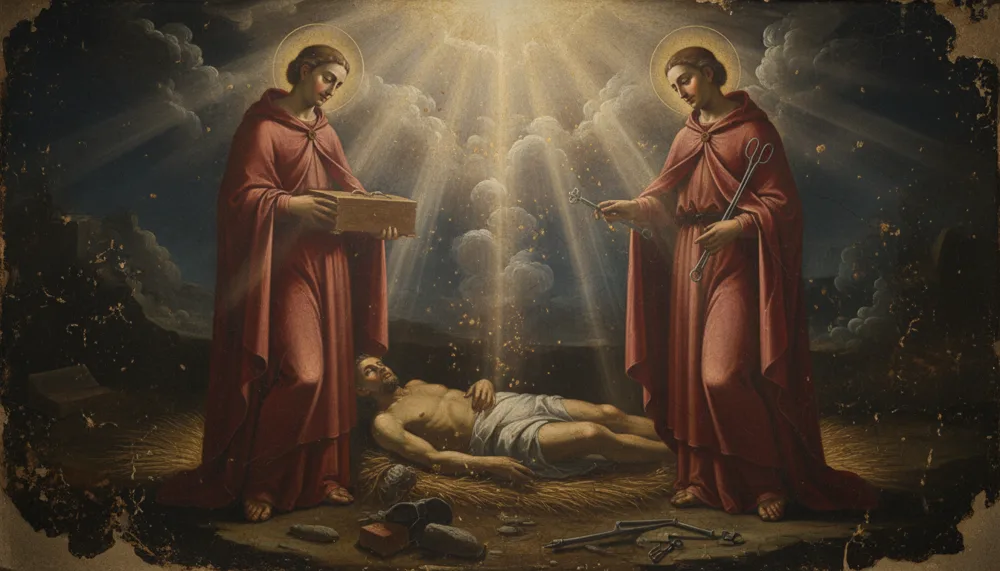
The novena to Saints Cosmas and Damian is a nine-day prayer to the twin brothers, physicians and martyrs of the early Church, asking their intercession for the healing of body and soul — most often for the sick, for a surgery or a diagnosis, for doctors and nurses, and for the grace to bear suffering as Christians.
Because they healed the sick without ever taking a fee and then gave their lives for Christ, the Church has honoured them for sixteen centuries as the holy Anargyroi, the "silverless ones," and named them in the very Canon of the Mass. Their feast falls on 27 September, and the nine days before it are the natural time to pray this novena. Below we give the full devotion, the traditional prayer, a daily form for each of the nine days, their true story from the old accounts, and answers to the questions most often asked.
The full novena to Saints Cosmas and Damian
A novena is simply nine days of steady prayer for one intention; if the practice itself is new to you, see our short guide to what is a novena. This novena is prayed once each day for nine days, ending on the eve of the feast. Each day has the same shape: begin with the Sign of the Cross, name your intention, say the traditional invocation of the two saints, add the day's short meditation and petition, and close with the Our Father, Hail Mary, and Glory Be.
The daily prayer
Say this traditional prayer on each of the nine days, naming your request where indicated:
In the name of the Father, and of the Son, and of the Holy Ghost. Amen.
O glorious martyrs of Christ, Saints Cosmas and Damian, you gave your lives for the love of God, doing good to your fellow men, and crowning your martyrdom with an open and loyal profession of your faith. You taught us to love God above all things, and to love our neighbour as ourselves, professing always, and without fear, the religion of Jesus Christ.
Through the many wonders God has worked at your intercession, you are glorious indeed before Him. By that same intercession we beg your aid in all our needs, and above all in this our present request... (here name your intention). Let your patronage never be far from us in the illness of our body and of our soul.
O great protectors, Saints Cosmas and Damian, assist us with your love, obtain for us health of soul and body, and free us from all evils. Amen.
The concluding prayer
After the day's meditation below, close with this petition and the three prayers:
O God, who in Thy providence didst give us the holy martyrs Cosmas and Damian to heal the sick without price and to bear witness to Thee unto death: grant, we beseech Thee, that by their prayers we may be delivered from the ills of the body, and, being made whole in soul, may serve Thee with a pure heart; through Christ our Lord. Amen.
Saints Cosmas and Damian, pray for us.
Then say one Our Father, one Hail Mary, and one Glory Be for your intention.
The nine days
Each day carries the same daily prayer above, with a short meditation drawn from the saints' own lives. Pray them in order over the nine days.
Day 1 — Their calling
Cosmas and Damian were brothers, born in Arabia, who studied medicine in Syria and became renowned for their skill. We ask the grace to see, as they did, that every good gift and every art comes from God, and is given us to serve Him.
Day 2 — Healing without price
They took no fee for their work, and so were called the Anargyroi, the silverless ones. We ask the grace of a generous, unmercenary charity, that we may give freely of what God has given us.
Day 3 — Physicians of the soul
They healed bodies chiefly to win souls, and many were brought to the faith of Christ by their goodness. We ask that our own health, sickness, and works may draw ourselves and others nearer to God.
Day 4 — Faith without fear
When the persecution of Diocletian broke out, they did not hide their faith but professed it openly. We ask for courage to confess Christ without fear before a world that despises Him.
Day 5 — Constancy under trial
Arrested by the prefect Lysias and commanded to deny Christ, they refused, and stood firm under torture. We ask the grace of constancy in our own trials, that no fear or pain may move us from the faith.
Day 6 — The martyr's crown
After many torments they were beheaded with the sword, sealing their witness with their blood. We ask to hold nothing — not health, not life itself — dearer than God.
Day 7 — The wonders after death
From the earliest ages the Church has honoured the miracles God worked through them, healing the sick who sought their aid. We bring before them our own request, trusting in the same power of their intercession.
Day 8 — Named in the Mass
So great was their glory that their names were placed in the Canon of the Mass, prayed at every altar. We ask to love the Holy Sacrifice, in which the whole Church, in heaven and on earth, prays as one.
Day 9 — Health of body and soul
On this last day we ask plainly, and in submission, for the favour we have carried through the novena. Physicians of body and soul, obtain for us health, if it be God's will — and above all, the health of a soul made ready for heaven.
The prayer to Saints Cosmas and Damian for healing
The heart of this devotion is healing, and many pray to the two brothers simply for the sick, apart from the full nine days. The traditional invocation above serves well as a stand-alone prayer for healing: say it at the bedside of the sick, before a surgery, or for yourself in illness, naming the person and the need.
Because Cosmas and Damian were true physicians who never once separated the care of the body from the care of the soul, their patronage is asked not only for a cure but for the grace to be healed inwardly — to bear pain patiently, to be reconciled to God, and to be made whole in the way that matters most. For a diagnosis or a long illness their help is often joined to that of the Novena to St Peregrine, the patron of the gravely sick, and to the Novena to St Raphael, the archangel of healing.
A prayer to Cosmas and Damian for surgery, for physicians and surgeons
Because they practised medicine and surgery themselves, Cosmas and Damian are the patron saints of physicians and surgeons — and of nurses, pharmacists, dentists, and all who tend the sick. Doctors and surgeons have for centuries placed their work under the two brothers' protection, and it is fitting to ask their prayers before an operation, for the hands and judgement of those who will perform it, and for the patient in their care.
The daily prayer above may be said before surgery with the intention named; some add a short petition that the physician may work "with the charity of Cosmas and Damian, seeking the good of the soul as well as the body." It is a devotion for the whole medical vocation, that it may be exercised as they exercised it — as a service of God in His suffering members.
The short novena and the daily invocation
Not everyone can keep a long form each day, and the tail of this devotion is often simply a short novena — the traditional invocation of the two saints, said once a day for nine days with the intention named, and nothing more. That is enough. The nine days matter more than the length of the words; a single heartfelt invocation of Cosmas and Damian, repeated faithfully, is a true novena. Say the daily prayer above, add "Saints Cosmas and Damian, pray for us," and leave the rest to God.
How to pray this novena
Fix an hour and keep it for the nine days — morning or evening, at a home altar or beside a candle. Name your intention plainly on the first day and carry the same one through to the ninth. The classic time to pray it is the nine days leading to the feast on 27 September — that is, from 18 September through 26 September, ending on the eve of the feast — but the novena may be prayed at any time of year, for the sick will not wait for a date on the calendar.
Where you can, join it to Holy Mass and Communion, or at least to a decade of the Rosary, for a novena is strongest when it leans on the Sacrifice of the altar. Above all, ask in submission: Thy will be done. We beg health of the body, but we ask first for health of the soul, and we accept the healing God chooses to send — which is always the one we most need.
Who are Saints Cosmas and Damian?
Cosmas and Damian were twin brothers, born in Arabia in the third century, who studied the sciences in Syria and became eminent physicians. They settled at Aegea, a seaport of Cilicia on the Gulf of Alexandretta, and there practised their art with such skill and charity that they were loved throughout the region. Being Christians, and full of the charity of Christ, they made it their rule to take no payment for their healing — and it is from this that they earned their enduring title, the Anargyroi, "the silverless," the holy unmercenary physicians. By their goodness and their open profession of the faith, many were brought to Christ.
When the persecution of Diocletian broke out at the end of the third century, the two brothers were seized by order of Lysias, prefect (or governor) of Cilicia, and commanded to renounce their faith. They refused. The old accounts tell of many torments, from which — the tradition holds — they came away unharmed, so that they suffered no injury from water, fire, or the cross; and at the last they were beheaded with the sword, on 27 September, likely in the year 287 during the earliest wave of the persecution. Three brothers — Anthimus, Leontius, and Euprepius — are named as suffering martyrdom with them. Their bodies were carried to Cyrus in Syria, which held them in honour.
Their cult spread swiftly and widely. The Emperor Justinian, believing himself cured through their intercession, restored and adorned their church at Constantinople; at Rome, Pope St Felix IV (526–530) raised a basilica in their honour in the Forum, whose ancient mosaics survive to this day. Above all, their names were inscribed in the Canon of the Mass, where they are still prayed among the martyrs, and in the Litany of the Saints.
The Church keeps their feast on 27 September; the modern calendar observes it on 26 September, but those attached to the 1962 books will find them on the 27th. They are honoured as patrons of physicians, surgeons, pharmacists, and the sick, and are invoked especially by twins, who see in these two brothers, one in life and one in death, the image of their own bond.
Frequently Asked Questions
Who are Saints Cosmas and Damian?
They were twin brothers, physicians and martyrs of the third century, born in Arabia and martyred at Aegea in Cilicia under the persecution of Diocletian, about the year 287. They healed the sick without ever taking a fee — which is why they are called the Anargyroi, "the silverless" — and were beheaded for refusing to deny Christ. They are among the most anciently venerated of all the martyrs, named in the Canon of the Mass.
What are Saints Cosmas and Damian the patron saints of?
They are the patron saints of physicians and surgeons, and with them of nurses, pharmacists, dentists, and all who care for the sick; of the sick themselves; and, because they were twins, of twins. Being healers who never sought profit, they are also held up as models of charitable, unmercenary service. They are invoked for healing of body and soul, before surgery, and in serious illness.
When is the feast of Saints Cosmas and Damian?
Their feast is kept on 27 September, the traditional date in the 1962 calendar and the day of their martyrdom. The modern Roman calendar moved the memorial to 26 September. Either way, the nine days before the feast — 18 to 26 September in the traditional reckoning — are the customary time to pray the novena, though it may be prayed whenever there is need.
Why are they called the "silverless" or "unmercenary" physicians?
Because they refused to accept any payment for their medical care. The Greek title Anargyroi means literally "without silver," and the English "unmercenary physicians" says the same: they healed for the love of God and neighbour, not for money. Their charity was itself a kind of preaching, and by it many were converted. The title is a standing rebuke to any healing art that forgets the poor.
What do you pray to Saints Cosmas and Damian for?
Chiefly for healing — of body and of soul. People pray this novena for the sick, for a good outcome to a surgery or a diagnosis, for chronic illness, for those who tend the sick, and for the grace to bear suffering as Christians. Because the two brothers cared for souls as well as bodies, the devotion always asks not only for a cure, but for the deeper health of a soul reconciled to God. Pray it in submission to God's will.
How do I pray the novena to Saints Cosmas and Damian?
Say the traditional prayer once each day for nine consecutive days, naming your intention, and close with an Our Father, Hail Mary, and Glory Be. You may add the short daily meditation given above and the concluding prayer. Keep the same intention throughout, pray at a fixed hour, and if you can, join the novena to Holy Mass. The nine days before 27 September are the classic time, but any nine days will do.
Are Saints Cosmas and Damian in the Canon of the Mass?
Yes. Their names are among the martyrs invoked in the Roman Canon — the ancient first Eucharistic Prayer — a sign of how deeply the early Church honoured them. To pray this novena is therefore to join a devotion the whole Church has carried at her altars for more than fifteen hundred years.
The Iter Fidei app carries this novena, with the prayers to Saints Cosmas and Damian in Latin and your own language, day-by-day reminders, and audio — so it can be prayed from your phone through all nine days. Get the app link by email here.
Sources. Butler, Lives of the Saints, 27 September, Sts Cosmas and Damian, Martyrs; the traditional invocation of Sts Cosmas and Damian as carried in Catholic prayer-books; the Roman Missal of 1962 (feast of 27 September) and the Canon of the Mass, in which the two martyrs are named; the Litany of the Saints.