
News
German missal: the revision reopens the question of “for many”
The German-speaking bishops open a new revision of the missal, with “inclusive” language and the expectation of keeping “for all” rather than the consecration’s “for many.”
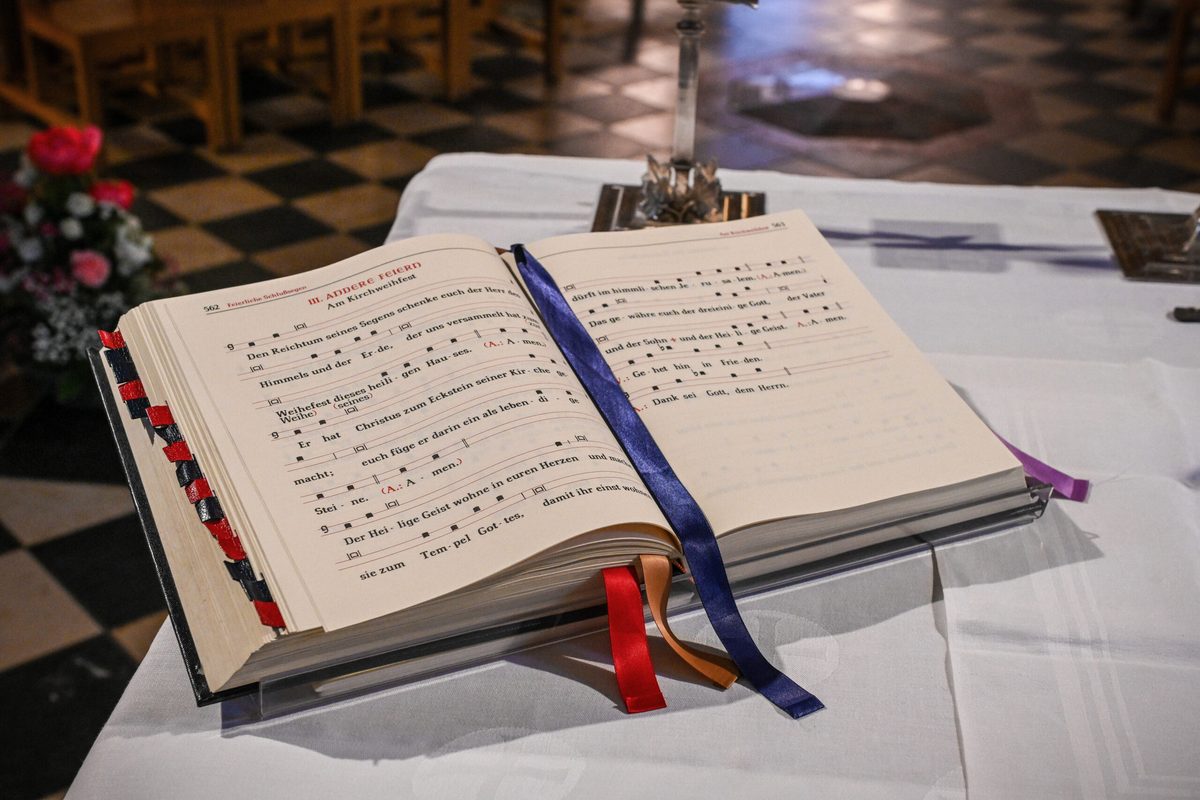
The liturgical commission of the German-speaking bishops, acting for the episcopates of Germany, Austria and Switzerland, has opened a new phase in the revision of the German missal, whose current edition dates back to 1975. A consultation phase opens in November 2026: experts and pastoral workers may submit proposals and justifications until the end of June 2027, newly translated texts will be trialled from the first half of 2027 in selected parishes and monastic communities, and the new missal is announced for 2033.
The priest who heads the German liturgical institute and co-leads the project has said that the language of the missal should be "as inclusive as possible." He specified: "Naturally, where today only the brothers appear, the sisters will also be added," adding that "in general, the language should be as inclusive as possible, and strongly masculine images of God will likewise be handled with care." On the very words of the consecration, he said he expects a vote of the German-speaking bishops to turn out as in Italy, where the episcopate kept "for all" (per tutti) and had it approved, rather than the literal "for many" (pro multis, für viele).
This point is not settled, and it is disputed. In a letter of 14 April 2012 addressed to the German bishops, Benedict XVI had asked that the translation retain the literal "for many" (für viele), faithful to the Latin pro multis, while acknowledging that "for all" remained "an interpretation that was and remains thoroughly well founded." What the man in charge of the file advances is therefore not a decision but an expectation: no act has fixed the text of the consecration, and the missal is not promised before 2033.
What the Church has always held on the form of the chalice
The consecratory form of the Precious Blood is not an interchangeable turn of phrase. The Catechism of the Council of Trent, written for parish priests in the wake of the Council, gives its letter and its reason. The form is: "This is the Chalice of My Blood, of the new and eternal Testament, the mystery of the Faith, which shall be shed for you and for many, unto the remission of sins."
The words "for you and for many," the Catechism explains, serve to express the fruits of the Passion: "If we consider, indeed, the virtue and the efficacy thereof, we are obliged to confess that the Blood of the Lord was shed for the salvation of all"; but if we consider the fruit, it does not profit all. And the Catechism concludes without detour: "Thus it is with reason that it was not said, for all, since there was here question of the fruit of the Passion, which procured salvation for the elect only."
The measure
The Latin says pro multis, "for many," and the Roman Catechism teaches that this is not an imprecision to be corrected but a truth to be kept: the form distinguishes the infinite value of the Blood shed, sufficient for all, from the fruit it produces, received by those alone who dispose themselves to it. To render pro multis by "for all" erases precisely the distinction that the Church wished to inscribe in the most holy words of the entire rite.
This is therefore no matter of sensibility or style: it is the very doctrine of the Sacrifice that hangs on a single word. As for the design of making "the language as inclusive as possible" and retouching "strongly masculine images of God," it measures the liturgy by the spirit of the age rather than the reverse; yet the missal does not receive its law from the language of men, it bears the faith received.
What this means for the faithful
Nothing has yet been promulgated: this is a phase of work and an expectation voiced by a man in charge, not a decree. The faithful attached to the 1962 Roman Rite find in their missal the form that the Catechism of Trent comments word for word: pro multis, "for many." That is the sure text, and the reason to hold to it is not nostalgia but the doctrine it protects. One may follow this work with vigilance, without prejudging its outcome and without drawing from it any conclusion that belongs to the Church alone.
Sources. Catechism of the Council of Trent (1566), on the Sacrament of the Eucharist, on the form of the consecration of the chalice ("for you and for many"); St. Matthew XXVI, 28 and St. Luke XXII, 20, according to the Douay-Rheims version of the Vulgate.