
News
In France, Leo XIV sets the right to life against the assisted-dying debate
On his visit to France, Leo XIV defended the right to life against assisted dying; we measure his words against the fifth commandment.
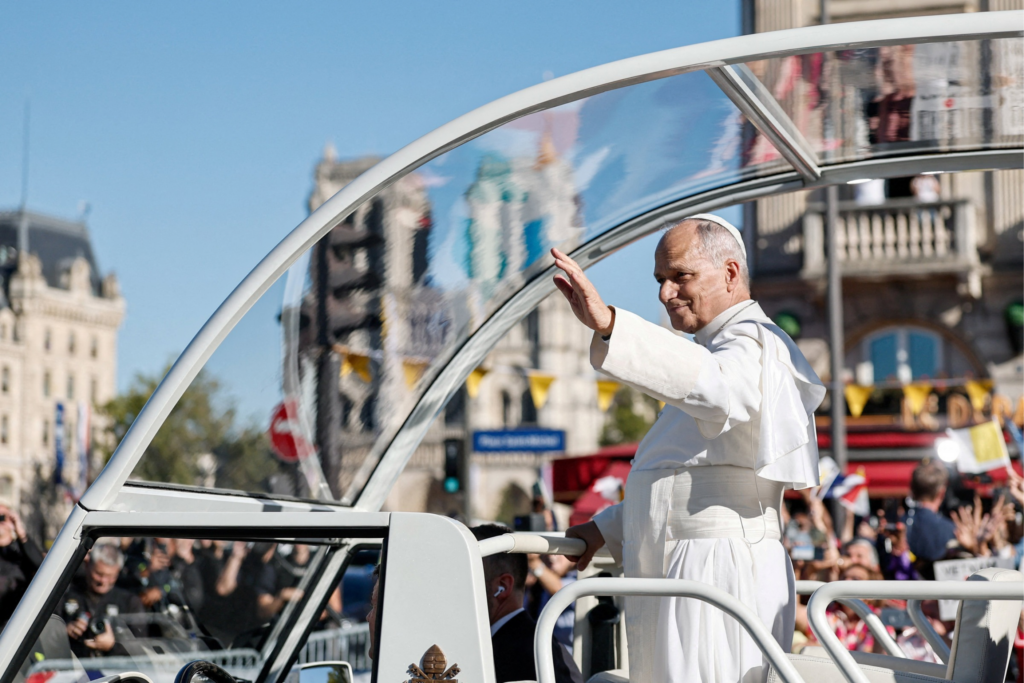
From 25 to 28 September 2026, Leo XIV made an apostolic journey to France, the first visit by a pope to that country in eighteen years. As France debates a law on assisted dying, the pope made the defence of life the thread of his interventions, from the Élysée to Lourdes and then to Metz.
On his arrival, before the head of state, he declared: "I reaffirm with force that the protection of the right to life constitutes the inescapable foundation of every other human right." On Sunday 27 September at Lourdes, addressing a severely disabled woman, counted among the million people deemed "eligible" for assisted dying, he added: "It is impossible to regard the giving of death as normal. What is legal is not necessarily moral!" On Monday 28 September at Metz, before leaders of countries of the Union, he spoke of serving life "to the very end": "To serve life is to surround it with care, presence and tenderness, above all in trial, to the very end."
On secularism, he maintained at the Élysée that "true secularism does not exclude the religious dimension, but on the contrary knows how to draw on it as an educational resource." Behind closed doors before the bishops of France, he affirmed that the word of the Church "has its full place in public debate in France" and possesses "by its nature, a prophetic authority."
That same 28 September, designated "International Safe Abortion Day," eleven states — Denmark, Estonia, Finland, France, Iceland, Lithuania, Luxembourg, the Netherlands, Norway, Spain and Sweden — issued a joint declaration presenting access to abortion as essential to bodily autonomy, gender equality and human rights. Two voices, the same day, on the same life.
The fifth commandment
The law is ancient and does not vary: "Thou shalt not kill" (Exodus 20:13). The Catechism of the Council of Trent, explaining the fifth commandment, teaches that no man, neither by private authority nor under cover of any law, has the right to take the life of the innocent. The unborn child and the sick are foremost among these innocents. Pius XI said it again against abortion: the life of each is equally sacred, and no reason can ever avail to excuse the direct killing of the innocent (Casti connubii, 1930).
The measure
On this point, the words spoken in France rejoin the constant doctrine: to give death to the weak never becomes an act of care, and the legality of an act does not make it moral. We say it plainly, as we would say the contrary: to defend the life of the innocent is to hold the place the Church has always held. The declaration of the eleven states walks in exactly the opposite direction. It sets "autonomy" up as a principle superior to the life of the innocent; yet no autonomy, no consensus of governments, can make licit what the fifth commandment forbids absolutely. What is voted is not thereby permitted before God.
What to take from it
The faithful need not wait for a majority to confirm it. Neither assisted dying nor abortion ceases to be the killing of the innocent because a law authorises it. To serve life "to the very end" is to surround the dying and the suffering with care and presence, never to hasten their end. Such is the only path the tradition recognises.
Sources. Exodus 20:13 (Vulgate); Catechism of the Council of Trent (1566), on the fifth commandment; Pius XI, Casti connubii (1930), on the direct killing of the innocent.