
News
At UNESCO, Leo XIV defends the dignity of the dying against assisted dying
At UNESCO, Leo XIV held that human dignity remains intact in illness and at the end of life; we measure his words against the fifth commandment.
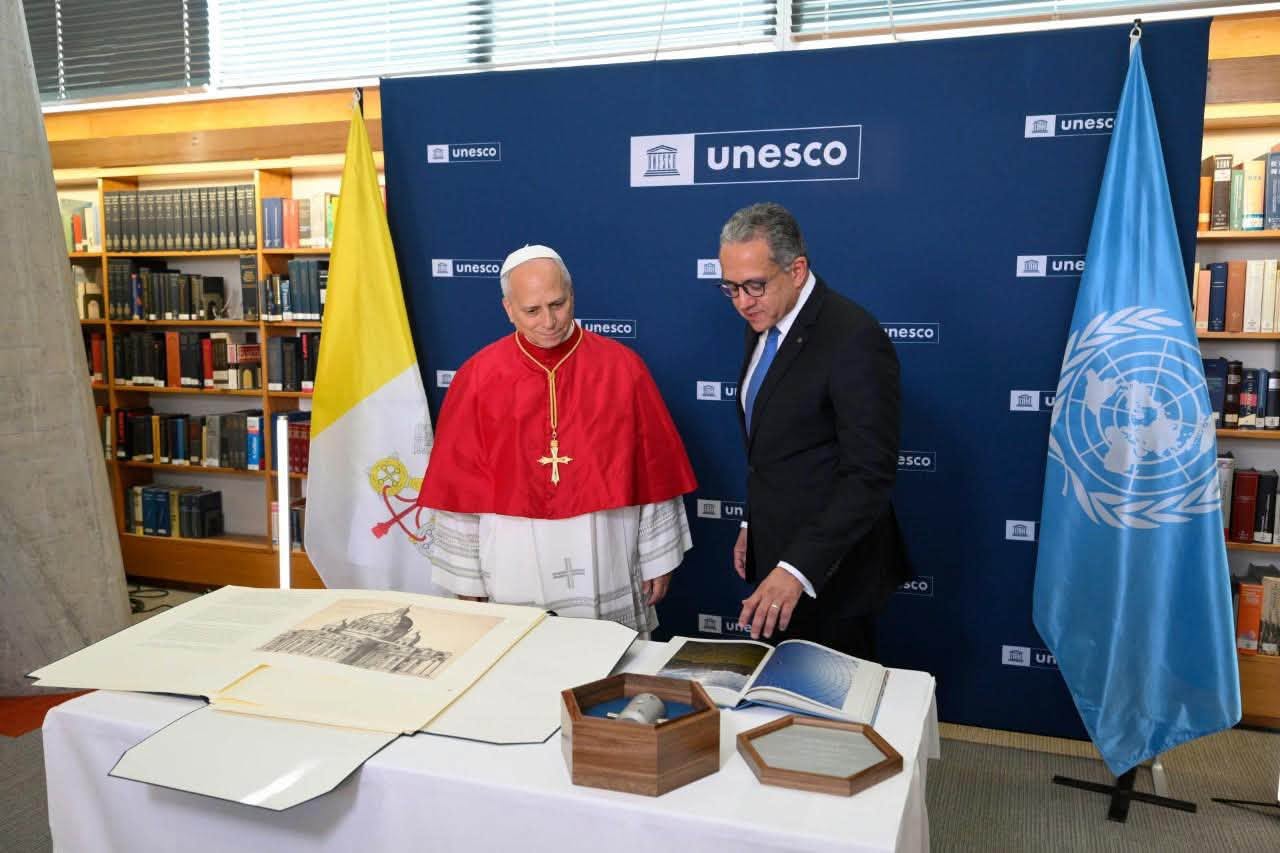
On Friday 25 September 2026, Pope Leo XIV went to the headquarters of UNESCO, in the 7th arrondissement of Paris, to deliver an address built around a single question: “What does it mean to be human?” It is the first time a pope has addressed this organisation since John Paul II in 1980. Before the delegates, he held that neither science nor technology can answer that question alone, and he defended the dignity of human life at every age, at birth as at the end of life, as France has just adopted its law on assisted dying.
“The human being is also the one who dies,” he said; “our dignity is not destroyed by illness or suffering, it remains intact at every stage of life.” He tied the future of peoples to “respect for and the promotion of the dignity of every human being created in the image of God.” On artificial intelligence, he warned that it can multiply disinformation, asked that it remain “at the service of the person” and not an instrument of domination, and called for children to be protected from the exploitation of their vulnerability online. Education itself, he added, “when it abandons the truth becomes an instrument for manipulating consciences.”
What tradition teaches
The fifth commandment admits no exception of condition or of age. The Catechism of the Council of Trent states it without detour: “Prohibition to kill whomsoever it be! The Law extends to all. There is no one, whatever be the lowliness of his condition, who is not protected by it.” And it goes further than the killing of another: “Nay more, prohibition to kill oneself.
None has power enough over his own life to give himself death when it pleases him.” The divine law does not say “thou shalt not kill others,” the Catechism observes, but simply “thou shalt not kill.” The reason is given from Genesis onward: it is forbidden to kill man “because God created him to His image and His likeness,” and he who sheds that blood makes “His image disappear from the midst of the world.”
The measure
On this point, the word spoken in Paris meets the constant doctrine of the Church. To affirm that dignity “is not destroyed by illness or suffering” and that it remains “intact at every stage of life” is to restate what Trent teaches: the life of the sick and of the dying is protected by the same precept as that of every other man, and no one owns his own life so as to dispose of it.
The French law on assisted dying stands precisely at the opposite: it organises what the Decalogue forbids absolutely, down to “contributing thereto by one’s counsels, by one’s means, by one’s help or in any manner whatsoever.” The Catechism ranks homicide among the crimes that “destroy, as much as is in them, the work of God.” To defend the dignity of the dying in words and to arm the hand that cuts his life short are two irreconcilable things.
For the faithful
Nothing is subtracted from the fifth commandment in the name of compassion. The relief owed to the sick is a duty the same precept commands, that of the charity which makes us “relieve the poor in what is necessary to them”; but to relieve is never to kill. The faithful will hold the two together, as the Church has always held them: one keeps watch beside the one who suffers, one does not hasten his death. As for the warning about the new techniques, it holds only so far as it stays ordered to that first truth: man is the image of God from the first breath to the last.
Sources. Catechism of the Council of Trent (1566), on the fifth commandment (“Thou shalt not kill”), §§ II and IV. Genesis I, 27 and IX, 6 (Vulgate).