
News
At the UN, Cardinal Parolin demands peace in Gaza and Ukraine
Before the UN General Assembly, Cardinal Parolin called for an end to the fighting in Gaza and Ukraine and denounced the persecution of Christians; we weigh his words against the perennial doctrine of peace and the just war.
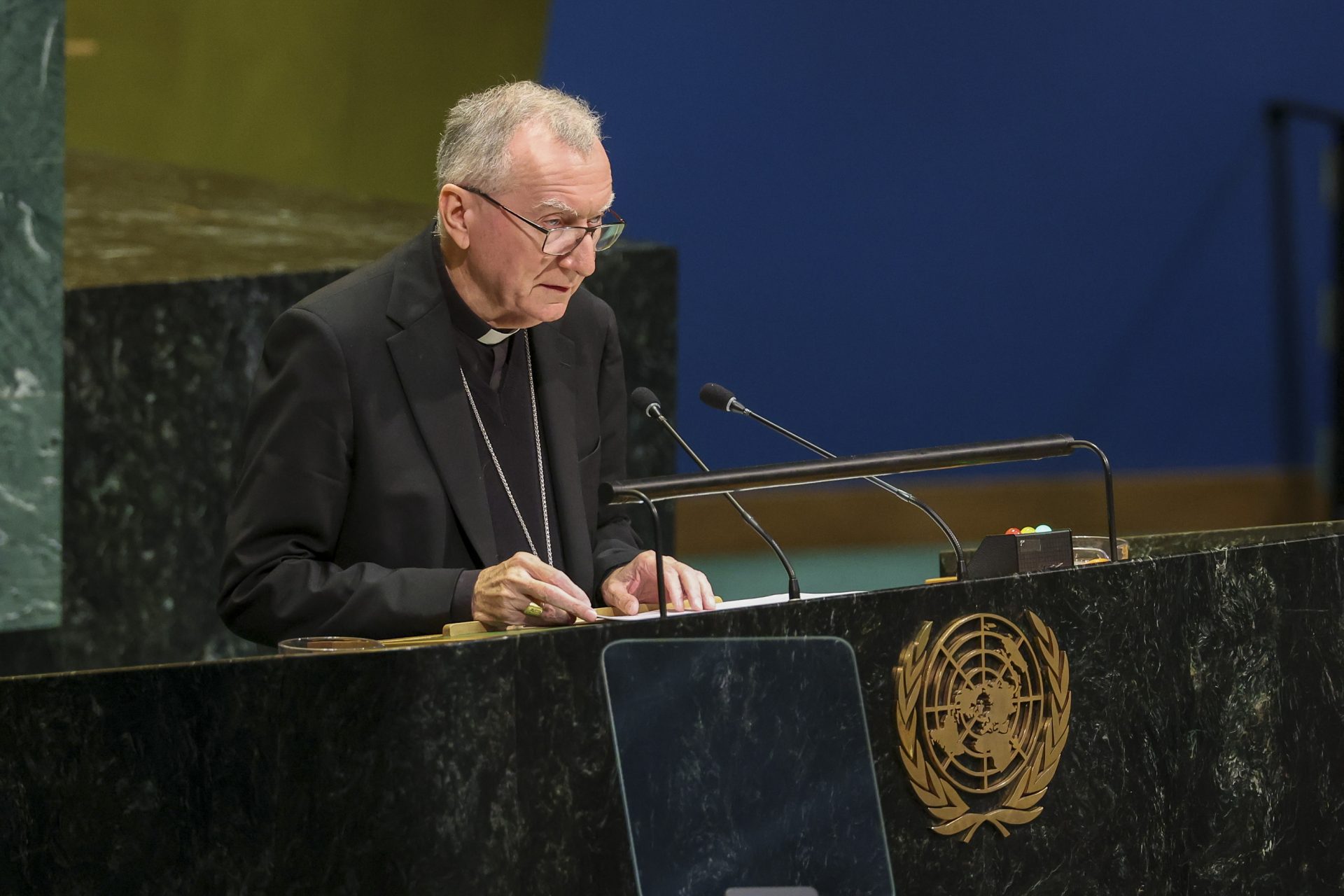
On 26 September 2026, before the 81st session of the United Nations General Assembly meeting in New York, the Secretary of State of the Holy See, Cardinal Pietro Parolin, called for the immediate cessation of hostilities in Gaza and in Ukraine. Conveying the greetings of Pope Leo XIV, he called the session's theme, “Rebuilding trust, managing transformation,” an “urgent moral and political imperative.” On Gaza, he denounced the destruction of hospitals, energy infrastructure and homes as a “grave violation of international humanitarian law” and warned of a “terrible humanitarian crisis” marked by mass displacement.
On Ukraine, after more than four years of war, he noted a death toll that keeps rising and demanded “an immediate, complete and effective ceasefire.” He welcomed the recent “Trilateral Framework Agreement” between the United States, Israel and Lebanon, denounced the persecution of Christians “in many parts of the world,” and warned against lethal autonomous weapons systems, whose responsibility “cannot be delegated to opaque or automated processes.”
The perennial measure: peace is order, not the mere silence of arms
The tradition measures a war neither by the calendar nor by outrage, but by justice. Saint Augustine defines peace as “the tranquillity of order” and teaches that one does not wage war for the sake of war: war is waged in order to obtain peace, never the reverse. The doctrine of the just war, received from Saint Augustine and fixed by Saint Thomas Aquinas, requires legitimate authority, a just cause and a right intention, and forbids striking the innocent.
The Catechism of the Council of Trent, expounding the fifth commandment, ranks among forbidden killings the murder of the innocent, and holds that no one may take life without just cause. As for persecution, it is nothing new under the sun: “If they have persecuted me, they will also persecute you,” says Our Lord, and “Blessed are they that suffer persecution for justice' sake.”
The measure of the appeal
Tested against this rule, the call to silence the guns and to spare the hospitals, homes and food of the population accords with the eternal law: to strike the innocent and to starve him are, according to the fifth commandment, evils that no reason of State can justify. Likewise, to demand that responsibility for the use of force remain under “conscious and responsible” human control, and not be handed to the machine, is to restate what morality has always held: the human act, and the guilt attached to it, presuppose the intelligence and will of a man; a weapon that kills with no responsible agent dissolves moral judgment itself. On these points the cardinal's words meet the received doctrine, and we say so plainly.
A word of prudence, however. True peace is not the mere silence of the cannon, but “the tranquillity of order” — of an order founded on justice and, ultimately, on the acknowledgment of God. To demand a ceasefire is just; it becomes a lasting peace only if the order restored is a just order, and this measure holds for all parties, without exception. This is what the tradition imposes on whoever invokes peace: not a truce that reconducts injustice, but the order that God wills among the nations.
Sources. Catechism of the Council of Trent (1566), on the fifth commandment. Saint Augustine, The City of God, Book XIX, ch. 13, and Letter 189 to Boniface. Saint Thomas Aquinas, Summa Theologica, IIa-IIae, q. 40, on war. Gospel according to Saint John, XV, 20, and according to Saint Matthew, V, 10 (Vulgate).