
News
At Lourdes, Leo XIV entrusts France to the Immaculate and offers the Golden Rose
At the grotto of Massabielle, Pope Leo XIV entrusted France to Our Lady of Lourdes and laid the Golden Rose at the feet of the Immaculate Conception.
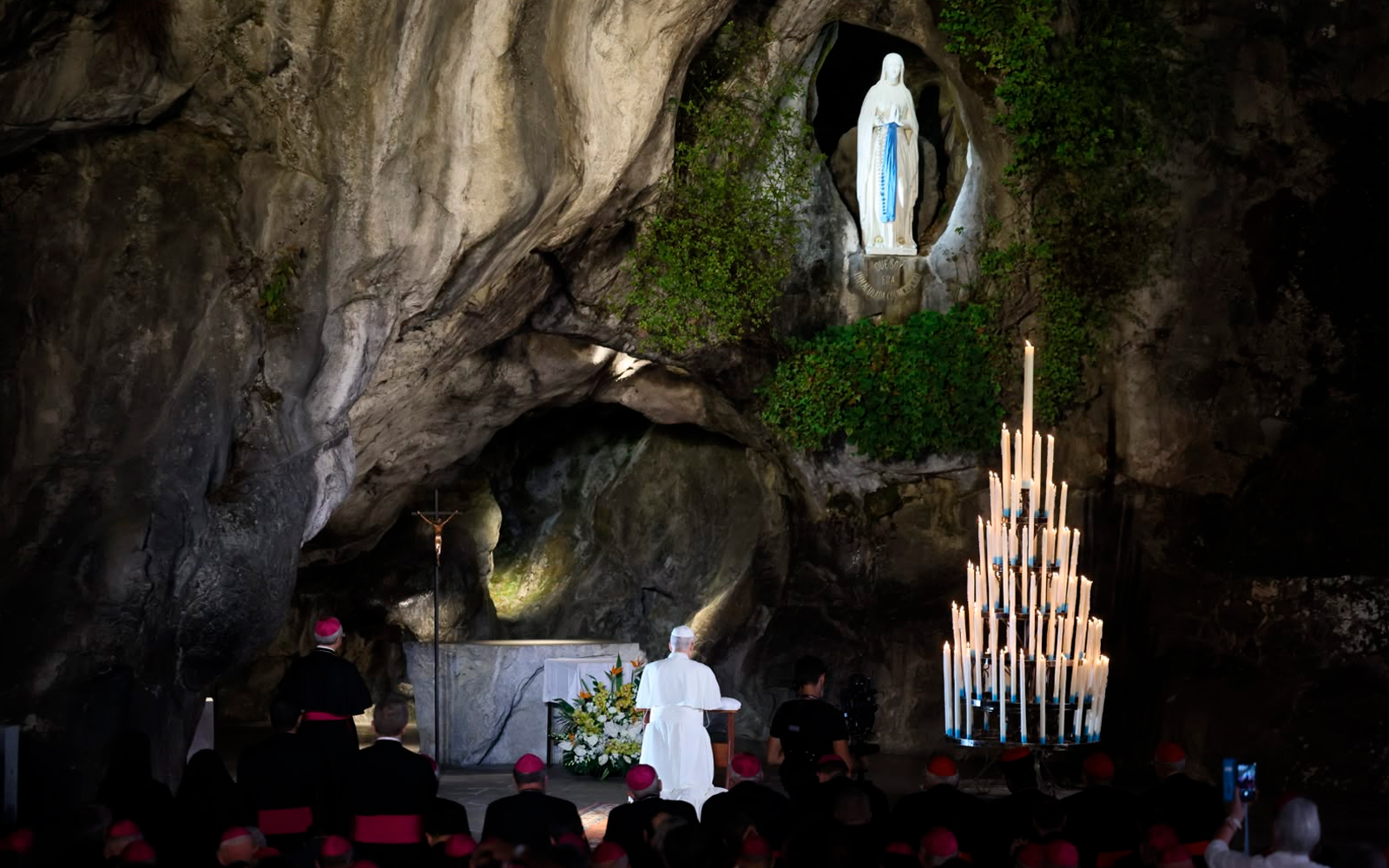
On Saturday, September 26, at the grotto of Massabielle, the second stage of his journey in France, Pope Leo XIV paused in silence before the statue of the Virgin, touched the rock, drank at the spring and lit a candle, then entrusted France to Our Lady of Lourdes. At the close of his prayer, he laid the Golden Rose at the feet of the statue of the Immaculate Conception. It was in this place that the Virgin appeared in 1858 to Saint Bernadette Soubirous.
Before the grotto, he asked for France “wise and generous rulers, ready for the sacrifice of themselves, able to face the challenges and resolved to serve the common good,” and for its people “the gift of fraternal concord,” in a society “free of all violence and all hatred, where each person may work, found a family and live his life to the end in tranquillity and serenity.”
What the Church has always held
The Immaculate Conception is not one devotion among others: it is a dogma. On December 8, 1854, in the bull Ineffabilis Deus, Pius IX defined that the Blessed Virgin Mary was, from the first instant of her conception, preserved from every stain of original sin. Four years later, at Massabielle, the Lady answered Bernadette, who had asked her name: “I am the Immaculate Conception.” Heaven thus sealed the definition of Rome.
The Golden Rose the Pope laid down is an ancient pontifical distinction, blessed on the fourth Sunday of Lent (Laetare) and granted to the sanctuaries and renowned images of Christendom. To pray for those who govern is likewise an apostolic precept: “I desire therefore, first of all, that supplications, prayers, intercessions and thanksgivings be made for all men: For kings and for all that are in high station: that we may lead a quiet and a peaceable life in all piety and chastity” (I Tim. II, 1-2).
The measure
A pope who kneels before the Immaculate, venerates the place of her apparitions and entrusts a nation to her protection performs an act the tradition recognizes without reserve. France, eldest daughter of the Church, was vowed to the Virgin by Louis XIII in 1638; to say it to her again is not a novelty but a fidelity. We say it with the same plainness as our ordinary reservations: this act is good, and in keeping with what the Church has always taught.
The request for a life lived “to the end” has been read as an allusion to the recent French law on the end of life. The Pope did not name that law; this is an interpretation, not an explicit word, and we give it as such. The doctrine, however, is explicit: the fifth commandment forbids taking the life of the innocent, and the Catechism of the Council of Trent, explaining that commandment, teaches that none has power over his own life to give himself death when it pleases him, nor over the life of another. On this point, the prayer meets the law of God.
For the faithful
The pilgrimage to Lourdes, the rosary, trust in the Immaculate: none of this has grown old. Where an act of the government of the Church accords with the faith of all time, we acknowledge it without reservation, just as we note without evasion whatever departs from it. Here, there is only to pray with the Pope for France, and to have recourse, like Bernadette, to her who is without sin.
Sources. Pius IX, bull Ineffabilis Deus (December 8, 1854); Catechism of the Council of Trent (1566), on the Fifth Commandment; I Timothy II, 1-2 (Douay-Rheims); the apparitions of Lourdes (1858) and the word of the Immaculate to Saint Bernadette Soubirous.