
Novenas
St Bridget Novena: The Full Nine Days & 12-Year Prayers
The full novena to St Bridget of Sweden, day by day with all the prayers — plus an honest answer on the famous 12-year novena and the 15 prayers, and the life of the widow, pilgrim and mystic of the Passion.
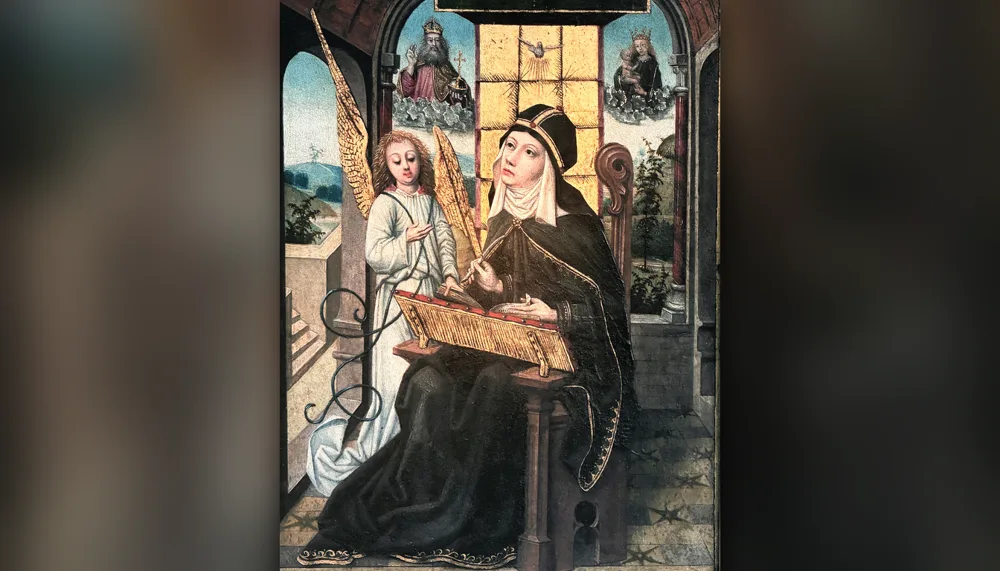
The novena to St Bridget of Sweden is nine days of prayer asking the intercession of the wife, mother, widow and pilgrim to whom our Lord unveiled the secrets of His birth and His Passion. We bring her the needs she knew herself: a household in trial, a bereavement, a journey, a conversion long awaited, a heart that has grown cold before the Cross. It is traditionally begun on 30 September and ended on 8 October, her feast in the calendar of 1962, but it may be prayed at any time of year, whenever a pressing need presses hard.
Below is the whole novena as we pray it — the nine meditations, the daily invocation, the proper petition of each day, the Our Father, three Hail Marys and Glory Be, and the closing versicle and Collect from the Roman Missal. Further down we answer the question most people are really asking when they search for the "St Bridget novena": the famous twelve-year novena and the fifteen prayers on the Passion, what they are, and what the Church has actually said about the promises attached to them.
The Novena to St Bridget of Sweden
The daily prayer — said on each of the nine days
Begin every day with the Sign of the Cross.
In the name of the Father,
and of the Son,
and of the Holy Ghost.
Amen.
Recollect thyself a moment in silence, then say the daily invocation, which is recited on each of the nine days before the meditation proper to the day.
St Bridget of Sweden, faithful spouse of Christ, mother, widow, and pilgrim, to whom the Lord revealed the secrets of His birth and His Passion, I trust in thy powerful intercession before the throne of God. Thou who didst sanctify every state of life by faith and love, obtain for me a lively faith and a burning love for the Cross of the Saviour; and I earnestly beseech thee to obtain for me also, if it please God and if it be good for my soul, the grace I ask in this novena.
Here name, simply and plainly, the intention thou entrustest to St Bridget — the same throughout the nine days.
St Bridget of Sweden, pray for us. Amen.
Then take the meditation and the petition of the day, and close with the Our Father, three Hail Marys and the Glory Be.
Day 1 — The wife and mother
Bridget was born about 1303 of one of the noblest houses of Sweden, daughter of Birger, governor of Upland, and reared in the fear of God by a devout father. Given young in marriage to Ulf Gudmarsson, prince of Nericia, she was for twenty-eight years a faithful wife and bore him eight children, whom she brought up in piety; among them was she who would become St Catherine of Sweden. Great among the great of her land, she governed her household as a Christian mother and never forgot the poor.
St Bridget, faithful wife and mother of a numerous household, thou didst sanctify the married state by patience, prayer, and the Christian rearing of thy children: obtain for our families concord, and for parents the grace to raise their children before all else for Heaven.
Our Father, who art in heaven,
hallowed be Thy name.
Thy kingdom come.
Thy will be done
on earth as it is in heaven.
Give us this day
our daily bread.
And forgive us our trespasses,
as we forgive
those who trespass against us.
And lead us not into temptation,
but deliver us from evil.
Amen.
Hail Mary, three times:
Hail Mary, full of grace;
the Lord is with thee.
Blessed art thou amongst women,
and blessed is the fruit of thy womb, Jesus.
Holy Mary, Mother of God,
pray for us sinners,
now and at the hour of our death.
Amen.
Glory be to the Father, and to the Son,
and to the Holy Ghost.
As it was in the beginning,
is now, and ever shall be,
world without end.
Amen.
Day 2 — The devout widow
After a pilgrimage to St James of Compostela made together, Ulf fell ill and died a holy death in the Cistercian abbey of Alvastra. Bridget, at his side to the end, laid aside the ornaments of her rank, gave herself to penance and prayer, and clothed her widowhood in poverty and works of mercy. What the world counts a loss she made the gate of a wholly new life given to God alone.
St Bridget, who in thy widowhood didst turn thy sorrow into an offering and give thyself without reserve to God: obtain for all widows consolation and courage, and for us the grace to find, even in bereavement, the beginning of a closer union with the Lord.
Our Father, who art in heaven,
hallowed be Thy name.
Thy kingdom come.
Thy will be done
on earth as it is in heaven.
Give us this day
our daily bread.
And forgive us our trespasses,
as we forgive
those who trespass against us.
And lead us not into temptation,
but deliver us from evil.
Amen.
Hail Mary, three times:
Hail Mary, full of grace;
the Lord is with thee.
Blessed art thou amongst women,
and blessed is the fruit of thy womb, Jesus.
Holy Mary, Mother of God,
pray for us sinners,
now and at the hour of our death.
Amen.
Glory be to the Father, and to the Son,
and to the Holy Ghost.
As it was in the beginning,
is now, and ever shall be,
world without end.
Amen.
Day 3 — The Revelations
God granted to Bridget, above all in her widowhood, wonderful visions, which she set down at the bidding of her confessors: the Revelations. She contemplated the sufferings of the Passion as though present at Calvary, and at Bethlehem the Nativity of the Lord — the Child laid upon the ground, and the Virgin kneeling in adoration before Him in a great light. From these visions the Church has drawn much of her devotion to the Crib and to the Cross.
St Bridget, to whom the Lord unveiled the mysteries of His birth and His Passion: obtain for us a living faith, that we may contemplate with love the God who was born in poverty and died upon the Cross for our salvation.
Our Father, who art in heaven,
hallowed be Thy name.
Thy kingdom come.
Thy will be done
on earth as it is in heaven.
Give us this day
our daily bread.
And forgive us our trespasses,
as we forgive
those who trespass against us.
And lead us not into temptation,
but deliver us from evil.
Amen.
Hail Mary, three times:
Hail Mary, full of grace;
the Lord is with thee.
Blessed art thou amongst women,
and blessed is the fruit of thy womb, Jesus.
Holy Mary, Mother of God,
pray for us sinners,
now and at the hour of our death.
Amen.
Glory be to the Father, and to the Son,
and to the Holy Ghost.
As it was in the beginning,
is now, and ever shall be,
world without end.
Amen.
Day 4 — The pilgrim
Bridget was a great pilgrim. With her husband she had journeyed to St James of Compostela; a widow, she set out for Rome in the Holy Year and made the City her home, visiting its churches and the tombs of the Apostles and Martyrs. Later she went even to the Holy Land, to Jerusalem, that she might tread the very ground the Saviour had trodden. She sought God upon the roads of this world as a stranger and pilgrim hastening to her true country.
St Bridget, tireless pilgrim to the shrines of the Apostles and to the holy places of our Redemption: obtain for us to walk through this life as pilgrims to Heaven, never setting our hearts upon the passing things of earth.
Our Father, who art in heaven,
hallowed be Thy name.
Thy kingdom come.
Thy will be done
on earth as it is in heaven.
Give us this day
our daily bread.
And forgive us our trespasses,
as we forgive
those who trespass against us.
And lead us not into temptation,
but deliver us from evil.
Amen.
Hail Mary, three times:
Hail Mary, full of grace;
the Lord is with thee.
Blessed art thou amongst women,
and blessed is the fruit of thy womb, Jesus.
Holy Mary, Mother of God,
pray for us sinners,
now and at the hour of our death.
Amen.
Glory be to the Father, and to the Son,
and to the Holy Ghost.
As it was in the beginning,
is now, and ever shall be,
world without end.
Amen.
Day 5 — The reformer
God made Bridget His messenger to the great ones of the earth. Fearless, she reproved the vices of princes, prelates, and peoples, and called kings to justice and the clergy to holiness. Above all she laboured and prayed that the Sovereign Pontiff, then dwelling at Avignon, might return to Rome, to the see of St Peter; and she warned of the chastisements that unrepented sin would bring. She spoke plainly to the mighty, seeking not her own advantage but the good of the Church.
St Bridget, who didst rebuke the great without fear and love the Church without measure: obtain for us the courage to profess the truth, filial love for the Vicar of Christ, and zeal for the good of souls.
Our Father, who art in heaven,
hallowed be Thy name.
Thy kingdom come.
Thy will be done
on earth as it is in heaven.
Give us this day
our daily bread.
And forgive us our trespasses,
as we forgive
those who trespass against us.
And lead us not into temptation,
but deliver us from evil.
Amen.
Hail Mary, three times:
Hail Mary, full of grace;
the Lord is with thee.
Blessed art thou amongst women,
and blessed is the fruit of thy womb, Jesus.
Holy Mary, Mother of God,
pray for us sinners,
now and at the hour of our death.
Amen.
Glory be to the Father, and to the Son,
and to the Holy Ghost.
As it was in the beginning,
is now, and ever shall be,
world without end.
Amen.
Day 6 — The foundress
Bridget received in her visions the rule of a new religious family, dedicated to the honour of the Saviour and of His holy Mother. Though she did not see it flourish in her lifetime, the great monastery of Vadstena rose after her in her native Sweden, and the Order of the Most Holy Saviour — the Bridgettines — spread her spirit of prayer and penance through many lands. What God had shown her, He brought to pass in His own hour.
St Bridget, foundress whom God made the mother of a religious family devoted to His Saviour and His Mother: obtain for the Church holy vocations, and for us a spirit of prayer and penance in the state to which God has called us.
Our Father, who art in heaven,
hallowed be Thy name.
Thy kingdom come.
Thy will be done
on earth as it is in heaven.
Give us this day
our daily bread.
And forgive us our trespasses,
as we forgive
those who trespass against us.
And lead us not into temptation,
but deliver us from evil.
Amen.
Hail Mary, three times:
Hail Mary, full of grace;
the Lord is with thee.
Blessed art thou amongst women,
and blessed is the fruit of thy womb, Jesus.
Holy Mary, Mother of God,
pray for us sinners,
now and at the hour of our death.
Amen.
Glory be to the Father, and to the Son,
and to the Holy Ghost.
As it was in the beginning,
is now, and ever shall be,
world without end.
Amen.
Day 7 — The love of the Passion
The whole life of Bridget was fixed upon the Cross. To her are ascribed the fifteen prayers on the Passion of the Lord, long recited by the faithful in memory of His wounds and His sufferings. She wept over the sins that had crucified her Saviour and found in His five wounds the refuge of her soul; and she taught countless Christians after her to love the Crucified.
St Bridget, faithful lover of the Passion of Jesus: obtain for us to keep ever before our eyes the wounds of our Redeemer, to grieve for the sins that caused them, and to draw from His Cross the strength to bear our own.
Our Father, who art in heaven,
hallowed be Thy name.
Thy kingdom come.
Thy will be done
on earth as it is in heaven.
Give us this day
our daily bread.
And forgive us our trespasses,
as we forgive
those who trespass against us.
And lead us not into temptation,
but deliver us from evil.
Amen.
Hail Mary, three times:
Hail Mary, full of grace;
the Lord is with thee.
Blessed art thou amongst women,
and blessed is the fruit of thy womb, Jesus.
Holy Mary, Mother of God,
pray for us sinners,
now and at the hour of our death.
Amen.
Glory be to the Father, and to the Son,
and to the Holy Ghost.
As it was in the beginning,
is now, and ever shall be,
world without end.
Amen.
Day 8 — Death at Rome
Worn by penance, journeys, and the labours of a long life, Bridget died at Rome on 23 July 1373, foretelling the hour of her passing and comforted by the sacraments. Her daughter Catherine, herself a saint, watched at her side and afterward bore her body home to Vadstena and gathered up her work. Bridget was canonized within twenty years, and Sweden has ever honoured her as its glory before God.
St Bridget, who didst leave to thy daughter St Catherine the inheritance of thy holiness: obtain for us the grace of a holy death, prepared for by a life of faith, and the joy of being reunited one day with those we love in the peace of God.
Our Father, who art in heaven,
hallowed be Thy name.
Thy kingdom come.
Thy will be done
on earth as it is in heaven.
Give us this day
our daily bread.
And forgive us our trespasses,
as we forgive
those who trespass against us.
And lead us not into temptation,
but deliver us from evil.
Amen.
Hail Mary, three times:
Hail Mary, full of grace;
the Lord is with thee.
Blessed art thou amongst women,
and blessed is the fruit of thy womb, Jesus.
Holy Mary, Mother of God,
pray for us sinners,
now and at the hour of our death.
Amen.
Glory be to the Father, and to the Son,
and to the Holy Ghost.
As it was in the beginning,
is now, and ever shall be,
world without end.
Amen.
Day 9 — Our petition
Wife and mother, widow and pilgrim, mystic and foundress, Bridget passed through every state of a Christian life and sanctified each by faith and love. She who was heard in her prayers for kingdoms and for the Church will not despise our lesser needs. At the end of this novena we bring her, with confidence, the intention we have carried through these nine days.
St Bridget of Sweden, faithful servant of the Passion of Christ, present to God the prayer we lay in thy hands, and obtain for us — if it be for the good of our souls — the grace we ask; and above all a firm faith, a living hope, and a love that never grows cold.
Our Father, who art in heaven,
hallowed be Thy name.
Thy kingdom come.
Thy will be done
on earth as it is in heaven.
Give us this day
our daily bread.
And forgive us our trespasses,
as we forgive
those who trespass against us.
And lead us not into temptation,
but deliver us from evil.
Amen.
Hail Mary, three times:
Hail Mary, full of grace;
the Lord is with thee.
Blessed art thou amongst women,
and blessed is the fruit of thy womb, Jesus.
Holy Mary, Mother of God,
pray for us sinners,
now and at the hour of our death.
Amen.
Glory be to the Father, and to the Son,
and to the Holy Ghost.
As it was in the beginning,
is now, and ever shall be,
world without end.
Amen.
The closing of the novena
On the ninth day — or, if one wishes, at the end of every day — add the versicle and the Collect of her feast.
V. Pray for us, O holy Bridget.
R. That we may be made worthy of the promises of Christ.
Let us pray.
O Lord our God, who didst reveal to blessed Bridget, through Thine only-begotten Son, the secrets of Heaven: grant unto us Thy servants, by her loving intercession, to rejoice in the revelation of Thine eternal glory. Through the same Jesus Christ, Thy Son, our Lord, who liveth and reigneth with Thee in the unity of the Holy Ghost, God, world without end. Amen.
In Latin, as it stands in the Roman Missal for the feast of St Bridget, Widow, on 8 October:
Dómine Deus noster, qui beátæ Birgíttæ per Fílium tuum unigénitum secréta cæléstia revelásti: ipsíus pia intercessióne concéde; ut fámuli tui in revelatióne sempitérnæ glóriæ tuæ gaudeámus. Per eúndem Dóminum nostrum Iesum Christum Fílium tuum, qui tecum vivit et regnat in unitáte Spíritus Sancti Deus, per ómnia sǽcula sæculórum. Amen.
Close as you began:
In the name of the Father,
and of the Son,
and of the Holy Ghost.
Amen.
The 12-Year Novena of St Bridget: what it really is
Most people who search for a "St Bridget novena" are in fact looking for something else entirely: the twelve-year novena of St Bridget, sometimes called the twelve-year prayers or the fifteen prayers of St Bridget. It is worth being exact, because the two devotions are not the same thing.
The nine-day novena above is a true novena in the ordinary sense: nine days of prayer to a saint for a particular intention. The twelve-year devotion is not a novena at all in that sense — it is a set of fifteen prayers on the Passion of our Lord, together with one Our Father and one Hail Mary before each, said every day for twelve years.
The count is not arbitrary: it is said that St Bridget long desired to know the number of blows our Lord received in His Passion, and that He answered her that He suffered 5,480 blows, and bade her honour them by saying these prayers daily for a year — fifteen prayers, fifteen Our Fathers and fifteen Hail Marys, which over a year come to some 5,475 in number. Praying them for twelve years is the extended form on which the popular "twelve-year novena" rests. There is likewise a one-year form of the same devotion, which is simply the original: the fifteen prayers said daily for a single year.
These prayers themselves are of unquestioned beauty. They are meditations on the Passion, wound by wound, and they were printed in Catholic prayer-books for centuries — commonly with an imprimatur — as an aid to what St Bridget above all taught: to keep the Crucified constantly before one's eyes. Any Catholic may pray them with profit, exactly as he may pray the Stations of the Cross or the chaplet of the Five Wounds, both of which nourish the same devotion to the Passion of Jesus Christ.
The promises attached to the 12-year novena — a necessary word
What circulates with these prayers, on leaflets and holy cards, is a list of extraordinary promises: that whoever prays them for twelve years will deliver fifteen souls of his lineage from Purgatory, that fifteen sinners of his family will be converted, that he will be told of his death fifteen days beforehand, and so on.
Here we must be honest, because honesty serves devotion better than enthusiasm. On 28 January 1954 the Holy Office issued a decree (published in the Acta Apostolicae Sedis of that year) declaring that the supernatural origin of these promises cannot be established — non constare de supernaturali origine earundem promissionum — and forbidding their publication and circulation. The decree touched the promises, not the prayers. It did not condemn the fifteen prayers, and it did not condemn St Bridget's Revelations; it removed a guarantee that the Church had never in fact given.
This is nothing new in the Church's manner of proceeding, and it is entirely in the spirit of St Bridget herself, who, as Butler notes, "with true simplicity of heart always submitted her revelations to the judgement of the pastors of the Church". Pope Benedict XIV had already written of her revelations, and of private revelations generally, that "even though many of these revelations have been approved, we cannot and we ought not to give them the assent of divine faith, but only that of human faith, according to the dictates of prudence whenever these dictates enable us to decide that they are probable and worthy of pious credence."
Even the approval given to her Revelations by John of Torquemada at the bidding of the Council of Basle amounted, as Butler says, to no more than a declaration that their doctrine is conformable to the orthodox faith and that they are credible upon a historical probability.
So: pray the fifteen prayers if you love the Passion, for a year or for twelve. But pray them as the Church prays — for the love of the Crucified and in the ordinary confidence with which we entrust everything to God — and not as one who has bought a receipt. That is the difference between a devotion and a bargain, and St Bridget, who fed pilgrims and denounced kings and asked nothing for herself, would have known it at once. If the whole question of nine days, promises and conditions is new to you, our article on what a novena is and how the Church understands it sets out the principles.
Variants of the novena
Day by day. The novena above is already arranged day by day: each day has its own meditation and its own petition, and everything else is repeated so that no day is incomplete. You can pray from this page directly, one section a day, without turning to anything else.
A short version. If time is very short — a sick-room, a night shift, a crowded morning — keep the shape and shorten the reading. Sign of the Cross, the daily invocation, your intention named in one sentence, the petition of the day, one Our Father, one Hail Mary, one Glory Be. Better a short novena prayed faithfully for nine days than a long one abandoned on the fourth.
The "novena to the Blood of Jesus". Prayers on the Precious Blood circulate under St Bridget's name too, and some look for her novena to the Blood of Jesus. This is not a tenth day of the novena above, nor a separate revelation: it is the fifteen prayers on the Passion again, or a selection made from them, which dwell at length on the blood shed in the scourging, the crowning with thorns and the five wounds — and that is where the title comes from. What is said above about the promises applies to it unchanged.
For a particular intention. St Bridget's patronage follows her life. Widows and the bereaved bring her their grief; mothers and fathers bring her their households and their children; travellers and pilgrims bring her their roads; and those who long to love the Cross bring her the coldness of their own hearts. Name the intention plainly on the first day and keep it unchanged to the ninth. Some pair this novena with the prayer for a happy death, since she foretold her own.
In print, or as a PDF. There is no official PDF of this novena, and you do not need one: this page is made to be printed or saved. Print it, or use your browser's print to PDF, and you will have the nine days entire, prayers included, to keep in your missal.
Read aloud, or in audio. Many look for the novena on video or in audio, and pray along with it. That is a perfectly good way — the ear carries the mind when the eyes are tired — but choose a recording that matches a text you have first read, so that you know what you are praying and no strange version is smuggled in.
How to pray the novena to St Bridget
- When to begin. The traditional start is 30 September, so that the ninth day falls on 8 October, her feast in the 1962 calendar. She died on 23 July 1373, and that date too is honoured; a novena kept to 23 July would begin on 15 July.
- Any time of year. A novena is not bound to a feast. Begin the day the need begins.
- Nine days, unbroken. Nine consecutive days, in memory of the nine days the Apostles and our Lady spent in the Cenacle awaiting the Holy Ghost — the pattern of every novena. If a day is missed, do not scruple: resume, and if you wish add a day at the end.
- Where and when. At a fixed hour, if you can, before a crucifix — which for St Bridget would have been the whole of the matter.
- With the sacraments. A novena for a grave intention is best crowned by confession and Holy Communion, ideally on the feast itself. Prayer opens the hand; the sacraments fill it.
- With confidence, not calculation. The novena is no magical device but a prayer of confidence: God always answers, in His hour and according to what is good for the soul.
The life of St Bridget of Sweden
Birgitta — Bridget in English — was the daughter of Birger, governor of Upland, the principal province of Sweden, and of his second wife Ingeborg, daughter of the governor of East Gothland. Her mother died about 1315, some twelve years after Bridget's birth, and the child was brought up by an aunt at Aspenas on Lake Sommen. She did not begin to speak until she was three, and then spoke clearly and unhesitatingly rather than confusedly like a child; her goodness matched her speech, though she tells us that in her youth she was inclined to be proud and overbearing.
At seven she had a vision of being crowned by our Lady. At ten a sermon on the Passion moved her deeply, and that night she seemed to see our Lord hanging upon His cross, and to hear Him say, "Look upon me, my daughter." — "Alas," said she, "who has treated you thus?" And He seemed to answer: "They who despise me, and spurn my love for them." The impression was never effaced. From that hour the sufferings of her Redeemer were the centre of her spiritual life, and everything else in her — the marriage, the court, the roads of Europe, the fifteen prayers — grew out of that one night.
Before she was fourteen she married Ulf Gudmarsson, himself only eighteen, and the marriage subsisted happily for twenty-eight years. They had eight children, four boys and four girls, of whom one is venerated as St Catherine of Sweden. For some years Bridget lived as a feudal lady on her husband's estate at Ulfasa, with the difference that she cultivated the friendship of learned and virtuous men.
About 1335 she was summoned to the court of the young king Magnus II as principal lady-in-waiting to his newly-wedded queen, Blanche of Namur. Magnus was weak and tended to be wicked; Blanche was good-willed but irresponsible and luxury-loving. Bridget bent all her energies to establishing an influence for good over both, earned their respect, and changed their lives very little: "What was the Lady Bridget dreaming about last night?" became a sort of byword at court. Grief came to her there too — her eldest daughter married a riotous noble whom Bridget calls simply "the Brigand", and about 1340 her youngest son Gudmar died.
After a pilgrimage to the shrine of St Olaf at Trondhjem she tried once more to curb the excesses of the sovereigns and, meeting no more success than before, got leave of absence and went with Ulf on pilgrimage to Compostela. On the way back Ulf fell gravely ill at Arras and received the last rites; Bridget spared neither pains nor prayers, and he recovered. Husband and wife then vowed to devote their lives to God in religious houses — but before the resolution could take effect Ulf died, in 1344, at the Cistercian monastery of Alvastra.
Bridget lived on at Alvastra four years as a penitent, and from that day she seemed to forget what she had been in the world. She changed her dress, used no linen except a veil for her head, and wore a rough hair-shift with a knotted cord for a girdle.
Her visions now became so insistent that she took fright, fearing delusion from the Devil or from her own imagination; a thrice-repeated vision told her to submit them to Master Matthias, a canon of Linkoping, a priest of learning and experience, who pronounced them to be of God. Thenceforward she communicated them as they came to Peter, prior of Alvastra, who wrote them down in Latin. They culminated in a command to go to the court and warn King Magnus of the judgement of God upon his sins — which she did, sparing neither queen nor nobles nor bishops.
At Vadstena on Lake Vattern she founded, in consequence of a further vision, the monastery that would become the mother-house of the Order of the Most Holy Saviour. She provided for sixty nuns and, in a separate enclosure, thirteen priests in honour of the twelve Apostles and St Paul, four deacons for the Doctors of the Church, and eight lay choir-brothers — eighty-five in all, the number of our Lord's apostles and disciples. Surplus income went every year to the poor and ostentatious building was forbidden; but each religious might have as many books for study as he or she pleased, and through the fifteenth century Vadstena was the literary centre of Sweden.
She wrote a very outspoken letter to Pope Clement VI urging him to abandon Avignon for Rome and to make peace between England and France. He declined. In 1349, in spite of the Black Death then ravaging Europe, she set out for a popeless Rome for the Jubilee of 1350, and there she stayed. She lived by rule, heard Mass at five every morning, and it is said went to confession daily and to Communion several times a week.
The brightness of her virtue shone doubly against the degradation of Rome in those days — open robbery and violence, unashamed vice, churches falling through neglect, the people uncared for except to be exploited. Her severity to herself and kindness to others, her tirelessness in serving the sick, the poor and pilgrims, made her loved by all in whom the light of Christianity was not entirely extinguished; every day she fed Swedish pilgrims at her house near St Laurence in Damaso. Before the Cavallini crucifix at St Paul's-outside-the-Walls she prayed, and it is said to have spoken to her.
She did not confine her exhortations to the humble. She went to the great abbey of Farfa to remonstrate with a very worldly abbot who did not trouble about souls at all; it is to be feared he did not mend his ways. She had more success with another relaxed house at Bologna, and it was probably there that her daughter St Catherine joined her; Bridget persuaded her not to return to Sweden, and Catherine remained her helper and dear companion to the end.
She did not fear to denounce a pope as "a murderer of souls, more unjust than Pilate and more cruel than Judas". More than once she and Catherine were seriously in debt and had to beg food at a convent of Poor Clares. She rode her white mule to Montefiascone to press Urban V, who gave her foundation a general approval under the Rule of St Augustine with the Bridgettine constitutions; and she wrote three times to Gregory XI at Avignon, warning him to come back to the apostolic see — which he did, four years after her death.
In 1371, after another vision, she embarked on the last of her journeys, a pilgrimage to the Holy Places with Catherine, her sons Charles and Birger, and others. It began badly: at Naples her son Charles entangled himself with Queen Joanna I, of unenviable reputation, who wished to marry him though his wife was alive in Sweden. His mother was horror-stricken and gave herself to ceaseless prayer; the difficulty was resolved tragically, for Charles took a fever and died after a fortnight in her arms.
In deepest grief she went on to Palestine, was nearly drowned in a wreck off Jaffa, and passed through the holy places in a succession of visions of the very events that had happened there. Returning by Cyprus and Naples, she reached Rome in March 1373, ailing and growing weaker every day, and died there on 23 July 1373, in her seventy-first year, having received the last sacraments from her faithful friend Peter of Alvastra.
She was buried at first in St Lawrence in Panisperna; four months later her body was taken up and carried in triumphal progress, in the care of St Catherine and Peter, by way of Dalmatia, Austria, Poland and Danzig to Vadstena, and there laid to rest. Boniface IX canonized her on 7 October 1391, within twenty years of her death, and she is patroness of the kingdom of Sweden. Some thirty-five years after she died, one of her maids in Rome told Margery Kempe of Lynn that Bridget "was kind and meek to every creature, and had a laughing face."
If her revelations made her name famous, it is by heroic virtue that it is venerable to the whole Church. To live according to the spirit of the mysteries of religion is greater and more sublime than to know hidden things. To have the knowledge of angels without charity is to be only a tinkling cymbal; both to have charity and to speak the language of angels was the happy privilege of St Bridget. She stands in the calendar with the other saints of the Church not as a visionary but as a Christian who loved much.
Frequently Asked Questions
What is the 12-year novena of St Bridget?
It is not strictly a novena but a long devotion: the fifteen prayers of St Bridget on the Passion of our Lord, each preceded by an Our Father and a Hail Mary, said every day for twelve years. It rests on the account that our Lord told St Bridget He had received 5,480 blows in His Passion and asked her to honour them by these prayers daily — fifteen prayers with fifteen Our Fathers and Hail Marys coming, over a year, to about that number. The nine-day novena given above is a different and simpler thing.
Are the promises of the 12-year novena approved by the Church?
No. On 28 January 1954 the Holy Office declared that the supernatural origin of the promises attached to these prayers cannot be established, and forbade their circulation. Note carefully what was and was not touched: the promises were struck, not the prayers, which remain a beautiful meditation on the Passion that any Catholic may pray. Pray them for love of the Crucified, not for the guarantees printed on the leaflet.
Is there a one-year novena of St Bridget?
Yes — and it is in fact the original form. The fifteen prayers said every day for one year is the devotion as it was first spread; the twelve-year form is a later extension. The same caution about the promises applies to both.
What are the 15 prayers of St Bridget?
Fifteen meditative prayers on the Passion, each dwelling on one part of our Lord's sufferings — the agony, the scourging, the crown of thorns, the wounds, the last words from the Cross — traditionally ascribed to St Bridget and long printed in Catholic prayer-books with an imprimatur. They are of a piece with everything else in her life, which turned on the vision of the Crucified she received at ten years old.
When do you pray the novena to St Bridget of Sweden?
The traditional nine days run from 30 September to 8 October, her feast in the 1962 calendar. She died on 23 July 1373, and a novena kept to that date begins on 15 July. But a novena may be begun on any day of the year, whenever a need is pressing.
Is St Bridget of Sweden the same as St Brigid of Ireland?
No — and the confusion is very common, because the names are near-identical in English. St Brigid of Ireland (c. 451–525), abbess of Kildare, is honoured on 1 February and has her own novena to St Brigid of Ireland. St Bridget of Sweden (c. 1303–1373) is the widow, pilgrim and foundress of this page, whose feast is 8 October. Nine centuries and a sea lie between them.
What is St Bridget of Sweden the patron saint of?
Of Sweden, of which she is patroness; and by the shape of her own life, of widows, of mothers, of pilgrims and travellers, and of those who seek to love the Passion of our Lord. Her Revelations on the Nativity also formed much of the Church's devotion to the Crib.
Can I pray the novena for someone else?
Certainly. A novena may be offered for another — a sick husband, a straying child, a soul in Purgatory, a family in trouble — as easily as for oneself. Name that intention on the first day and keep it to the ninth. St Bridget prayed for kingdoms and for popes; she will not think your intention too small.
Pray the novena to St Bridget of Sweden day by day, with reminders and audio, in the Iter Fidei app. Download it here.
Sources. Holy Scripture (Douay-Rheims); The Roman Missal, Mass of St Bridget, Widow, 8 October; the Roman Martyrology; Butler's Lives of the Saints, St Bridget, Widow, 23 July; the Revelations of St Bridget; the Bull of canonization of Boniface IX, 7 October 1391; Benedict XIV, De servorum Dei beatificatione; Decree of the Holy Office of 28 January 1954, Acta Apostolicae Sedis 46 (1954).