
Novenas
St Blaise Novena for Throats — Full 9 Days
The traditional nine-day novena to St Blaise, bishop and martyr, invoked for throat ailments and every sickness — the full novena prayer, day by day, from 26 January to his feast on 3 February.
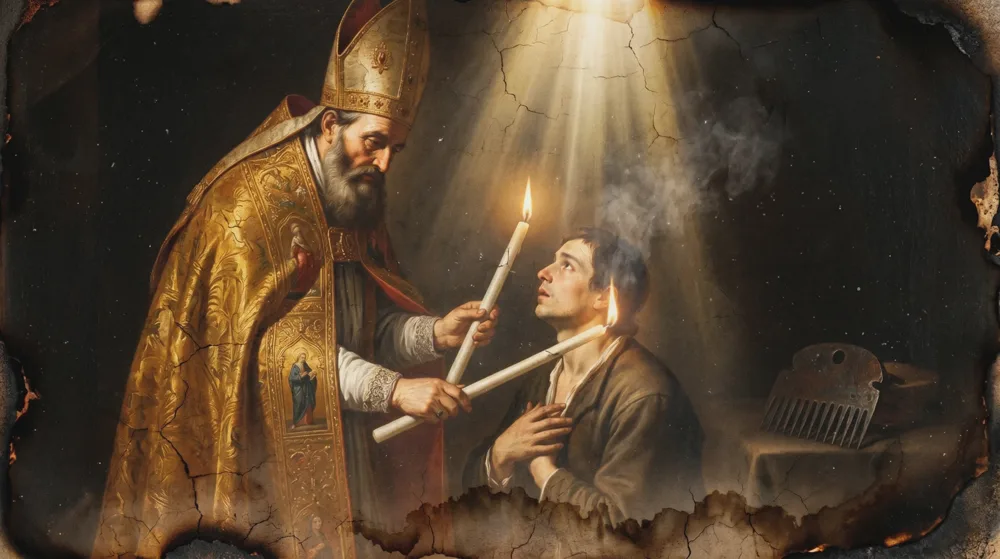
The novena to St Blaise is a nine-day prayer to the bishop of Sebaste and martyr, invoked since the earliest centuries for ailments of the throat and, more widely, for deliverance from sickness of every kind. It is prayed for a throat that will not heal, for a failing voice, for the neck and the breathing, for the sick we love. Traditionally it is begun on 26 January and ended on 3 February, the day of his feast, when the Church gives the blessing of throats with two crossed candles; but it may be prayed at any time of the year.
Below is the full text as the Iter Fidei app carries it: the nine meditations and petitions, the three traditional orations with the Glory Be, the ancient prayer for the ailing throat, the versicle and the collect of 3 February.
The full 9 day novena prayer to St Blaise
Each of the nine days follows the same order: the Sign of the Cross, a moment of silence, the meditation and petition proper to the day, then the three orations with the prayer for the ailing throat. Nothing else is required — no book, no fixed hour, only the nine days kept.
Begin each day with the Sign of the Cross.
In the name of the Father,
and of the Son,
and of the Holy Ghost.
Amen.
Recollect thyself a moment in silence, then read the meditation proper to the day; after which are said, as on each of the nine days, the three orations to St Blaise with the prayer for the ailing throat.
Day 1 — The faith kept
St Blaise kept the faith of Christ unto death. Summoned to sacrifice to the idols, he refused without trembling; scourged and hung upon a stake, he denied not his Saviour, but sealed his witness with his blood. In a time when men forsook Christ to keep their lives, he loved the truth more than his own flesh.
St Blaise, faithful martyr, obtain for us to keep our faith whole and courageous amid the trials of this present time, to confess it without human respect, and to remain faithful to it unto the last breath.
Day 2 — The charity of the shepherd
Chosen bishop of Sebaste while still young, Blaise, who had first practised medicine, cared for his people in body and in soul. He healed the sick who were brought to him, comforted the afflicted, and turned from his door neither the poor man nor the beast. The true shepherd he showed himself to the end: he laid down his life for his flock.
St Blaise, good shepherd and physician of bodies and souls, obtain for us a heart attentive to the distress of our neighbour, the spirit of charity toward all, and above all the zeal to succour the sick and the afflicted who have none but God to help them.
Day 3 — Detachment from the world
When the persecution arose, Blaise withdrew to a cave on Mount Argeus, there to seek God alone in prayer and penance. He left honours and ease that he might attend the more freely to his sanctification. Far from the noise of men, he learned what the world cannot give: the silence in which God makes Himself heard.
St Blaise, thou who didst flee the vanities of the age to seek God alone, obtain for us the grace of detachment from passing things, the love of recollection and of prayer, that we may seek before all else the Kingdom of God and His justice.
Day 4 — Dominion over the passions
In his solitude the wild beasts came to Blaise without doing him harm; he healed them of their wounds, and they awaited his blessing. What God wrought without, in taming the beasts, He wrought first within the saint: for none commands the lions who has not first made himself master of the more hidden beasts of his own heart.
St Blaise, before whom the beasts grew calm, obtain for us to subject to reason and to faith the disordered passions of our heart, that, masters of ourselves by grace, we may serve God in the peace and the liberty of the children of God.
Day 5 — The healing of the body
As he was led to prison, a weeping mother brought to him her child, who was dying, a fishbone lodged in his throat. Blaise prayed, laid on his hands, and the child was delivered. From this wonder comes his patronage: the saint who snatched a throat from death is invoked for every throat in peril, and for every infirmity of the body.
St Blaise, who didst save the hapless child from choking, cast a look of kindness upon the sick; to thee we entrust our throat ailments and every infirmity, for ourselves and for those we love: obtain for us of God, if it be good for our souls, the health of the body, and ever patience in suffering.
Day 6 — The holiness of speech
The throat that St Blaise protects is also the seat of speech. The tongue he has delivered from peril should serve to praise God, to confess the truth, to comfort and not to wound. Many evils of the soul are born of the mouth: the lie, detraction, blasphemy; and the saint who kept his own to proclaim Christ teaches us to sanctify ours.
St Blaise, protector of the throat and of the voice, obtain for us never to sin by speech, but to employ our tongue to sing the praises of God, to confess and defend the truth of the faith, and to lead all our brethren to the good.
Day 7 — Patience in tribulations
Delivered to the tyrant, Blaise was hung upon a stake, and his flesh was torn with iron combs, from head to foot. Under this torment he failed not, but offered his wounds for the faith. Those combs that rent him have made him the patron of woolcombers, and his example the master of all who suffer.
St Blaise, who didst not faint beneath the iron combs, obtain for us to bear with patience the crosses of every day, to unite them to the sufferings of Our Lord, and to find in His Passion the strength never to murmur against the hand of God.
Day 8 — The fortitude of martyrs
Tradition relates that Blaise, though he could have escaped his executioners, returned freely into their hands to seal with his blood the faith he had preached. He fled not death, but embraced it, preferring the glory of martyrdom to the safety of a day. Thus did the martyrs conquer, not by shunning the cross, but by receiving it for the love of Christ.
St Blaise, who didst return of thyself to martyrdom, obtain for us Christian fortitude: that we may ever be ready to suffer all things rather than betray the faith, to sacrifice for the glory of God our ease, our goods, and even life, that we may share the reward of the martyrs in Heaven.
Day 9 — The reward of Heaven
Beheaded for Christ about the year 316, Blaise received the crown he had hoped for, and he reigns now in the glory of God. The Church honours him each 3 February, and by the blessing of throats she entrusts still to the martyr the ailments of her people. He awaits us at the end of this novena as he awaited his Lord: in fidelity and in peace.
St Blaise, who reignest in the glory of the martyrs, obtain for us, by thy intercession, the grace we bear in our heart, if it be profitable to our salvation, and above all final perseverance, that, faithful to the end, we may join thee in the Heaven where thou awaitest us.
The three orations to St Blaise — said every day
The three orations to St Blaise are now said, each followed by the Glory Be.
They are the heart of the devotion and are the same on all nine days: the first for Mount Argeus and the mastery of the passions, the second for the child delivered and the sanctifying of speech, the third for the martyrdom freely embraced.
O glorious St Blaise, who, having renounced the bishopric of Sebaste to attend more fully to thy sanctification in the solitude of Mount Argeus, didst see the tigers and the lions grow gentle before thee and keep thee peaceful company: obtain for us all the grace to apply ourselves with all our strength to the gaining of the Christian virtues, that we may subject to the maxims of the faith the mysterious beasts of our passions.
Glory be to the Father, and to the Son,
and to the Holy Ghost.
As it was in the beginning,
is now, and ever shall be,
world without end.
Amen.
O glorious St Blaise, who by a short prayer didst restore to perfect health an unhappy child who, by a fishbone lodged in his throat, was about to yield his last breath; and who then didst animate by thy example and thy counsel unto martyrdom those devout women who gathered up the blood thou sheddest under the torment of the iron combs: obtain for us all the grace to prove the power of thy patronage in every ailment of the throat, but above all the grace to mortify, by Christian penance, this dangerous sense, and ever to employ our tongue to sing the praises of God, to confess and defend the truth of the faith, and to lead all our brethren to the good.
Glory be to the Father, and to the Son,
and to the Holy Ghost.
As it was in the beginning,
is now, and ever shall be,
world without end.
Amen.
O glorious St Blaise, who, though thou couldst have withdrawn from the fury of the tyrants and the executioners when in their presence thou didst walk freely upon the waters as upon solid stones, didst return of thyself into their hands to seal with thy blood thy faith and to render ever more glorious the most holy Religion of Jesus Christ: obtain for us all the grace ever to embrace with joy all the afflictions it shall please the Lord to send us, and to be always ready to sacrifice for His glory not only our ease and our goods, but life itself, that we may share the reward of the martyrs in paradise, having imitated their intrepidity upon earth.
Glory be to the Father, and to the Son,
and to the Holy Ghost.
As it was in the beginning,
is now, and ever shall be,
world without end.
Amen.
The ancient prayer for the ailing throat
The ancient prayer for the ailing throat may be added.
Holy martyr, at whose sign the pain flees from the throat, behold the incense that is consumed; yet the soul burns toward thee more than it. Fervent are its prayers, sincere its vows: change then, thou who canst, its trouble into calm. If through thee the lot of present ills be softened, in life and in death it shall exalt thy name; and at the foot of thine altars, which it shall heap with gifts, it shall call, trusting and fervent, men of every rank.
Present now to the Lord, through the hands of St Blaise, the intention thou entrustest to him throughout these nine days.
Through the intercession of St Blaise, bishop and martyr, may God deliver thee from every ailment of the throat and from every other evil. In the name of the Father, and of the Son, and of the Holy Ghost. Amen.
V. Pray for us, O St Blaise.
R. That we may be made worthy of the promises of Christ.
Let us pray.
O God, who dost gladden us by the yearly solemnity of blessed Blaise, Thy martyr and bishop: mercifully grant that we who keep his heavenly birthday may rejoice also in his protection. Through our Lord Jesus Christ, Thy Son, who liveth and reigneth with Thee in the unity of the Holy Ghost, God, world without end. Amen.
Deus, qui nos beati Blasii Martyris tui atque Pontificis annua sollemnitate laetificas: concede propitius; ut, cuius natalitia colimus, de eiusdem etiam protectione gaudeamus. Per Dominum nostrum Iesum Christum, Filium tuum, qui tecum vivit et regnat in unitate Spiritus Sancti Deus, per omnia saecula saeculorum. Amen.
Close with the Sign of the Cross.
In the name of the Father,
and of the Son,
and of the Holy Ghost.
Amen.
The novena to St Blaise for throats and for the neck
Most of those who come to this novena come with a throat. That is honest, and the Church has never been embarrassed by it: she blesses throats once a year with two crossed candles precisely because bodies matter to God. If you are praying for a throat, a neck, a swallowing gone wrong, a voice lost before it was needed, or a growth the doctors are watching — name it plainly, on the first day, and keep naming it for nine.
But notice what the novena itself does with that intention. Day 5 asks for the health of the body "if it be good for our souls"; Day 9 asks for the grace we carry in our heart "if it be profitable to our salvation," and then asks for something greater — final perseverance. This is the traditional shape of every petition to a saint, and it is not a hedge. St Blaise does not heal of himself: he carries our supplication before God, the sole master of life and of health. Ask boldly for the throat; leave Him free to give more than the throat.
If your intention is a serious illness, this novena pairs naturally with the prayer for the sick and the prayer for healing, and — when the case is grave — with the sacrament of Anointing of the Sick, which is the Church's own remedy and no substitute for it.
How to pray the novena to St Blaise
When to begin. The traditional start is 26 January, which brings the ninth day to 3 February, the feast of St Blaise. Count it simply: 26, 27, 28, 29, 30, 31 January, then 1, 2, 3 February. Praying the last day on the feast itself is the whole point of a preparatory novena — the nine days are a running-up to the day the Church keeps.
If you have missed the start. Begin anyway. A novena to a saint may be prayed at any time of the year, for any intention: nine consecutive days is the only condition. Many keep it in illness, whenever the illness comes.
One day at a time. Take the meditation, then the petition, then the three orations. Do not rush ahead to read all nine days at once; the meditation is meant to be chewed, and a novena read as an article is not a novena. For the shape of the devotion in general, see our explanation of what a novena is.
If you have only three minutes. There is no separate "short novena," and inventing one would only weaken it; but the busy may read the day's meditation and petition, say the second oration — the child and the fishbone — with one Glory Be, and add the prayer for the ailing throat. That is a complete day. What makes a novena is nine days without a gap, not the length of the sitting.
The blessing of throats. On 3 February — and in many places on the Sunday nearest it — a priest blesses throats with two candles blessed the day before at Candlemas, joined in the form of a St Andrew's cross and held under the chin, saying: "Through the intercession of St Blaise, bishop and martyr, may God deliver thee from every ailment of the throat and from every other evil." The same words end this novena. If you can receive the blessing on the feast, the novena finds its natural end there; that is a sacramental, and it is the Church herself who prays through the priest's hands.
Who was St Blaise? The saint of the 1962 calendar
In the traditional Roman calendar St Blaise is kept on 3 February as a simple commemoration of a bishop and martyr, the day after the Purification. He is not a modern figure and needs no rehabilitation: he has been honoured in East and West for well over a thousand years, and he is counted among the Fourteen Holy Helpers, the ancient company of saints invoked in emergency and sickness.
What is soberly known of him, Butler tells with his usual restraint. He was bishop of Sebaste (Sebastea) in Armenia and was crowned with martyrdom in the persecution of Licinius, by command of Agricolaus, governor of Cappadocia and Lesser Armenia, about the year 316. Butler notes honestly that there is no evidence earlier than the eighth century for his cultus; the rest — beautiful, and believed for centuries — comes to us through his legendary Acts. The Church has never pretended otherwise, and has never stopped invoking him. Sanctity does not depend on the survival of documents.
Those Acts relate that he was born of rich and noble parents, was given a Christian education, and was made a bishop while still quite young; the traditional prayer-books add that he had first practised medicine, so that he healed his people in body as in soul. When the persecution arose he withdrew, by divine direction, to a cave in the mountains, frequented only by wild beasts.
These he healed when they were sick or wounded, and they used to come round him to receive his blessing — the detail Day 4 turns inward, for the beasts a man must first tame are his own. Hunters sent to secure animals for the amphitheatre found him surrounded by them and took him to Agricolaus; on the way, at his command, a wolf restored unhurt the pig it had carried off from a poor woman.
Then the scene that made him famous. A woman brought to him a little boy who was at the point of death owing to a fishbone in his throat, and the saint healed him. On account of this and other similar cures St Blaise has been invoked, for many centuries past, for all kinds of throat trouble. The governor ordered him to be scourged and deprived of food; the woman whose pig had been restored brought him provisions, and also tapers to dispel the darkness of his gloomy prison. Then Licinius tortured him by tearing his flesh with iron combs, and afterwards had him beheaded. From those combs comes his patronage of woolcombers, and from the tapers, the two candles of the blessing.
He is thus the patron of those who suffer from afflictions of the throat, of the sick, of wild animals and of woolcombers, and he stands beside the other helpers in need whom Christians have called upon when medicine reached its limit: St Peregrine in cancer, St Rita in the impossible, St Dymphna in affliction of mind. Their power is one power, and it is not their own: it is the communion of saints. For the fuller life, see our article on St Blaise, and the wider treasury in our guide to Catholic devotions.
Frequently Asked Questions
What is the novena prayer to St Blaise?
It is a 9 day prayer to St Blaise, bishop of Sebaste and martyr: a meditation and a petition proper to each day, then three traditional orations — on his solitude on Mount Argeus, on the child he saved from choking, and on his martyrdom — each with a Glory Be, completed by the ancient prayer for the ailing throat, the versicle Pray for us, O St Blaise, and the collect of his feast from the Roman Missal. The whole text is given in full above.
When do you start the novena to St Blaise?
Traditionally on 26 January, so that the ninth day falls on 3 February, his feast. That is the ideal, because the last day coincides with the blessing of throats. But the novena may be begun on any day of the year and prayed for any need — nine consecutive days is the only rule.
Is the novena to St Blaise for throats only?
No. The throat is his most famous patronage, because of the child with the fishbone, and the novena keeps it — Day 5 and Day 6 are given to the healing of the body and the holiness of speech. But St Blaise is invoked for the sick generally and for deliverance from every evil: the blessing itself asks God to free us "from every ailment of the throat and from every other evil." Bring him the neck, the voice, the breathing — and anything else.
Can I pray the St Blaise novena for someone else?
Yes, and it is one of the most common uses of it. Name the person at the start of the first day and keep him before you through the nine. Day 2 and Day 5 are written in exactly that direction — "for ourselves and for those we love." Praying for another is an act of charity, not a transaction, and belongs to the works of mercy.
What is the blessing of throats on St Blaise's day?
On 3 February a priest holds two candles — blessed the day before at Candlemas — crossed under the chin, and says: "Through the intercession of St Blaise, bishop and martyr, may God deliver thee from every ailment of the throat and from every other evil." It is a sacramental of the Roman Ritual, and the same formula closes this novena, so that those who cannot get to a church on the feast may still make the petition their own.
Why is St Blaise the patron saint of throats?
Because of the child. As he was being led to prison, a mother brought him her little boy who was choking to death on a fishbone; Blaise prayed and laid his hands on him, and the child was delivered. From that cure — and, Butler adds, from others like it — grew a patronage that has lasted since at least the eighth century, and with it the yearly blessing of throats.
Why do different versions of the St Blaise novena exist?
Because there has never been a single official text: publishers have printed different arrangements of the same devotion for centuries. The one on this page is the traditional novena of the old prayer-books — the three orations to St Blaise, the prayer for the ailing throat, and the collect of 3 February from the Roman Missal, with a meditation for each of the nine days. It is the text the Iter Fidei app carries, word for word, so that page and app say the same thing.
What do I do if I miss a day?
Nothing dramatic. Take up the count where you left off, or begin the nine afresh if you would rather — but do not abandon the novena over it, and do not treat the broken chain as an offence that voids the prayer. The perseverance of nine days is a discipline offered to God, not a condition He imposes; keep it as well as you can and go on.
Pray the novena to St Blaise with day-by-day reminders and audio in the Iter Fidei app. Download it here.
Sources. Butler's Lives of the Saints (St Blaise, 3 February); the Roman Missal and the Roman Martyrology, 3 February; the Rituale Romanum, blessing of throats; the traditional prayer-books carrying the three orations to St Blaise and the prayer for the ailing throat; Holy Scripture, Douay-Rheims.