
News
China: a Bishop of Datong ordained under the Sino-Vatican Agreement
Paul Liu Honggang was ordained Bishop of Datong on 31 August 2026, his candidacy approved by Leo XIV under the Agreement between the Holy See and China; we measure the act against the pre-1958 doctrine on the appointment of bishops.
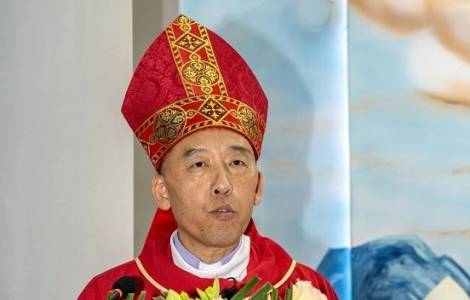
Paul (Paolo) Liu Honggang was ordained Bishop of Datong, in the Chinese province of Shanxi, on Monday 31 August 2026, in the Cathedral of the Immaculate Heart of Mary, in the Pingcheng district. His candidacy had been approved on 10 August by Leo XIV, "having approved his candidacy within the framework of the Provisional Agreement between the Holy See and the People's Republic of China." The principal consecrator was Joseph Shen Bin, Bishop of Shanghai; four bishops of Shanxi concelebrated. Born near Taiyuan in 1970, ordained a priest for Datong in 1996, Liu had administered the diocese since 2005.
With this ordination, seventeen Chinese bishops have now received consecration in full communion with Rome under this agreement, signed in September 2018 during the pontificate of Francis, renewed in 2020 and 2022, then extended for four years in October 2024. The procedure it establishes requires that a candidate first be designated with the assent of the Communist Party, the ordination taking place only once the appointee has been accepted by the pope. On the scope of this arrangement the accounts diverge: some present it without reservation, others call it contested and report the reproach of its critics, who charge it with leaving the Party too great a voice in a decision internal to the Church, to the point that "only clergy conforming to the Party line are made bishops." China is said to number around ten million Catholics.
What the Church has always taught
The choice of bishops belongs to the Church alone, and to her visible head. The ancient law fixes it without ambiguity: "the Roman Pontiff freely appoints the bishops" (1917 Code, canon 329 §2). This is not a rule of administration but a consequence of the divine constitution of the Church, a perfect and independent society, whose liberty is subject to no civil power (Leo XIII, Immortale Dei). The prince, even a Christian one, has over ecclesiastical appointments only what the Church concedes to him; a power that wars against her holds no such title.
This precise case the Church has known and judged. Faced with a civil authority that claimed to present and consecrate its own candidates in China, Pius XII recalled that the right to appoint and institute bishops belongs to the Apostolic See, and condemned as illegitimate any consecration removed from that mandate (Ad Apostolorum Principis, 1958).
The measure
A distinction is due, and we make it. The consecrations that Pius XII censured were carried out without pontifical mandate: they were illicit. Here the candidacy received the pope's approval; this ordination is not of that kind, and the man is in communion with Rome. That is the difference, and it must be stated.
But tradition does not ask only that Rome ratify at the end; it holds the whole choice to be free of the civil power. An arrangement in which an atheist State first designates the candidate, and the Holy See then approves, grants to Caesar a voice that doctrine reserved to the Church. That the procedure closes with Roman assent answers the question of the validity of the orders; it does not answer that of the liberty of the Church, which is precisely the peril Pius XII had named. The ordination is licit; the arrangement remains what tradition warned against. Whether the sources agree on this point or not, the fact itself is not in dispute.
What this means for the faithful
To pray for the Church in China, her priests and her tried faithful, and to hold firmly the doctrine that the liberty of the Church is not a gift of the State. Neither triumphalism nor despair: the measure of acts belongs to the faith of all ages, not to the calculus of the balance of power.
Sources. Pius XII, encyclical Ad Apostolorum Principis (29 June 1958), on the Church in China and the right of the Apostolic See to appoint and institute bishops; 1917 Code of Canon Law, canon 329 §2; Leo XIII, encyclical Immortale Dei (1 November 1885), on the Church as a perfect society, independent of the civil power.